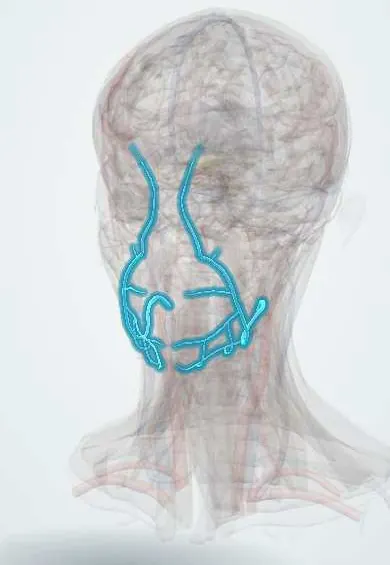
Cardiovascular system · Head and neck
Facial vein !
The facial vein drains the face into the neck; it connects with veins inside the skull, so infections near the nose can spread inward.
Opens in the Durgical app, no sign-up needed.
What it is
The vein running from the inner corner of the eye down across the face.
What it does
Links to the cavernous sinus through the eye veins, so infections of the 'danger triangle' can spread inward.
Key facts
- Drains
- Face (from the angular vein at the inner eye)
- Into
- Internal jugular vein; links to the cavernous sinus via the ophthalmic veins (danger triangle)
Relations
- Course
- Starts at the medial angle of the eye as the angular vein, runs down and back across the face, crosses the body of the mandible at the front of the masseter and joins the internal jugular vein near the hyoid bone
- In front
- The facial artery, which takes a more winding course just in front of it
- Superficial
- The zygomaticus major and zygomaticus minor on the cheek; the platysma at the lower border of the jaw
- Deep
- The buccinator and the front of the masseter on the cheek; below the jaw it crosses superficial to the submandibular gland
How to find it
It is rarely seen. Its line runs from the inner corner of the eye to the front edge of the masseter, where the facial artery pulse is felt on the lower border of the mandible just in front of the vein.
On imaging
Colour Doppler shows it just behind the facial artery at the lower border of the mandible. When an infection of the danger triangle of the face causes eye signs, contrast CT or MRI looks for spread to the cavernous sinus: a bulging sinus with filling defects, an enlarged superior ophthalmic vein and proptosis. Venous malformations of the face are mapped with ultrasound and MRI.
Clinical notes
- Septic thrombophlebitis from the danger triangle can reach the cavernous sinus; rare since antibiotics but a classic exam link
- Submandibular gland surgery: the marginal mandibular branch of the facial nerve crosses superficial to the vein, so tying the vein low and lifting it upward protects the nerve
- The common facial vein crosses in front of the carotid near its bifurcation; in carotid endarterectomy and neck dissection it is tied and divided to open the view of the artery
Anatomical variants
- Usually joins the anterior division of the retromandibular vein before reaching the internal jugular vein; it sometimes drains into the external jugular vein instead
Development
In the embryo the veins of the face and tongue gather into one linguofacial vein that ends in the primitive jugular; this is the origin of the common facial vein, which receives the lingual veins before reaching the internal jugular.
Test yourself
Think of the answer, then tap the question to see it.
Why can infection in the facial danger triangle spread to the cavernous sinus?
The facial vein, classically valveless, links through the angular and superior ophthalmic veins to the cavernous sinus.
What are the boundaries of the facial danger triangle drained by the facial vein?
From the corners of the mouth to the bridge of the nose.
Into which vein does the facial vein drain?
The internal jugular vein near the hyoid, usually after joining the anterior division of the retromandibular vein.
Educational information, not medical advice. For any symptom, see a health professional.
Its names
- Official Latin (TA2)
- vena facialis TA2 4817
- Official Spanish (DeCS)
- Venas facial y angular
- English (TA2)
- Facial vein
- Also called
- vena facialis anterior · anterior facial vein
Related
Sources: Terminologia Anatomica (TA2); Anatomy, Head and Neck: Face; Anatomy, Head and Neck, Scalp Veins; Anatomy of the Human Body (20th ed.): Development of the Vascular System (Lea & Febiger (Gray's Anatomy, 1918), 1918) · adapted, Public domain.
Spotted a mistake?We are always improving for the community. Tell us what is wrong and our team will review it.Report a mistake
Representative model, for educational purposes only.