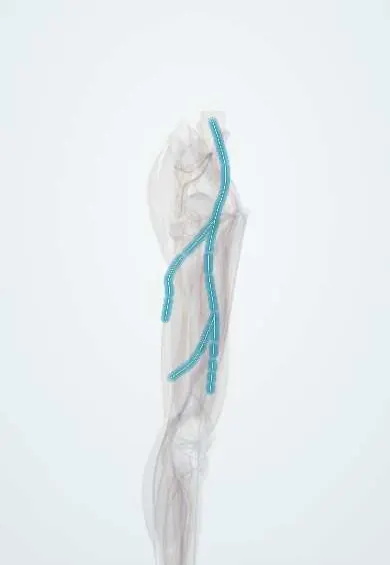
Lateral femoral cutaneous nerve !
The lateral femoral cutaneous nerve carries feeling from the outer thigh; it passes near the front point of the hip bone.
Opens in the Durgical app, no sign-up needed.
What it is
A sensory nerve that leaves the pelvis near the front point of the hip bone, passing under or through the inguinal ligament.
What it does
Carries feeling from the skin of the outer thigh. It does not control muscles.
Key facts
- Roots
- L2–L3
- Moves
- None (purely sensory, cutaneous)
- Feeling from
- Anterolateral and lateral thigh; compression near ASIS under inguinal ligament causes meralgia paresthetica; posterior (gluteal) branch to the skin of the upper lateral buttock over the greater trochanter
Relations
- Course
- Appears at the lateral border of the psoas major, crosses the iliacus obliquely under the fascia iliaca toward the anterior superior iliac spine, passes under or through the lateral end of the inguinal ligament just medial to the spine, then crosses over or through the sartorius and divides into anterior and posterior branches
- Deep
- The iliacus in the pelvis; the sartorius and tensor fasciae latae near its exit
- Superficial
- The fascia iliaca and peritoneum in the iliac fossa (caecum on the right, sigmoid colon on the left); the inguinal ligament at its exit
- Lateral
- The anterior superior iliac spine, which it passes just medial to in most people
- Medial
- The femoral nerve, further medial on the iliacus
How to find it
It is sought just medial to and below the anterior superior iliac spine; ultrasound finds it in the fat between the sartorius and the tensor fasciae latae. Pressure or tapping at this spot reproduces burning in the outer thigh in meralgia paresthetica.
Examination
- Tinel's sign or pressure just medial and below the anterior superior iliac spine: burning or tingling in the anterolateral thigh supports compression of this nerve
- Pelvic compression test: firm downward pressure on the side of the pelvis with the person lying on the unaffected side slackens the inguinal ligament and relieves symptoms in meralgia paresthetica
- Normal hip flexion, knee extension and patellar reflex with an outer-thigh numb patch support meralgia over an upper lumbar root lesion
On imaging
Meralgia paresthetica is mainly a clinical diagnosis. High-resolution ultrasound can show the nerve near the anterior superior iliac spine as it passes under or through the inguinal ligament, swollen at the entrapment site, and can guide a diagnostic nerve block. MRI of the lumbar spine or pelvis is chosen when a radiculopathy or a mass along the nerve's course has to be excluded.
Common problems
- Meralgia paresthetica: burning, tingling or numbness on the outer thigh when the nerve is pressed, for example by tight belts, weight gain or pregnancy.
How it is diagnosed
History and exam of the numb area; sometimes a nerve block or nerve tests.
Treatment
- Removing the pressure (looser clothing, weight loss), medicines for nerve pain, or an injection.
Clinical notes
- Iatrogenic injury in anterior hip approaches, periacetabular osteotomy, iliac crest graft harvest, laparoscopic hernia repair and prone positioning on hip supports for spine surgery
- Persistent cases may be treated by decompression or by cutting the nerve (neurectomy), which leaves a permanent numb patch
Anatomical variants
- Its exit varies: most often under the inguinal ligament just medial to the anterior superior iliac spine, but it may pierce the ligament or cross over the iliac crest lateral to the spine
- Rarely it arises from the femoral nerve or is missing, with femoral branches covering its skin territory
Related conditions
Test yourself
Think of the answer, then tap the question to see it.
What are the roots and function of the lateral femoral cutaneous nerve?
L2–L3; purely sensory, supplying the skin of the anterolateral and lateral thigh.
What is meralgia paresthetica, and where is the nerve usually compressed?
Burning or numbness of the outer thigh from compression of this nerve near the ASIS, under or through the inguinal ligament.
What separates meralgia paresthetica from an L2–L3 radiculopathy or femoral neuropathy?
No weakness and no reflex change: hip flexion, knee extension and the patellar reflex are normal.
In which hip operation is the lateral femoral cutaneous nerve most often injured?
The anterior approach to the hip; it is also at risk in iliac crest bone graft harvest.
Educational information, not medical advice. For any symptom, see a health professional.
Its names
- Official Latin (TA2)
- nervus cutaneus lateralis femoris TA2 6521
- Official Spanish (DeCS)
- Nervio cutáneo femoral lateral
- English (TA2)
- Lateral femoral cutaneous nerve
- Also called
- lateral cutaneous nerve of thigh · nervus cutaneus femoris fibularis
Sources: Terminologia Anatomica (TA2); Anatomy, Bony Pelvis and Lower Limb: Lateral Femoral Cutaneous Nerve.
Spotted a mistake?We are always improving for the community. Tell us what is wrong and our team will review it.Report a mistake
Representative model, for educational purposes only.