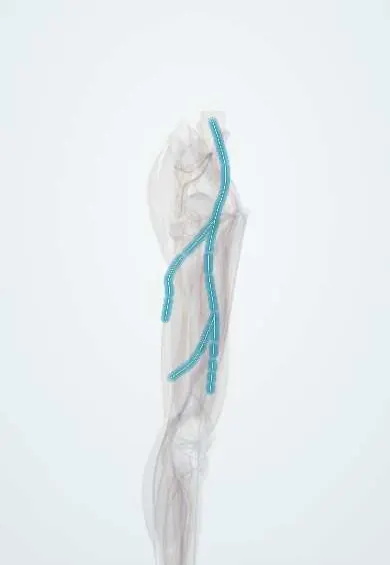
Meralgia paresthetica !
Meralgia paresthetica is burning, tingling or numbness of the outer thigh from a pinched skin nerve near the front of the hip bone.
Updated 2026-10-29
Structures involved
Tap one to see what it is and open it in 3D.
- Lateral femoral cutaneous nerve
- Inguinal ligament
- Hip bone
- Tensor fasciae latae
- Sartorius
- Iliacus
- Fascia lata
Why it happens
What it is
Burning pain, tingling and numbness of the outer front thigh caused by compression of the lateral femoral cutaneous nerve, usually where it passes under or through the inguinal ligament near the anterior superior iliac spine.
Who gets it
Seen mostly in adults between middle age and older age and is more frequent with obesity, diabetes and pregnancy.
Causes
- Compression by tight belts, waistbands, tool belts or body armor
- Raised abdominal pressure: obesity, pregnancy, ascites
- Injury during hip, pelvic or spinal surgery, iliac crest bone graft harvest or prone positioning
- Seat-belt trauma
- Rarely a pelvic or retroperitoneal mass
Risk factors
- Obesity
- Pregnancy
- Diabetes
- Tight clothing and belts
- Recent hip or pelvic surgery
- Prolonged standing or walking
Pathophysiology
The nerve carries only skin sensation from the L2 and L3 roots. It makes a sharp turn at the anterior superior iliac spine as it leaves the pelvis, so external pressure or stretch at this point irritates it and causes local demyelination. Because it has no motor fibers, there is no weakness.
Symptoms and signs
- Burning pain, tingling or numbness over the anterolateral thigh
- Skin sensitive to touch or clothing in that area
- Worse with standing, walking or hip extension and better with sitting
- No weakness and normal knee reflex
Diagnosis
- Clinical
- Diagnosis is mainly clinical: sensory change limited to the nerve territory, tenderness or Tinel sign just medial to the anterior superior iliac spine, symptoms reproduced by pelvic compression, normal strength and reflexes.
- Tests
- A nerve block with local anesthetic that relieves symptoms supports the diagnosis. Nerve conduction studies are technically hard; glucose testing looks for diabetes.
- Imaging
- Ultrasound can show the nerve and guide injections. Lumbar or pelvic MRI or CT only when the history suggests a root lesion or mass.
Differential diagnosis
- L2–L3 lumbar radiculopathy
- Femoral neuropathy
- Lumbar plexopathy, including diabetic amyotrophy
- Greater trochanteric pain syndrome
- Hip osteoarthritis
- Pelvic or retroperitoneal mass
Goal of treatment
Remove the source of compression and control neuropathic pain; most cases settle without surgery.
Treatment
- Lifestyle
- Looser clothing, avoiding tight belts and weight loss.
- Medical
- NSAIDs, topical anesthetics and neuropathic pain agents such as gabapentinoids or tricyclic antidepressants.
- Procedure
- Local anesthetic with corticosteroid injected around the nerve, usually ultrasound-guided; pulsed radiofrequency in refractory cases.
- Surgical
- Decompression (neurolysis) or division of the nerve (neurectomy) when pain persists despite conservative care.
Complications
- Chronic neuropathic pain
- Permanent numbness of the outer thigh, expected after neurectomy
- Sleep disturbance and reduced activity
Prognosis
Most patients improve with removal of compression and conservative treatment, often within months. Surgery is reserved for a minority.
Prevention
- Avoiding tight belts and waistbands
- Healthy body weight
- Careful padding and positioning during prone surgery
Test yourself
Think of the answer, then tap the question to see it.
Which nerve is affected in meralgia paresthetica?
The lateral femoral cutaneous nerve (L2–L3), a purely sensory nerve.
Where is the lateral femoral cutaneous nerve usually compressed?
Under or through the inguinal ligament, just medial to the anterior superior iliac spine.
Why is there no weakness in meralgia paresthetica?
The nerve carries only sensory fibers; weakness or a reduced knee reflex points to another lesion.
What are two everyday risk factors for meralgia paresthetica?
Tight belts or waistbands and obesity; pregnancy and diabetes are others.
Which test supports the diagnosis when the picture is unclear?
A diagnostic nerve block with local anesthetic that temporarily relieves the symptoms.
Related conditions
- Obesity
- Type 2 diabetes mellitus
- Lumbar Disc Herniation
- Greater Trochanteric Pain Syndrome
- Hip Osteoarthritis
Educational information, not medical advice. For any symptom, see a health professional.
Sources: Meralgia Paresthetica (StatPearls (NCBI Bookshelf), 2023).
Spotted a mistake?We are always improving for the community. Tell us what is wrong and our team will review it.Report a mistake
Representative model, for educational purposes only.