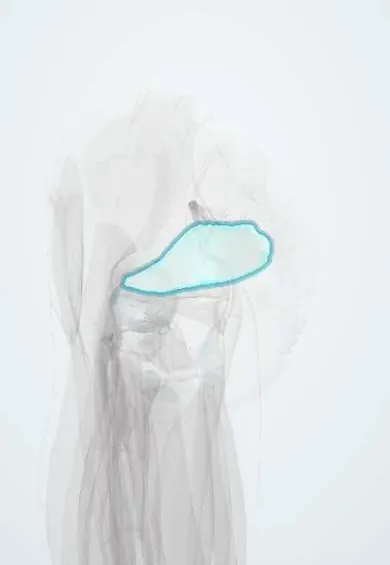
Piriformis fascia !
The piriformis fascia is a thin sheet covering the piriformis muscle inside the pelvis; the sacral nerves lie just beneath it.
Opens in the Durgical app, no sign-up needed.
What it is
A thin sheet covering the piriformis muscle.
What it does
Wraps the muscle and separates it from nearby nerves and vessels.
Key facts
- Where
- Covers pelvic surface of piriformis; part of parietal pelvic fascia
- Function
- Sacral plexus lies on it; piriformis divides greater sciatic foramen into supra- and infrapiriform parts
Relations
- In front
- Sacral plexus (anterior rami of L4–S4) on the fascia, then the internal iliac artery branches and the rectum
- Medial
- Front of the sacrum, where the muscle arises between the anterior sacral foramina and the sacral nerve roots emerge
- Above
- Suprapiriform part of the greater sciatic foramen: superior gluteal nerve, artery and vein
- Below
- Infrapiriform part: sciatic nerve, inferior gluteal nerve and vessels, posterior femoral cutaneous nerve, pudendal nerve, internal pudendal vessels, nerves to obturator internus and quadratus femoris
How to find it
The fascia on the pelvic surface is seen only from inside the pelvis, behind the sacral plexus in pelvic dissection or laparoscopy. In the buttock, piriformis is found deep to gluteus maximus, running from the sacrum to the top of the greater trochanter.
On imaging
Not seen as a separate layer. On MRI it is inferred from its neighbours: the sacral plexus roots lie on the piriformis behind it, the internal iliac vessels in front. MR neurography shows the plexus in this plane when a sacral nerve lesion is suspected. CT shows a tumour or haematoma here pushing on the plexus. Radiographs and ultrasound do not show it.
Clinical notes
- Gluteal injections are given in the upper outer quadrant of the buttock to keep away from the sciatic nerve leaving below piriformis
- Deep endometriosis or tumours on the pelvic side wall can involve the sacral plexus on piriformis and cause sciatica of pelvic origin
- In the posterior approach to the hip, the piriformis tendon is the landmark released and later repaired
Anatomical variants
- The sciatic nerve, or its common fibular part, can pass through or above piriformis; texts differ on how often (from about 1 in 10 up to 1 in 5 or more)
Memory aid
Below piriformis: "POPS IQ" (Pudendal nerve, nerve to Obturator internus, Posterior femoral cutaneous nerve, Sciatic nerve, Inferior gluteal nerve and vessels, nerve to Quadratus femoris).
Related conditions
Test yourself
Think of the answer, then tap the question to see it.
How are the sacral plexus and internal iliac vessels arranged relative to the piriformis fascia?
Nerves outside, vessels inside: the sacral plexus lies between the piriformis and its fascia, the internal iliac vessels in front of the fascia.
How can deep endometriosis on the pelvic side wall cause sciatica?
It can involve the sacral plexus lying on the piriformis, causing sciatica of pelvic origin.
What is piriformis syndrome?
Buttock pain and sciatica-like symptoms from the sciatic nerve compressed by the piriformis or its fascial bands; a diagnosis of exclusion.
Educational information, not medical advice. For any symptom, see a health professional.
Its names
- Official Latin (TA2)
- fascia musculi piriformis TA2 2437
- Official Spanish (DeCS)
- Fascia del músculo piriforme DeCS D005205
- English (TA2)
- Piriformis fascia
Related
Sources: Terminologia Anatomica (TA2); DeCS; Anatomy, Bony Pelvis and Lower Limb: Piriformis Muscle.
Spotted a mistake?We are always improving for the community. Tell us what is wrong and our team will review it.Report a mistake
Representative model, for educational purposes only.