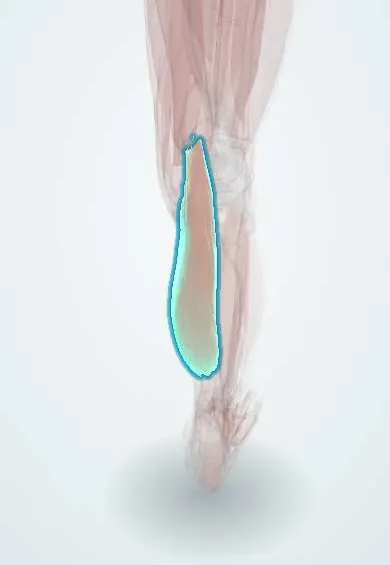
Achilles tendon rupture !
An Achilles tendon rupture is a tear of the big tendon above the heel; it often feels like a kick to the calf and makes pushing off weak.
Updated 2026-10-29
Structures involved
Tap one to see what it is and open it in 3D.
- Gastrocnemius (inner head)
- Gastrocnemius (outer head)
- Soleus
- Calcaneus
- Plantaris
- Heel bursae
- Sural nerves
- Flexor hallucis longus
- Tibial nerve
In the clinical exam
Why it happens
What it is
A partial or complete tear of the Achilles tendon, the common tendon of the gastrocnemius and soleus that inserts on the calcaneus, usually a few centimetres above the heel.
Who gets it
Typically affects middle-aged adults who play sport occasionally ("weekend athletes"), more often men. Football and racquet sports are common settings.
Causes
- Sudden push-off with the knee straight
- Unexpected forced dorsiflexion of the ankle
- Violent dorsiflexion of a plantar-flexed foot, e.g. a fall from height
Risk factors
- Pre-existing Achilles tendinopathy
- Fluoroquinolone antibiotics
- Systemic or local corticosteroids
- Intermittent sport without conditioning
- Older age and male sex
- Inflammatory and metabolic diseases (e.g. gout, chronic kidney disease)
Pathophysiology
The tendon's mid-portion has a relatively poor blood supply, a watershed area where degeneration builds up. A sudden eccentric load on a weakened tendon makes the fibres fail, most often 2–6 cm above the insertion. The torn ends can retract, and plantar flexion strength falls.
Classification
- Acute or chronic (missed, neglected) rupture
- Partial or complete
- By site: mid-substance, insertional, musculotendinous junction
Symptoms and signs
- Sudden pain in the back of the heel, often like being kicked or hit
- A pop or snap at the moment of injury
- Weak push-off; difficulty walking on tiptoe or climbing stairs
- Swelling and bruising above the heel
- A palpable gap in the tendon
Diagnosis
- Clinical
- Thompson test (squeezing the calf does not move the foot), palpable gap, increased resting dorsiflexion compared with the other side (Matles test). Clinical diagnosis is usually reliable.
- Tests
- Usually none.
- Imaging
- Ultrasound confirms the tear and measures the gap; MRI if unclear or chronic. X-ray excludes calcaneal avulsion.
Differential diagnosis
- Achilles tendinopathy or partial tear
- Medial gastrocnemius strain ("tennis leg")
- Plantaris rupture
- Deep vein thrombosis
- Calcaneal avulsion fracture
- Ankle fracture
Goal of treatment
Heal the tendon at the right length and tension to restore push-off strength, with the least re-rupture and complication risk.
Treatment
- Conservative
- Non-operative care: a boot or cast with the foot pointed down, then gradually brought up, with early functional rehabilitation.
- Surgical
- Surgical repair (open or minimally invasive) is often offered to active patients; it may lower re-rupture risk but adds wound and nerve risks. Evidence varies.
- Surgical
- Chronic ruptures may need reconstruction, for example a flexor hallucis longus tendon transfer.
- Rehabilitation
- Structured rehabilitation for range of motion, calf strength and return to sport over months.
Complications
- Re-rupture
- Tendon healing elongated, with weak push-off
- Wound infection or breakdown after surgery
- Sural nerve injury
- Deep vein thrombosis during immobilisation
Prognosis
Most patients return to walking and many to sport, but full recovery takes months and some calf weakness may persist.
Prevention
- Gradual conditioning before sport
- Caution with fluoroquinolones and corticosteroids, especially in older adults
Test yourself
Think of the answer, then tap the question to see it.
How is the Thompson test performed and what is a positive result?
With the patient prone, the examiner squeezes the calf. In a complete rupture the foot does not plantar-flex.
Where does the Achilles tendon usually rupture?
In the relatively poorly perfused mid-portion, roughly 2–6 cm above its insertion on the calcaneus.
Which antibiotic class is associated with Achilles tendon rupture?
Fluoroquinolones, especially in older adults and with corticosteroid use.
Why can a patient with a complete rupture still plantar-flex the foot weakly?
Other muscles (tibialis posterior, long toe flexors, fibularis muscles) can still plantar-flex, which can mask the diagnosis.
Related conditions
Educational information, not medical advice. For any symptom, see a health professional.
Sources: Achilles Tendon Rupture (StatPearls (NCBI Bookshelf), 2023).
Spotted a mistake?We are always improving for the community. Tell us what is wrong and our team will review it.Report a mistake
Representative model, for educational purposes only.