Charcot-Marie-Tooth disease !
An inherited nerve disease that slowly weakens and thins the feet, legs and hands, often with high-arched feet and trouble lifting the toes.
Updated 2026-11-01
Structures involved
Tap one to see what it is and open it in 3D.
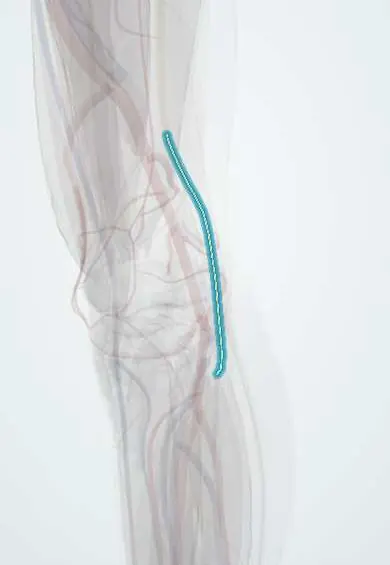
- Common fibular nerve
- Tibial nerve
- Deep fibular nerve
- Superficial fibular nerve
- Sciatic nerve
- Tibialis anterior
- Fibularis longus
- Fibularis brevis
- Gastrocnemius (inner head)
Why it happens
- Mendelian inheritance: autosomal dominant, recessive and X-linked
- Impulse conduction and myelin
- Peripheral nerve: endoneurium, perineurium, epineurium; myelin
What it is
A group of inherited peripheral neuropathies (hereditary motor and sensory neuropathies) that damage the myelin or the axons of long peripheral nerves. It causes slowly progressive distal weakness and wasting that starts in the feet and lower legs, foot deformities and mild sensory loss. It is the most common inherited disorder of peripheral nerves.
Who gets it
Affects about 1 in 2,500 people worldwide, in all populations. Symptoms usually begin in childhood, adolescence or early adulthood. Latin American cohorts show the same main genes (PMP22 duplication most often); genetic confirmation is limited in many regions, so diagnosis is often clinical and electrophysiological.
Causes
- Variants in dozens of genes; PMP22, MPZ, MFN2 and GJB1 explain most genetically confirmed cases
- CMT1A (the most common form): duplication of the PMP22 gene on chromosome 17, causing demyelination
- CMT2: axonal forms, often from MFN2 variants
- CMTX: X-linked forms, mostly GJB1 (connexin 32)
- Inheritance may be autosomal dominant (most common), autosomal recessive or X-linked; some cases are new variants
Risk factors
- Affected parent or relative
- Male sex for X-linked forms
- Neurotoxic drugs (e.g. vincristine) can severely worsen an existing CMT
Pathophysiology
Faulty myelin proteins (demyelinating types) or axonal transport and mitochondrial proteins (axonal types) make the longest nerves fail first. The common fibular nerve and its branches are hit early, so the ankle dorsiflexors and evertors (tibialis anterior, fibularis muscles) weaken while the plantar flexors are relatively spared. This muscle imbalance pulls the foot into a high arch with hammer toes. In demyelinating forms, repeated demyelination and remyelination make nerves thick and conduction uniformly slow.
Classification
- CMT1: demyelinating, autosomal dominant, slow nerve conduction velocities (CMT1A = PMP22 duplication)
- CMT2: axonal, normal or near-normal velocities with low amplitudes
- CMTX: X-linked
- CMT4: autosomal recessive, usually more severe and earlier
- Intermediate forms; related entity: hereditary neuropathy with liability to pressure palsies (PMP22 deletion)
Symptoms and signs
- Foot drop with high-stepping (steppage) gait, tripping and frequent ankle sprains
- High-arched feet (pes cavus) and hammer toes
- Distal leg muscle wasting giving an "inverted champagne bottle" or "stork leg" appearance
- Later weakness and wasting of the hand muscles
- Reduced or absent ankle reflexes and mild distal loss of sensation
- Cold feet, cramps, and in some forms tremor or scoliosis
Diagnosis
- Clinical
- Suspected in a person with slowly progressive, symmetric distal weakness and wasting, pes cavus, areflexia and a family history. Examining relatives often reveals mild undiagnosed cases.
- Tests
- Nerve conduction studies separate demyelinating forms (uniformly slow velocities, e.g. below 38 m/s in the arm) from axonal forms (low amplitudes). Genetic testing confirms the type, starting with PMP22 duplication in demyelinating cases, then multigene panels. Nerve biopsy is rarely needed.
- Imaging
- Not required for diagnosis. Foot and spine radiographs assess deformity and scoliosis; MRI of leg muscles can show the pattern of fatty replacement.
Differential diagnosis
- Chronic inflammatory demyelinating polyneuropathy (non-uniform slowing, treatable)
- Acquired polyneuropathies (diabetes, alcohol, vitamin B12 deficiency, toxins)
- Friedreich ataxia
- Distal myopathies
- Spinal muscular atrophy and other motor neuron diseases
- Isolated common fibular nerve injury
Goal of treatment
There is no cure; the aims are to keep the person walking and independent, correct and prevent foot deformity, protect the feet and avoid drugs that damage nerves.
Treatment
- Conservative
- Physiotherapy with stretching and moderate strengthening, and ankle-foot orthoses for foot drop; adapted footwear and occupational therapy for hand function.
- Surgical
- Orthopaedic surgery (tendon transfers, osteotomies, arthrodesis) for fixed or painful foot deformity; spinal surgery for severe scoliosis.
- Medical
- Treatment of neuropathic pain and cramps; avoidance of neurotoxic medicines such as vincristine; genetic counselling for the family.
- Follow-up
- Periodic review of strength, gait, feet and skin, falls and spine; daily foot inspection to catch painless ulcers.
Complications
- Falls and ankle fractures
- Fixed foot deformity and chronic pain
- Foot ulcers and infections
- Scoliosis
- Hand weakness limiting fine tasks
Prognosis
A slowly progressive disease with wide variation in severity, even within one family. Most people stay able to walk, sometimes with orthoses, and life expectancy is usually normal.
Prevention
- No primary prevention exists
- Genetic counselling helps families understand inheritance and reproductive options
- Avoiding neurotoxic drugs prevents sudden worsening
Test yourself
Think of the answer, then tap the question to see it.
What is the most common genetic cause of Charcot-Marie-Tooth disease?
Duplication of the PMP22 gene on chromosome 17 (CMT1A), inherited in an autosomal dominant pattern.
What are the classic examination findings?
Pes cavus with hammer toes, foot drop with steppage gait, distal leg wasting (inverted champagne bottle legs) and absent ankle reflexes.
Which nerve is affected early and explains foot drop?
The common fibular nerve, which supplies the ankle dorsiflexors and evertors.
How do nerve conduction studies separate CMT1 from CMT2?
CMT1 (demyelinating) has uniformly slowed velocities; CMT2 (axonal) has near-normal velocities with reduced amplitudes.
Which chemotherapy drug can cause severe worsening in CMT?
Vincristine.
Related conditions
- Peripheral neuropathy (diabetic and other)
- Chronic inflammatory demyelinating polyneuropathy (CIDP)
- Friedreich ataxia
- Common Fibular (Peroneal) Nerve Injury
- Spinal muscular atrophy
- Diabetic foot
Educational information, not medical advice. For any symptom, see a health professional.
Sources: Charcot-Marie-Tooth disease: MedlinePlus Genetics (MedlinePlus (U.S. National Library of Medicine), 2026).
Spotted a mistake?We are always improving for the community. Tell us what is wrong and our team will review it.Report a mistake
Representative model, for educational purposes only.