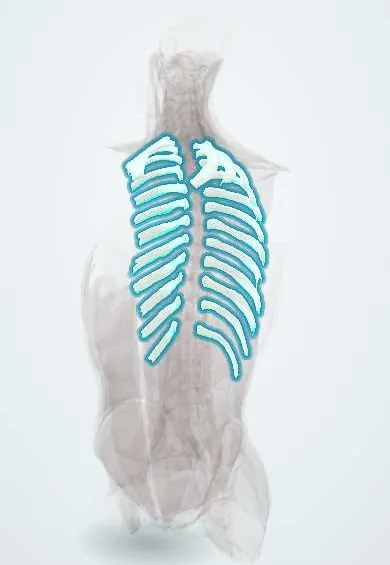
Flail chest !
Flail chest is when several ribs are each broken in two places, so a piece of chest wall moves inward as the person breathes in.
Updated 2026-10-29
Structures involved
Tap one to see what it is and open it in 3D.
In the clinical exam
In physiology
Why it happens
What it is
A segment of chest wall that has lost its bony continuity because several adjacent ribs are each broken in more than one place. The segment moves paradoxically and usually comes with lung contusion.
Who gets it
Found in a minority of patients with blunt chest trauma, mainly after high-energy road traffic collisions and falls. It is a marker of severe injury and is often seen with other trauma.
Causes
- High-energy blunt trauma: road traffic collisions, motorcycle crashes, falls from height
- Crush injuries
- Cardiopulmonary resuscitation, especially in older people
- Falls in older people with fragile bones
Risk factors
- High-energy mechanism
- Older age
- Osteoporosis
- Chronic lung disease
- Associated head or abdominal injuries
Pathophysiology
The free segment is pulled in on inspiration and pushed out on expiration (paradoxical movement), which makes breathing less efficient. The underlying pulmonary contusion is the main cause of hypoxaemia: blood and oedema fill alveoli and cause shunting. Pain and shallow breathing add atelectasis and pneumonia.
Classification
- Anterior (costochondral or sternal)
- Lateral
- Posterior (better splinted by the back muscles)
- Definitions vary: commonly three or more adjacent ribs, each broken in two or more places
Symptoms and signs
- Severe chest wall pain
- Paradoxical movement of a chest wall segment
- Shortness of breath and rapid shallow breathing
- Crepitus and bruising of the chest wall
- Hypoxaemia
Diagnosis
- Clinical
- Paradoxical movement on inspection, though muscle spasm can hide it early. Assessment follows a trauma primary survey (airway, breathing, circulation).
- Tests
- Blood gases to assess oxygenation and ventilation; blood count and lactate in polytrauma.
- Imaging
- Chest X-ray shows multiple fractures and associated injuries; CT defines the flail segment and the extent of pulmonary contusion. Ultrasound looks for pneumothorax and haemothorax.
Differential diagnosis
- Multiple simple rib fractures
- Sternal fracture
- Pneumothorax
- Haemothorax
- Diaphragmatic injury
Goal of treatment
Maintain oxygenation and ventilation, control pain, treat the lung contusion and associated injuries, and stabilise the chest wall when it helps.
Treatment
- Acute
- Trauma primary survey; oxygen; decompression or drainage of any pneumothorax or haemothorax.
- Medical
- Strong analgesia, often with regional anaesthesia such as an epidural or paravertebral catheter.
- Acute
- Non-invasive ventilation in selected patients; intubation and positive-pressure ventilation for respiratory failure, which also splints the segment from inside.
- Surgical
- Surgical stabilisation of rib fractures with plates in selected patients; it can shorten ventilation and reduce pneumonia, though criteria vary.
- Rehabilitation
- Respiratory physiotherapy, careful fluid balance and early mobilisation.
Complications
- Pneumonia
- Respiratory failure
- Acute respiratory distress syndrome (ARDS)
- Prolonged mechanical ventilation
- Chest wall deformity
- Chronic pain and reduced lung function
Prognosis
Serious: mortality is substantial and depends mainly on lung contusion, associated injuries and age. Survivors may have long-term pain and breathlessness.
Test yourself
Think of the answer, then tap the question to see it.
What is paradoxical movement in flail chest?
The free chest wall segment moves inward on inspiration and outward on expiration, the opposite of the rest of the chest.
What is the main cause of hypoxaemia in flail chest?
The underlying pulmonary contusion, which fills alveoli with blood and oedema and causes shunting.
How does positive-pressure ventilation help in flail chest?
It supports gas exchange and splints the flail segment from inside (internal pneumatic stabilisation).
Which serious lung complication can follow flail chest and contusion?
Pneumonia and acute respiratory distress syndrome (ARDS).
Related conditions
- Rib fractures
- Haemothorax
- Pneumothorax
- Acute respiratory distress syndrome (ARDS)
- Community-acquired pneumonia
Educational information, not medical advice. For any symptom, see a health professional.
Sources: Flail Chest (StatPearls (NCBI Bookshelf), 2025).
Spotted a mistake?We are always improving for the community. Tell us what is wrong and our team will review it.Report a mistake
Representative model, for educational purposes only.