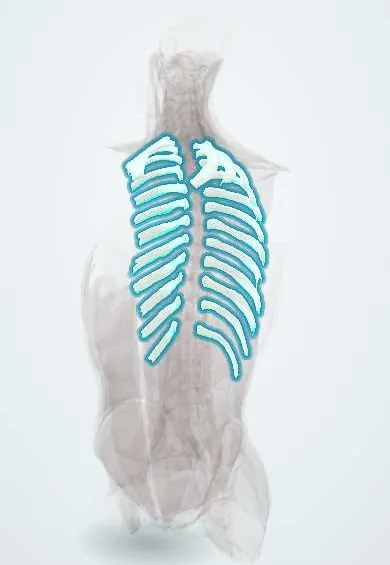
Rib fractures !
A rib fracture is a break in one or more ribs, usually from a blow to the chest; the pain limits breathing and coughing and can lead to pneumonia.
Updated 2026-10-29
Structures involved
Tap one to see what it is and open it in 3D.
- Ribs (back part)
- Costal cartilages
- Intercostal nerves
- Posterior intercostal arteries
- Pleura
- External intercostals
In the clinical exam
What it is
A break in one or more ribs, usually from blunt chest trauma. The pain limits breathing and coughing, and in older people even a few fractures can lead to pneumonia and respiratory failure.
Who gets it
The most common injury after blunt chest trauma, from road traffic collisions, falls and assaults. In older adults a simple fall is enough, and they have the highest rates of complications and death.
Causes
- Blunt chest trauma: road traffic collisions, falls, assaults
- Low-energy falls in older or osteoporotic people
- Repetitive stress (rowing, persistent coughing)
- Pathological fracture through a bone metastasis
- Cardiopulmonary resuscitation
Risk factors
- Older age
- Osteoporosis
- Chronic lung disease
- High-energy mechanism
- Anticoagulant use
- Several ribs fractured
Pathophysiology
Ribs 4 to 10 break most often. Pain makes the patient breathe shallowly and avoid coughing, so secretions build up, the bases collapse and pneumonia can follow. Sharp fragments can tear the pleura, lung and intercostal vessels; upper rib fractures signal high energy and lower ones can come with liver, spleen or kidney injury.
Classification
- Simple (one or a few ribs, single break each)
- Multiple rib fractures
- Flail segment (separate page)
- By site: upper (1–3), middle (4–9), lower (10–12)
- Displaced or non-displaced
Symptoms and signs
- Localised chest wall pain worse on breathing, coughing or moving
- Point tenderness over the rib, sometimes crepitus
- Shallow, rapid breathing (splinting)
- Bruising of the chest wall
Diagnosis
- Clinical
- History of trauma with point tenderness and pain on breathing; the chest is examined for paradoxical movement, emphysema and reduced breath sounds.
- Tests
- Pulse oximetry and blood gases in multiple fractures; blood count when bleeding is suspected; ECG if cardiac contusion is possible.
- Imaging
- Chest X-ray looks for pneumothorax and haemothorax but misses many rib fractures; CT is more sensitive and shows associated injuries. Ultrasound can also detect fractures.
Differential diagnosis
- Chest wall contusion
- Costochondritis
- Pneumothorax
- Pulmonary embolism
- Pathological fracture
Goal of treatment
Control pain well enough for deep breathing and coughing, prevent pneumonia and respiratory failure, and find associated injuries.
Treatment
- Medical
- Multimodal analgesia with paracetamol, anti-inflammatories when safe and opioids when needed, adjusted to age and kidney function.
- Procedure
- Regional anaesthesia (epidural, paravertebral or chest wall plane blocks) in multiple fractures or older patients with poor pain control.
- Rehabilitation
- Breathing exercises, incentive spirometry, early mobilisation and help with clearing secretions.
- Surgical
- Surgical rib fixation in selected cases: flail chest, severe displacement, failure to wean or persistent pain; indications vary between centres.
- Follow-up
- Admission and close observation for older patients, several fractures or underlying lung disease.
Complications
- Pneumonia
- Respiratory failure
- Pneumothorax
- Haemothorax
- Injury to liver, spleen or kidney (lower ribs)
- Chronic chest wall pain
- Non-union (rare)
Prognosis
Most heal in about six weeks. Risk of pneumonia and death rises with age and with each extra fractured rib, which is why older patients are watched closely.
Prevention
- Fall prevention and osteoporosis treatment in older people
- Seat belts and road safety
Test yourself
Think of the answer, then tap the question to see it.
Why are rib fractures more dangerous in older patients?
Pain causes shallow breathing and poor coughing, leading to atelectasis and pneumonia; risk of complications and death rises with age and number of fractures.
What does a first or second rib fracture suggest?
A high-energy mechanism, with a search for associated injuries of the great vessels, brachial plexus and lung.
Which organs may be injured with fractures of the lower ribs?
The liver on the right, the spleen on the left and the kidneys posteriorly.
What is the main goal of treating simple rib fractures?
Effective pain control so the patient can breathe deeply and cough, to prevent pneumonia.
Related conditions
- Flail chest
- Haemothorax
- Pneumothorax
- Community-acquired pneumonia
- Osteoporosis
- Costochondritis
- Pulmonary embolism
- Splenic injury
Educational information, not medical advice. For any symptom, see a health professional.
Sources: Flail Chest (StatPearls (NCBI Bookshelf), 2025).
Spotted a mistake?We are always improving for the community. Tell us what is wrong and our team will review it.Report a mistake
Representative model, for educational purposes only.