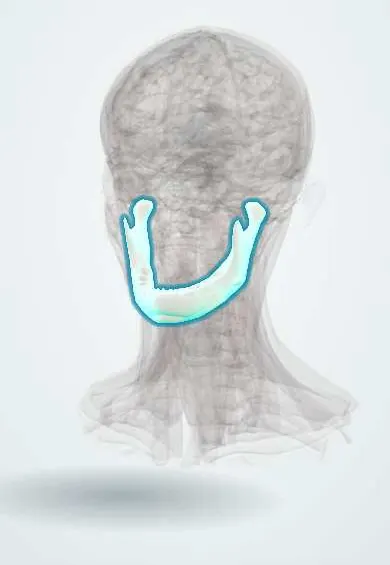
Mandible fracture !
A mandible fracture is a break of the lower jaw, often in two places because the jaw forms a ring with its two joints; it is a common facial fracture.
Updated 2026-10-29
Structures involved
Tap one to see what it is and open it in 3D.
What it is
Break of the mandible (lower jaw), often at more than one site because the bone forms a ring with the two temporomandibular joints. It is one of the commonest facial fractures.
Who gets it
Most frequent in young men. Interpersonal violence, road traffic accidents (including motorcycle crashes, common in Colombia), falls and sports are the main causes.
Causes
- Assault and interpersonal violence
- Road traffic and motorcycle accidents
- Falls
- Sports injuries
- Pathological fractures (cysts, tumours, osteonecrosis, atrophic jaw)
Risk factors
- Young male sex
- Alcohol use
- Not wearing a helmet
- Contact sports without a mouthguard
- Impacted third molars and an atrophic jaw in older adults
Pathophysiology
Force applied to one point of the jaw ring often fractures the opposite side too, typically a body or angle fracture plus a contralateral condyle. The pull of the masticatory muscles displaces the fragments, causing malocclusion. Fractures through the tooth-bearing area are open to the mouth and can become infected.
Classification
- By site: symphysis or parasymphysis, body, angle, ramus, condyle, coronoid, alveolar process
- Single or multiple; open or closed
- Favourable or unfavourable according to muscle pull
- Comminuted
Symptoms and signs
- Pain and swelling of the jaw
- Malocclusion: the teeth no longer meet normally
- Trismus or pain opening the mouth
- Numbness of the lower lip and chin (inferior alveolar nerve)
- Step deformity, mobile segment or loose teeth
- Bleeding in the mouth, sublingual haematoma
- Deviation of the jaw on opening (condylar fracture)
Diagnosis
- Clinical
- Airway, breathing and circulation first, with cervical spine protection. Then occlusion, step deformities, mobility, sublingual haematoma and lip sensation are examined.
- Tests
- No specific laboratory tests; preoperative tests as needed. Chest X-ray if a tooth may have been inhaled.
- Imaging
- Panoramic radiograph (orthopantomogram) shows most fractures. CT of the face is preferred for condylar, comminuted or multiple facial fractures and in polytrauma.
Differential diagnosis
- Temporomandibular joint dislocation
- Dental or alveolar fracture alone
- Soft tissue contusion
- Temporomandibular joint haemarthrosis
- Other facial fractures (zygomatic complex)
Goal of treatment
Secure the airway, restore normal occlusion and jaw function, achieve bone healing and prevent infection and nerve damage.
Treatment
- Acute
- Airway control, bleeding control and trauma assessment, with cervical spine protection.
- Medical
- Antibiotics for open (tooth-bearing) fractures, analgesia and chlorhexidine-class mouth rinses.
- Conservative
- Non-displaced fractures with normal occlusion, and many condylar fractures: soft diet and close follow-up, sometimes with short intermaxillary fixation and elastics.
- Surgical
- Open reduction and internal fixation with plates and screws for displaced fractures; closed reduction with intermaxillary fixation in selected cases.
- Rehabilitation
- Jaw opening exercises and physiotherapy after immobilisation to restore movement.
Complications
- Malocclusion and malunion
- Infection and osteomyelitis
- Non-union
- Numbness of the lip and chin (inferior alveolar nerve injury)
- Temporomandibular joint ankylosis after condylar fractures, especially in children
- Tooth loss
Prognosis
Most fractures heal well within about six weeks with correct reduction and fixation. Smoking, infection, poor oral hygiene and delayed treatment raise complication rates.
Prevention
- Helmets for motorcycles and bicycles, seat belts
- Mouthguards in contact sports
- Violence prevention and reducing alcohol misuse
Test yourself
Think of the answer, then tap the question to see it.
Why are mandible fractures often found at two sites?
The mandible and its two joints form a ring, so a blow to one side often also breaks the opposite side, often the condyle.
Which sign is the most sensitive clinical indicator of a mandible fracture?
Malocclusion: the patient's teeth no longer meet normally.
Which nerve injury causes numbness of the lower lip after a mandible fracture?
Injury to the inferior alveolar nerve in its canal, which ends as the mental nerve.
Which mandible fracture pattern can obstruct the airway?
Bilateral parasymphyseal fractures, which let the tongue fall back.
What is the standard screening radiograph for mandible fractures?
The panoramic radiograph (orthopantomogram); CT is used for condylar or complex fractures.
Related conditions
Educational information, not medical advice. For any symptom, see a health professional.
Sources: Mandible Fracture (StatPearls (NCBI Bookshelf), 2023).
Spotted a mistake?We are always improving for the community. Tell us what is wrong and our team will review it.Report a mistake
Representative model, for educational purposes only.