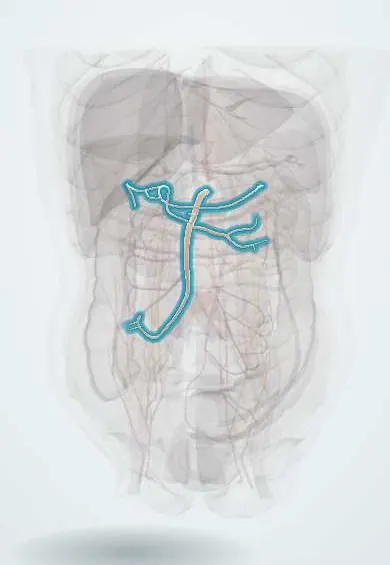
Polyarteritis nodosa !
A rare inflammation of medium-sized arteries that damages the gut, kidneys, nerves and skin. Some cases are linked to hepatitis B. The lungs are spared.
Updated 2026-11-01
Structures involved
Tap one to see what it is and open it in 3D.
- Superior mesenteric artery
- Vessels inside the kidney
- Common fibular nerve
- Celiac trunk
- Right renal artery
- Left renal artery
- Sural nerves
- Skin
- Testes
Why it happens
- Patterns of necrosis: coagulative, liquefactive, caseous, fat, fibrinoid, gangrenous
- Infarction: red vs white, and what decides the damage
- Adenosine deaminase (ADA)
- Blood vessels: artery, vein and capillary layers
What it is
A systemic necrotising vasculitis of medium-sized muscular arteries that spares the lungs and does not involve glomeruli and is not associated with ANCA. Segmental inflammation produces aneurysms, thrombosis and infarcts in the kidneys, gut, peripheral nerves, skin and testes.
Who gets it
Rare in adults, most often diagnosed in middle age and slightly more in men. Hepatitis B–associated cases have fallen sharply where hepatitis B vaccination is widespread, as in Colombia's national immunisation programme. A cutaneous-only form and genetic forms (DADA2) occur in children and young adults.
Causes
- Idiopathic in most cases today
- Hepatitis B infection (immune-complex mediated); less often hepatitis C
- Deficiency of adenosine deaminase 2 (DADA2), a genetic form in young people
- Some cases associated with hairy cell leukaemia
Risk factors
- Chronic hepatitis B infection
- Injection drug use and other routes of hepatitis B exposure
- Middle age
Pathophysiology
Transmural necrotising inflammation affects medium arteries segmentally, often at branch points, with lesions of different ages side by side. Weakening of the wall creates microaneurysms, and fibrosis or thrombosis narrows the lumen, causing ischaemia: renal infarcts and renin-mediated hypertension, mesenteric ischaemia, and nerve infarction (mononeuritis multiplex). Capillaries and the lungs are spared.
Classification
- Systemic PAN (idiopathic)
- Hepatitis B–associated PAN
- Cutaneous PAN (skin-limited)
- Genetic PAN-like disease (DADA2)
Symptoms and signs
- Fever, weight loss, fatigue, muscle and joint pain
- Mononeuritis multiplex: sudden foot drop or wrist drop, numbness in the territory of single nerves
- Abdominal pain after meals, GI bleeding
- New or severe hypertension
- Skin nodules, livedo reticularis, ulcers or digital gangrene
- Testicular pain
Diagnosis
- Clinical
- Suspected in a systemically unwell patient with mononeuritis multiplex, new hypertension, abdominal pain or skin nodules, especially with hepatitis B infection.
- Tests
- Raised ESR/CRP, anaemia; ANCA negative; creatinine and urinalysis (no active glomerular sediment); hepatitis B and C serology. Biopsy of an involved site (skin, sural nerve or muscle) showing necrotising arteritis confirms the diagnosis; nerve conduction studies document mononeuritis multiplex.
- Imaging
- Mesenteric or renal angiography (conventional or CT) shows multiple microaneurysms and segmental narrowing («string of beads» pattern) when no tissue is available.
Differential diagnosis
- ANCA-associated vasculitides (microscopic polyangiitis involves capillaries, glomeruli and lungs)
- Kawasaki disease, the medium-vessel vasculitis of young children
- Cryoglobulinaemic vasculitis
- Fibromuscular dysplasia and segmental arterial mediolysis
- Infective endocarditis with emboli
- Atherosclerotic mesenteric ischaemia
Goal of treatment
Suppress the inflammation quickly to prevent organ infarction and death, treat hepatitis B when present, and control blood pressure and ischaemic damage.
Treatment
- Acute
- Idiopathic PAN: glucocorticoids; cyclophosphamide is added for severe or organ-threatening disease (kidney, gut, heart or nerve), followed by a maintenance agent such as azathioprine or methotrexate.
- Medical
- Hepatitis B–associated PAN: antiviral therapy with a short course of glucocorticoids, often with plasma exchange, avoiding prolonged immunosuppression.
- Medical
- Blood-pressure control (ACE inhibitors are often used for renin-mediated hypertension), pain control and supportive care; surgery or endovascular treatment for bowel infarction or bleeding aneurysms.
- Follow-up
- Monitoring of blood pressure, kidney function, neurological status and abdominal signs; nursing care for foot drop (fall prevention, splints) and infection risk on treatment.
Complications
- Bowel infarction, perforation or GI bleeding
- Renal infarcts, hypertension and chronic kidney disease
- Permanent foot drop or neuropathic pain
- Myocardial infarction, heart failure or stroke
- Aneurysm rupture
- Infections from immunosuppression
Prognosis
Untreated it is often fatal; with treatment most patients reach remission and relapses are less common than in ANCA vasculitis. Gut, kidney, heart and nerve involvement at diagnosis worsens the outlook.
Prevention
- Hepatitis B vaccination and safe injection and transfusion practices reduce hepatitis B–associated PAN
Test yourself
Think of the answer, then tap the question to see it.
Which organ is characteristically spared in polyarteritis nodosa?
The lungs (and glomeruli are not involved, so there is no glomerulonephritis).
Which infection is classically associated with PAN?
Hepatitis B.
What neurological pattern is typical of PAN?
Mononeuritis multiplex, for example a sudden foot drop from common fibular nerve infarction.
What does angiography show in PAN?
Multiple microaneurysms and segmental stenoses of medium arteries, especially renal and mesenteric («string of beads»).
Is PAN usually ANCA-positive?
No; ANCA is typically negative, which helps distinguish it from microscopic polyangiitis.
Related conditions
- Viral hepatitis
- Acute mesenteric ischaemia
- Arterial hypertension
- Peripheral neuropathy (diabetic and other)
- Common Fibular (Peroneal) Nerve Injury
- Granulomatosis with polyangiitis
- Microscopic polyangiitis
- Kawasaki disease
- Myocardial Infarction (Heart Attack)
- Ischaemic stroke
Educational information, not medical advice. For any symptom, see a health professional.
Sources: Polyarteritis nodosa (MedlinePlus (U.S. National Library of Medicine), 2026).
Spotted a mistake?We are always improving for the community. Tell us what is wrong and our team will review it.Report a mistake
Representative model, for educational purposes only.