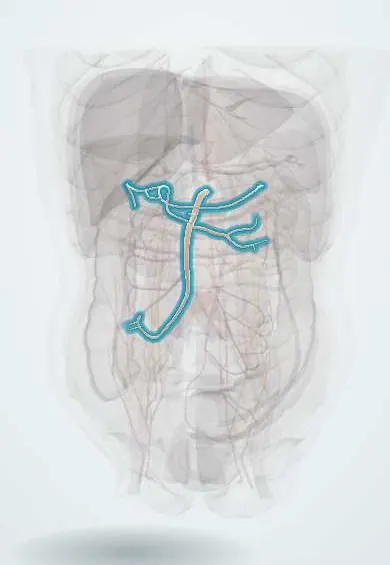
Acute mesenteric ischaemia !
Acute mesenteric ischaemia is a sudden loss of blood flow to the intestine, usually in the superior mesenteric artery; the bowel can die within hours.
Updated 2026-10-29
Structures involved
Tap one to see what it is and open it in 3D.
- Superior mesenteric artery
- Mesenteric veins
- Jejunum
- Ileum
- Abdominal aorta
- Celiac trunk
- Inferior mesenteric artery
- Colic arteries
- Ileocolic artery
In the clinical exam
In physiology
Why it happens
- Systemic (arterial) thromboembolism
- Hypoxia, ischemia and reperfusion injury
- Infarction: red vs white, and what decides the damage
- The GI tract wall: mucosa, submucosa, muscularis, serosa; enteric plexuses
What it is
A sudden loss of blood flow to the intestine, most often in the superior mesenteric artery, that can quickly lead to bowel necrosis. It is a surgical emergency with high mortality.
Who gets it
Uncommon but lethal; it mainly affects older adults with heart and vascular disease. Diagnosis is often delayed because early signs are subtle.
Causes
- Arterial embolism to the superior mesenteric artery, usually from the heart (atrial fibrillation, recent myocardial infarction)
- Arterial thrombosis on atherosclerotic narrowing at the origin of the vessel
- Non-occlusive mesenteric ischaemia: low-flow states, shock, vasopressors, cardiac surgery, dialysis
- Mesenteric venous thrombosis: thrombophilia, portal hypertension, pancreatitis, malignancy
- Aortic dissection involving the mesenteric vessels
Risk factors
- Atrial fibrillation, especially without anticoagulation
- Atherosclerosis, smoking, diabetes; prior chronic mesenteric ischaemia (pain after meals, food fear, weight loss)
- Heart failure and low cardiac output
- Older age
- Hypercoagulable states, oral contraceptives (venous form)
Pathophysiology
The mucosa is the layer most sensitive to ischaemia and starts to die within hours, releasing lactate and allowing bacteria to cross the bowel wall. Ischaemia then progresses to full-thickness necrosis, perforation, peritonitis and sepsis. Emboli usually lodge just beyond the origin of the middle colic artery, sparing the proximal jejunum; thrombosis occludes the ostium and affects more bowel.
Classification
- Arterial embolic
- Arterial thrombotic
- Non-occlusive (NOMI)
- Mesenteric venous thrombosis
Symptoms and signs
- Severe abdominal pain out of proportion to the physical findings
- Sudden bowel emptying: vomiting and diarrhoea
- Blood in the stool (later)
- Distension, then guarding and rigidity when the bowel has infarcted
- Venous form: more gradual, less specific pain
Diagnosis
- Clinical
- High suspicion in an older patient with cardiovascular risk and severe pain with few signs; early examination may be nearly normal.
- Tests
- Lactate often rises but is non-specific, and a normal value does not rule out ischaemia. Leukocytosis, metabolic acidosis, D-dimer, raised amylase. ECG for atrial fibrillation.
- Imaging
- CT angiography (arterial and venous phases) is the first-line test: it shows the occlusion, bowel wall changes, pneumatosis and portal venous gas. It is not delayed for kidney function concerns. Plain X-ray is of little use.
Differential diagnosis
- Perforated viscus
- Acute pancreatitis
- Small bowel obstruction or volvulus
- Aortic dissection or ruptured abdominal aortic aneurysm
- Ischaemic colitis
- Myocardial infarction with abdominal pain
Goal of treatment
Restore blood flow to the bowel as fast as possible, remove dead bowel, and support the circulation, to save the patient and as much intestine as possible.
Treatment
- Acute
- Resuscitation with fluids, correction of acidosis, nasogastric decompression and broad-spectrum antibiotics.
- Medical
- Immediate anticoagulation with intravenous heparin unless contraindicated; it is the main treatment of mesenteric venous thrombosis.
- Surgical
- Laparotomy with embolectomy or bypass of the superior mesenteric artery, resection of non-viable bowel and often a planned second-look operation.
- Procedure
- Endovascular treatment (aspiration, thrombolysis, angioplasty and stenting) in selected patients, especially thrombotic occlusion, often in a hybrid setting.
- Medical
- Non-occlusive ischaemia: treatment of the cause, improvement of cardiac output, reduction of vasopressors and, in some centres, intra-arterial vasodilators.
- Medical
- Long-term anticoagulation for embolic or venous disease and antiplatelet and lipid-lowering therapy for atherosclerosis.
Complications
- Bowel necrosis and perforation
- Peritonitis, sepsis and multiorgan failure
- Short bowel syndrome after extensive resection
- Recurrent ischaemia or stricture
Prognosis
Mortality remains high, and it rises with every hour of delay. Early diagnosis with CT angiography and rapid revascularisation improve survival.
Prevention
- Anticoagulation for atrial fibrillation when indicated
- Control of vascular risk factors and stopping smoking
- Revascularisation of symptomatic chronic mesenteric ischaemia
Test yourself
Think of the answer, then tap the question to see it.
What is the classic clinical feature of acute mesenteric ischaemia?
Severe abdominal pain out of proportion to the physical examination, often with sudden vomiting or diarrhoea.
What is the most common source of an embolus to the superior mesenteric artery?
The heart, usually a left atrial thrombus in atrial fibrillation, or a ventricular thrombus after myocardial infarction.
Which imaging test is first line when acute mesenteric ischaemia is suspected?
Biphasic CT angiography of the abdomen, done without delay.
Does a normal lactate exclude acute mesenteric ischaemia?
No. Lactate is non-specific and may stay normal early; a rising lactate is a late sign.
Why does an SMA embolus often spare the proximal jejunum?
Emboli usually lodge distal to the origin of the middle colic artery, so the first jejunal branches still receive blood.
Related conditions
- Atrial fibrillation
- Atherosclerosis and dyslipidaemia
- Peritonitis
- Small bowel obstruction
- Aortic dissection
- Acute pancreatitis
- Myocardial Infarction (Heart Attack)
- Sigmoid volvulus
Educational information, not medical advice. For any symptom, see a health professional.
Sources: Acute Mesenteric Ischemia (StatPearls (NCBI Bookshelf), 2026).
Spotted a mistake?We are always improving for the community. Tell us what is wrong and our team will review it.Report a mistake
Representative model, for educational purposes only.