Sigmoid volvulus !
Sigmoid volvulus is a twist of the sigmoid colon around its own mesentery; it blocks the bowel and can cut off its blood supply.
Updated 2026-10-29
Structures involved
Tap one to see what it is and open it in 3D.
In the clinical exam
In physiology
Why it happens
What it is
Twisting of the sigmoid colon around its mesentery, causing a closed-loop large bowel obstruction that can cut off the blood supply and lead to gangrene and perforation.
Who gets it
Most common in older adults, often institutionalised or with chronic constipation. It is frequent in the 'volvulus belt' of Africa, the Middle East and the Andean highlands of South America. In Latin America, Chagas megacolon is a known cause; in Colombia Chagas affects mostly the heart, so this link is less common there.
Causes
- Long, redundant sigmoid colon on a narrow mesenteric base
- Chronic constipation and megacolon
- Chagas disease megacolon (damaged enteric nerves)
- Andean or high-altitude megacolon (dolichomegacolon)
- Neurological disease and drugs that slow the bowel
Risk factors
- Older age, long-term care residence
- Chronic constipation and laxative use
- Neurological or psychiatric disease and their medicines
- Chagas disease
- High-fibre diet and living at high altitude (proposed)
- Pregnancy (rare cause)
Pathophysiology
A redundant sigmoid loop rotates on its mesentery, usually anticlockwise. The twist blocks both ends of the loop (closed loop) and the bowel upstream. Gas and fluid build up, pressure rises and the twisted mesenteric vessels are compressed, leading to ischaemia, gangrene and perforation.
Classification
- Without ischaemia (viable) versus with gangrene or perforation
- Acute versus subacute and recurrent
Symptoms and signs
- Sudden or gradual abdominal distension, often very marked
- Colicky abdominal pain
- Absolute constipation: no stool or gas
- Nausea; vomiting appears late
- Tympanic, distended abdomen; often previous similar episodes
Diagnosis
- Clinical
- Elderly or constipated patient with massive distension, pain and obstipation; signs of peritonitis suggest gangrene.
- Tests
- Full blood count, electrolytes, renal function, lactate and blood gas to look for ischaemia and dehydration.
- Imaging
- Abdominal X-ray: a huge dilated inverted-U loop, the 'coffee-bean' sign, pointing from the pelvis to the right upper quadrant. CT shows the whirl of mesenteric vessels and bird's-beak narrowing, and checks for ischaemia and perforation. Contrast enema shows the bird's beak.
Differential diagnosis
- Large bowel obstruction from colorectal cancer
- Caecal volvulus
- Acute colonic pseudo-obstruction (Ogilvie syndrome)
- Toxic megacolon
- Faecal impaction
Goal of treatment
Untwist the colon before it becomes gangrenous, remove dead bowel when present and prevent the high rate of recurrence.
Treatment
- Acute
- Resuscitation with intravenous fluids, correction of electrolytes and bowel decompression.
- Procedure
- Endoscopic detorsion with flexible sigmoidoscopy, then a rectal tube left in place, when there are no signs of gangrene or perforation.
- Surgical
- Elective sigmoid colectomy during the same admission after successful detorsion, because recurrence is common.
- Surgical
- Emergency laparotomy with resection, often with an end colostomy (Hartmann procedure), for gangrene, perforation or failed detorsion.
- Conservative
- Treatment of underlying constipation; in Chagas megacolon, a wider colon resection may be considered.
Complications
- Bowel ischaemia and gangrene
- Perforation and faecal peritonitis
- Sepsis and shock
- Recurrence after detorsion alone
- Complications of stoma and surgery
Prognosis
Good when detorsion is followed by planned resection. Mortality rises sharply with gangrene, perforation, older age and delayed care.
Prevention
- Preventing and treating chronic constipation
- Planned resection after a first episode
- Control of Chagas disease transmission
Test yourself
Think of the answer, then tap the question to see it.
What is the classic plain X-ray sign of sigmoid volvulus?
The 'coffee-bean' sign: a massively dilated inverted-U loop of sigmoid colon rising from the pelvis.
What is the first-line treatment of sigmoid volvulus without signs of gangrene?
Endoscopic detorsion with flexible sigmoidoscopy and a rectal tube, after resuscitation.
Why is elective sigmoid colectomy advised after successful detorsion?
Because recurrence after detorsion alone is common, and recurrent episodes carry risk of gangrene.
Which Latin American infection can cause megacolon and predispose to sigmoid volvulus?
Chagas disease (Trypanosoma cruzi), which destroys the enteric nerve plexuses.
Related conditions
- Large bowel obstruction
- Chagas disease
- Colorectal cancer
- Peritonitis
- Acute mesenteric ischaemia
- Diverticular disease and diverticulitis
Educational information, not medical advice. For any symptom, see a health professional.
Sources: Sigmoid Volvulus (StatPearls (NCBI Bookshelf), 2023).
Spotted a mistake?We are always improving for the community. Tell us what is wrong and our team will review it.Report a mistake
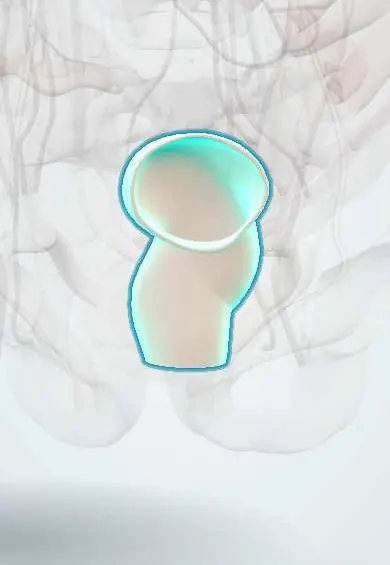
Representative model, for educational purposes only.