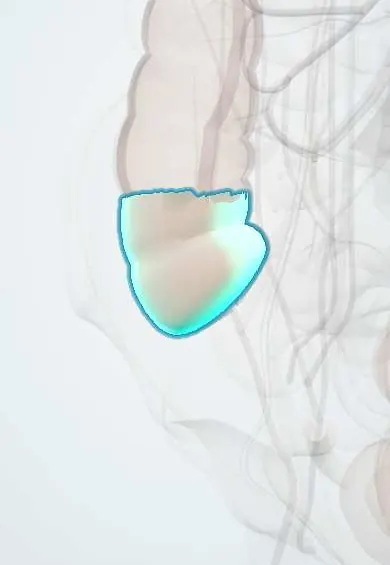
Large bowel obstruction !
Large bowel obstruction is a blockage of the colon or rectum, usually from cancer or volvulus; stool and gas cannot pass and the colon may burst.
Updated 2026-10-29
Structures involved
Tap one to see what it is and open it in 3D.
In the clinical exam
- Abdominal auscultation: bowel sounds and bruits
- Abdominal percussion: liver span and tympany
- Bowel obstruction syndrome
In physiology
Why it happens
What it is
Blockage of the colon or rectum, usually by a mechanical cause such as cancer or volvulus, that stops the passage of stool and gas and can lead to perforation if not relieved.
Who gets it
Mainly in older adults. Colorectal cancer is the most common cause in most series, followed by volvulus and diverticular disease. In parts of the Andes and Latin America, sigmoid volvulus is a relatively frequent cause.
Causes
- Colorectal cancer (most common)
- Volvulus (sigmoid, caecal)
- Diverticular stricture
- Faecal impaction
- External compression or invasion (pelvic tumours), hernia, inflammatory strictures
Risk factors
- Older age
- Colorectal cancer risk factors
- Chronic constipation, megacolon, Chagas disease
- Previous diverticulitis
- Previous abdominal or pelvic surgery or radiotherapy
Pathophysiology
Gas and fluid gather above the block. When the ileocaecal valve is competent, nothing can escape back into the small bowel, forming a closed loop between the valve and the obstruction. By Laplace's law the wide caecum takes the highest wall tension, so it is the usual site of ischaemia and perforation.
Classification
- Complete versus partial
- Mechanical versus pseudo-obstruction (Ogilvie syndrome)
- Competent versus incompetent ileocaecal valve
- By cause: neoplastic, volvulus, stricture
Symptoms and signs
- Progressive abdominal distension
- Constipation progressing to absolute constipation (no stool or gas)
- Colicky lower abdominal pain
- Vomiting appears late and may become faeculent
- Preceding change in bowel habit, weight loss or rectal bleeding (cancer)
Diagnosis
- Clinical
- Distended, tympanic abdomen; digital rectal examination for a rectal mass or impacted stool; hernia orifices checked; signs of peritonitis looked for.
- Tests
- Full blood count, electrolytes, renal function, lactate, blood gas; group and save before surgery.
- Imaging
- CT with intravenous contrast confirms the level and cause, shows closed loop and ischaemia and stages a tumour. Abdominal X-ray shows a dilated colon with haustra. A water-soluble contrast enema separates mechanical obstruction from pseudo-obstruction.
Differential diagnosis
- Small bowel obstruction
- Acute colonic pseudo-obstruction (Ogilvie syndrome)
- Paralytic ileus
- Toxic megacolon
- Severe constipation
Goal of treatment
Resuscitate, decompress the colon before it perforates and treat the cause, ideally with a single safe operation.
Treatment
- Acute
- Resuscitation with intravenous fluids, electrolyte correction, nil by mouth and nasogastric tube when vomiting.
- Procedure
- Endoscopic detorsion for sigmoid volvulus.
- Procedure
- Self-expanding colonic stent as a bridge to elective surgery or for palliation in selected malignant obstructions.
- Surgical
- Emergency resection with primary anastomosis or with end colostomy (Hartmann procedure), or a diverting stoma, depending on cause and patient condition.
- Surgical
- Urgent surgery for perforation, ischaemia or peritonitis.
Complications
- Caecal ischaemia and perforation
- Faecal peritonitis and sepsis
- Dehydration and electrolyte disturbance
- Aspiration of vomit
- Stoma-related problems
Prognosis
Depends on the cause, age and whether perforation has occurred. Emergency surgery carries a higher risk than planned surgery; in cancer, long-term outcome depends on stage.
Prevention
- Colorectal cancer screening
- Treatment of constipation
- Elective resection after volvulus
Test yourself
Think of the answer, then tap the question to see it.
What is the most common cause of large bowel obstruction in adults?
Colorectal cancer, followed by volvulus and diverticular stricture.
Why does a competent ileocaecal valve make large bowel obstruction dangerous?
It creates a closed loop between the valve and the obstruction, so pressure keeps rising and the caecum can perforate.
Why does the caecum usually perforate first?
By Laplace's law, wall tension is highest in the widest segment, the caecum.
Which condition mimics large bowel obstruction without a mechanical cause?
Acute colonic pseudo-obstruction (Ogilvie syndrome); a water-soluble contrast enema or CT tells them apart.
Related conditions
- Colorectal cancer
- Sigmoid volvulus
- Diverticular disease and diverticulitis
- Small bowel obstruction
- Peritonitis
- Acute mesenteric ischaemia
Educational information, not medical advice. For any symptom, see a health professional.
Sources: Large Bowel Obstruction (StatPearls (NCBI Bookshelf), 2024).
Spotted a mistake?We are always improving for the community. Tell us what is wrong and our team will review it.Report a mistake
Representative model, for educational purposes only.