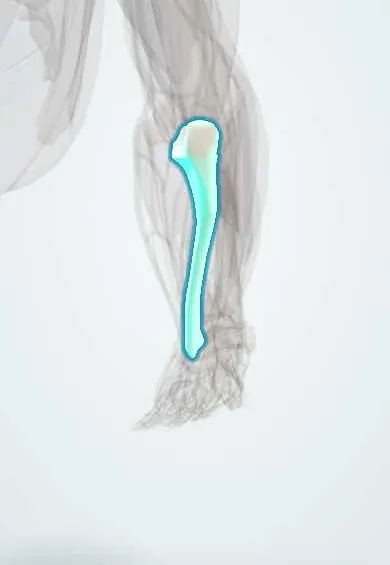
Ulna !
The ulna is the forearm bone on the little-finger side; it forms the elbow hinge and is the fixed post the radius turns around.
Opens in the Durgical app, no sign-up needed.
What it is
The forearm bone on the little-finger side; its hook (olecranon) is the point of the elbow.
What it does
Forms the hinge of the elbow with the humerus and is the fixed post the radius turns around.
Key facts
- Joints with
- Humerus (trochlea), radius (proximal and distal radio-ulnar joints); separated from the carpus by the TFCC
- Landmarks
- Olecranon, coronoid process, trochlear and radial notches, ulnar tuberosity, head, styloid process
Relations
- Above
- Olecranon with the triceps tendon and the olecranon bursa over it; the trochlear notch wraps the trochlea of the humerus
- In front
- Coronoid process with the brachialis on the ulnar tuberosity; FDP and pronator quadratus on the front of the shaft; the ulnar artery and ulnar nerve descend under the flexor carpi ulnaris
- Medial
- UCL (elbow) on the sublime tubercle of the coronoid; the ulnar nerve passes into the forearm through the gap between the humeral and ulnar heads of flexor carpi ulnaris
- Lateral
- Radial notch for the radial head, held by the annular ligament; the interosseous membrane to the radius; the supinator from the supinator crest
- Behind
- Subcutaneous posterior border along its whole length; anconeus beside the olecranon; ECU in its groove next to the styloid process
How to find it
The olecranon is the point of the elbow, and the posterior border is followed under the skin all the way to the wrist. The ulnar head is the rounded bump on the back of the little-finger side of the wrist with the forearm pronated; the styloid process lies just behind and distal to it.
On imaging
A true lateral of the elbow shows olecranon and coronoid fractures; forearm films include both the elbow and the wrist. Ulnar variance is measured on a PA wrist view taken in neutral rotation (shoulder abducted, elbow flexed to 90°), because pronation and grip make the ulna look longer.
Common problems
- Olecranon (elbow tip) fracture from a fall on the elbow.
- Shaft fracture from a direct blow when raising the arm to protect the head ('nightstick' fracture).
- Ulnar styloid fracture alongside a distal radius fracture.
How it is diagnosed
X-rays of the elbow, forearm and wrist (both forearm joints are always checked).
Treatment
- Cast or splint for stable, undisplaced fractures.
- Surgery (wires, plate or screws) for displaced olecranon or shaft fractures.
Clinical notes
- Displaced olecranon fractures are pulled apart by the triceps and lose active elbow extension; the ulnar nerve lies close to the fixation
- Fractures at the base of the ulnar styloid can involve the TFCC attachment at the fovea and destabilise the distal radio-ulnar joint
- Coronoid fractures are a marker of a recent elbow dislocation or instability, even when the joint has gone back into place
Anatomical variants
- Ulnar variance differs between people and between ethnic groups, and changes with forearm rotation and grip
- Congenital radio-ulnar synostosis is rare and often bilateral
Development
The olecranon centre appears around age 9–10 (the O of CRITOE) and may ossify from more than one piece; before it fuses in adolescence, the physis can be mistaken for a fracture, and a comparison view of the other elbow helps.
Related conditions
Test yourself
Think of the answer, then tap the question to see it.
What is a Monteggia fracture of the ulna, and what is easily missed?
A proximal ulnar fracture with dislocation of the radial head; the dislocation is missed if the radiocapitellar line is not checked.
What makes up the terrible triad of the elbow?
Posterior elbow dislocation plus a radial head fracture and a coronoid process fracture of the ulna: a very unstable injury.
Which conditions are linked to positive and to negative ulnar variance?
Positive variance: ulnocarpal impaction and TFCC wear. Negative variance: Kienböck disease.
Why do displaced olecranon fractures of the ulna lose active elbow extension?
The triceps, which inserts on the olecranon, pulls the fragments apart.
Educational information, not medical advice. For any symptom, see a health professional.
Its names
- Official Latin (TA2)
- ulna TA2 1230
- Official Spanish (DeCS)
- Ulna
- English (TA2)
- Ulna
Related
- Interosseous arteries
- Anconeus
- Annular ligament
- APL
- Brachialis
- Elbow cartilage (humerus)
- Radial head cartilage
- Ulnar notch cartilage
Sources: Terminologia Anatomica (TA2); Anatomy, Shoulder and Upper Limb, Forearm Ulna; Anatomy, Shoulder and Upper Limb, Forearm Bones.
Spotted a mistake?We are always improving for the community. Tell us what is wrong and our team will review it.Report a mistake
Representative model, for educational purposes only.