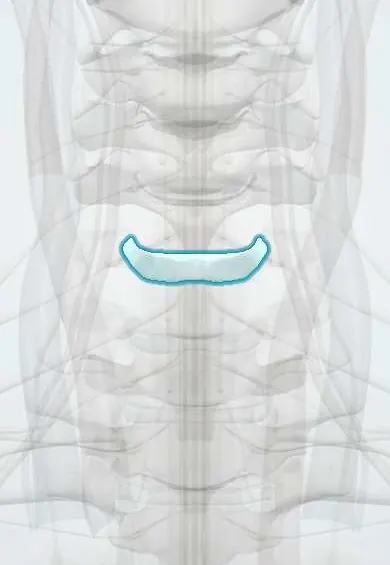
C5–C6 disc !
The C5-C6 disc is the cushion between the C5 and C6 neck vertebrae; it is the most mobile and most worn level of the neck.
Official name: C5-C6
Opens in the Durgical app, no sign-up needed.
What it is
The cushion between C5 and C6: an outer ring of crossing fibres (annulus fibrosus) around a soft centre.
What it does
Absorbs load and lets the neck bend and turn. C5-C6 is the most mobile and most worn neck level.
Key facts
- Where
- Between C5 and C6 bodies; taller in front (cervical lordosis); flanked by uncovertebral joints
- Attaches
- Annulus fibrosus anchored to the endplates and ring apophyses of C5 and C6; anterior and posterior longitudinal ligaments
- Function
- Absorbs and spreads load; posterolateral herniation usually compresses the C6 root (one of the two commonest cervical levels)
Relations
- In front
- Longus colli, esophagus and trachea, with the thyroid gland and the cricoid cartilage; the recurrent laryngeal nerve runs in the groove between trachea and esophagus, and the carotid sheath lies anterolaterally
- Behind
- Posterior longitudinal ligament, the dural sac and the spinal cord at its cervical enlargement
- Lateral
- Uncovertebral joint, the usual source of the spur that narrows the C6 foramen; the C6 nerve root; the vertebral artery, which usually enters the transverse foramen at C6
How to find it
The cricoid cartilage and the carotid (Chassaignac) tubercle on the C6 transverse process mark the C6 vertebra; the C5–C6 disc lies just above them. In surgery the level is confirmed on a lateral X-ray with a marker.
Examination
- Spurling test: neck extension and rotation toward the painful side with gentle downward pressure; arm pain into the thumb side reproduces C6 radiculopathy
- Shoulder abduction relief sign: resting the hand on top of the head eases the arm pain, which favours a root cause over shoulder disease
On imaging
Lateral X-ray shows disc-space narrowing with front and back osteophytes, often most marked at C5–C6. Axial MRI or CT shows whether an uncovertebral spur or soft disc narrows the C6 foramen and how much room the cord has.
Common problems
- Herniation pressing on the C6 nerve root: neck pain and pain, numbness or weakness down the arm into the thumb side of the hand.
- Degeneration with bone spurs, which can narrow the canal and press on the spinal cord (myelopathy: clumsy hands, unsteady walking).
How it is diagnosed
Exam of arm strength, reflexes and feeling, plus signs of cord pressure. MRI shows the disc, nerve roots and cord.
Treatment
- Most arm pain from a disc improves with time, physical therapy, medicine and sometimes an injection.
- Lasting arm pain, weakness or cord pressure: anterior cervical discectomy and fusion (ACDF), or disc replacement in selected patients.
Clinical notes
- ACDF route: between the carotid sheath laterally and the trachea and esophagus medially, then the longus colli is lifted off the bone; risks include hoarseness (recurrent laryngeal nerve) and difficulty swallowing
- Adjacent-segment degeneration after a C5–C6 fusion tends to appear at C4–C5 or C6–C7
Memory aid
Thumb and index finger form a pistol, a «six-shooter»: C6 sensation.
Related conditions
Test yourself
Think of the answer, then tap the question to see it.
What is the clinical picture of the C6 root compressed by a C5–C6 disc herniation?
Weak wrist extension and elbow flexion, a reduced brachioradialis (and biceps) reflex, and numbness of the thumb, index finger and outer forearm.
What does an inverted brachioradialis reflex suggest at the C5–C6 disc?
Cord compression at C5–C6: tapping the tendon gives finger flexion instead of elbow flexion.
Which operation is standard when root or cord compression at the C5–C6 disc needs surgery, and what are its main risks?
Anterior cervical discectomy and fusion (ACDF); risks include hoarseness from the recurrent laryngeal nerve and difficulty swallowing.
Where does adjacent-segment degeneration tend to appear after a C5–C6 fusion?
At C4–C5 or C6–C7.
Educational information, not medical advice. For any symptom, see a health professional.
Its names
- Official Latin (TA2)
- discus intervertebralis C5-C6 TA2 1684
- Official Spanish (DeCS)
- Disco C5-C6 DeCS D007403
- English (TA2)
- C5-C6
- Also called
- fibrous ring · fibrocartilago intervertebralis
Related
Sources: Terminologia Anatomica (TA2); DeCS; Anatomy, Back, Intervertebral Discs.
Spotted a mistake?We are always improving for the community. Tell us what is wrong and our team will review it.Report a mistake
Representative model, for educational purposes only.