Cardiovascular system · Head and neck
Cerebellar arteries !
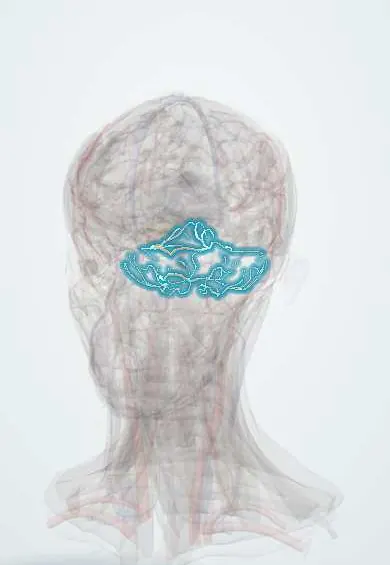
The three cerebellar arteries on each side feed the cerebellum and parts of the brainstem, which control balance and coordination.
Official name: Superior cerebellar artery
Opens in the Durgical app, no sign-up needed.
What it is
Three pairs of arteries from the vertebral and basilar arteries.
What it does
Feed the cerebellum and parts of the brainstem; a PICA stroke causes the lateral medullary syndrome.
Key facts
- Origin
- SCA and AICA from the basilar; PICA from the vertebral
- Branches
- Hemispheric and vermian branches; AICA gives the labyrinthine artery (often)
- Supplies
- PICA: lateral medulla, inferior vermis, tonsil, fourth-ventricle choroid plexus (lateral medullary syndrome); AICA: anterior inferior cerebellum, middle peduncle, lower lateral pons, inner ear; SCA: upper cerebellum, superior peduncle, inferior colliculus
Relations
- Course
- PICA leaves the vertebral artery beside the olive and winds round the medulla to the lower cerebellum; AICA leaves the lower basilar for the cerebellopontine angle; the superior cerebellar artery leaves the upper basilar and winds round the pons to the upper surface
- Above
- Superior cerebellar artery: separated from the posterior cerebral artery by the oculomotor nerve; a loop can touch the trigeminal nerve root
- Lateral
- AICA: the facial and vestibulocochlear nerves at the cerebellopontine angle, often with a loop toward the internal acoustic meatus
- Below
- PICA: rootlets of the glossopharyngeal, vagus, accessory and hypoglossal nerves, and the cerebellar tonsil
How to find it
None can be felt. The superior cerebellar artery runs just below the tentorium, under the oculomotor nerve; the anterior inferior artery loops near the facial and vestibulocochlear nerves at the internal acoustic meatus; the posterior inferior artery winds around the medulla among the lower cranial nerves. The retrosigmoid approach exposes all three.
Examination
- HINTS in acute continuous vertigo: a normal head impulse, nystagmus that changes direction or a skew deviation points to a central (stroke) cause
- Same-side cerebellar signs: finger–nose and heel–shin ataxia, dysdiadochokinesia; truncal ataxia when sitting or standing
On imaging
Diffusion-weighted MRI is the test of choice; CT often misses early infarcts in the posterior fossa.
Clinical notes
- A loop of the superior cerebellar artery pressing on the trigeminal root is the classic cause of trigeminal neuralgia; microvascular decompression moves it away
- Vertebral artery dissection, sometimes after neck trauma or manipulation, often presents as a PICA-territory stroke with neck pain
- Isolated vertigo can be the only sign of a cerebellar stroke
Anatomical variants
- PICA is often small or absent, with AICA supplying its territory (AICA–PICA dominance)
- PICA can arise outside the skull, below the foramen magnum
Memory aid
Wallenberg: "Don't PICA horse (hoarseness) that can't eat (dysphagia)".
Related conditions
Test yourself
Think of the answer, then tap the question to see it.
Which cerebellar artery is involved in lateral medullary (Wallenberg) syndrome, and what is the sensory pattern?
PICA (or the vertebral artery): loss of pain and temperature on the same side of the face and the opposite side of the body.
Why is there no limb weakness in Wallenberg syndrome?
The pyramids are spared; signs are vertigo, same-side Horner and ataxia, hoarseness and dysphagia (nucleus ambiguus).
How does an AICA stroke differ from a PICA stroke?
AICA gives a lateral pontine syndrome: similar, but with same-side facial weakness and hearing loss (labyrinthine branch).
Which cerebellar artery classically causes trigeminal neuralgia?
The superior cerebellar artery, whose loop presses on the trigeminal root; microvascular decompression moves it away.
Educational information, not medical advice. For any symptom, see a health professional.
Its names
- Official Latin (TA2)
- arteria superior cerebelli TA2 4563
- Official Spanish (DeCS)
- Arterias cerebelosas superior, anteroinferior y posteroinferior
- English (TA2)
- Superior cerebellar artery
- Also called
- arteria cerebellaris superior · sCA
Related
Sources: Terminologia Anatomica (TA2); Neuroanatomy, Anterior Inferior Cerebellar Arteries; Neuroanatomy, Vertebrobasilar System.
Spotted a mistake?We are always improving for the community. Tell us what is wrong and our team will review it.Report a mistake
Representative model, for educational purposes only.