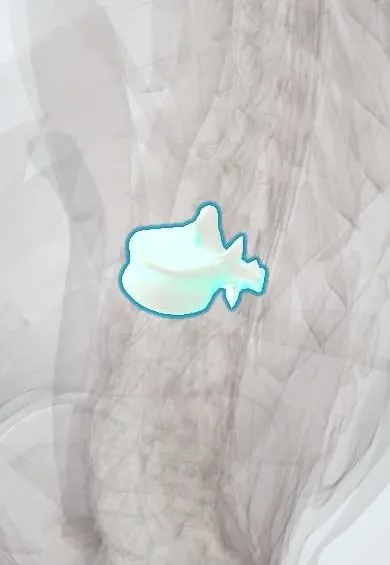
T11 vertebra !
T11 is the eleventh thoracic (mid-back) vertebra; it has joints for the ribs and helps form the cage that protects the heart and lungs.
Official name: T11
Opens in the Durgical app, no sign-up needed.
What it is
The T11 mid-back vertebra, with joints on each side for the ribs.
What it does
Holds up the trunk and, with the ribs and breastbone, forms the rib cage, which protects the heart and lungs. The ribs make this part of the spine stiff.
Key facts
- Joints with
- T10 above and T12 below (discs, facet joints); head of rib 11 (single facet); no costotransverse joint
- Landmarks
- Single full costal facet for rib 11, mostly on pedicle; no transverse costal facets; short transverse processes; body becoming lumbar-like
Relations
- In front
- Descending thoracic aorta and azygos vein, close to where they pass behind the diaphragm
- Lateral
- Head of the floating eleventh rib on a single facet; the pleura and the lung edge lie in the costodiaphragmatic recess beside it
- Behind
- Latissimus dorsi, serratus posterior (inferior) and the thoracolumbar fascia over the erector spinae
How to find it
The twelfth rib is followed inward from the flank to its vertebra and the count goes up one spine. The free tip of the eleventh rib is felt in the flank, below the costal margin.
On imaging
Chance fracture on CT: a horizontal line through the posterior elements and body, best seen on sagittal reconstructions; uncovered ('naked') facets on axial slices. The AP film may show a widened gap between spines. Abdominal CT looks for bowel injury.
Common problems
- Compression fractures from osteoporosis, sometimes after a minor fall or even a cough.
- A rounded upper back (kyphosis) from posture, wedge fractures or Scheuermann disease in teens.
- Scoliosis: a sideways curve with rotation, often starting in adolescence.
How it is diagnosed
X-rays for fractures and curves (scoliosis is measured with the Cobb angle). MRI tells new fractures from old ones. A bone density scan (DEXA) checks for osteoporosis.
Treatment
- Osteoporosis fractures: pain control, a short time in a brace, and treatment of the osteoporosis.
- Painful fractures that do not settle: kyphoplasty or vertebroplasty (cement injected into the bone).
- Large or progressive curves: bracing in growing children, sometimes fusion surgery.
Clinical notes
- The facets change from thoracic (coronal) to lumbar (sagittal) orientation between T11 and L1, concentrating stress at the junction
- Thoracolumbar injuries are scored by morphology, the posterior ligament complex and neurology (TLICS); Chance and fracture-dislocation injuries are typically unstable
- Seat-belt marks across the abdomen in a crash victim raise suspicion of a Chance fracture and bowel injury together
Anatomical variants
- The level where the facets turn from the thoracic (coronal) to the lumbar (sagittal) pattern varies: most often at T11–T12 or T12–L1, and sometimes the change is abrupt within one vertebra (texts differ on the usual level)
Related conditions
Test yourself
Think of the answer, then tap the question to see it.
Why is the eleventh rib, which joins the T11 vertebra, called a floating rib?
Its head meets only T11, it has no joint with the transverse process and its front end ends free in the flank muscles.
What is a Chance fracture of the thoracolumbar spine, such as at T11?
A horizontal split through spine, pedicles and body from flexion over a lap belt; all three columns fail in distraction, and bowel or mesenteric injury often comes with it.
Why does the thoracolumbar junction (about T11–L2) take most high-energy spinal fractures?
The rib-braced thoracic spine meets the mobile lumbar spine there, and the facets change from coronal to sagittal between T11 and L1, concentrating stress.
Which three elements does the TLICS score assess in injuries of the thoracolumbar spine, such as at T11?
Fracture morphology, the posterior ligament complex and neurology.
Educational information, not medical advice. For any symptom, see a health professional.
Its names
- Official Latin (TA2)
- vertebra thoracica XI TA2 1059
- Official Spanish (DeCS)
- Vértebra dorsal D11 DeCS D013904
- English (TA2)
- T11
Related
- T10–T11 disc
- T11–T12 disc
- Posterior intercostal arteries
- Rib-to-spine ligaments
- Diaphragm
- Endplates
- Mid-back facet joints
- Interspinales
Sources: Terminologia Anatomica (TA2); DeCS; Anatomy, Back, Thoracic Vertebrae.
Spotted a mistake?We are always improving for the community. Tell us what is wrong and our team will review it.Report a mistake
Representative model, for educational purposes only.