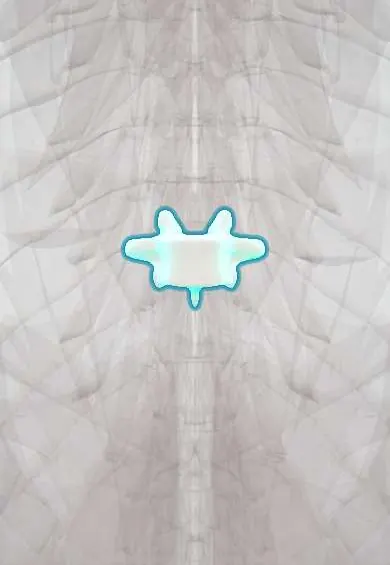
T9 vertebra !
T9 is the ninth thoracic (mid-back) vertebra; it has joints for the ribs and helps form the cage that protects the heart and lungs.
Official name: T9
Opens in the Durgical app, no sign-up needed.
What it is
The T9 mid-back vertebra, with joints on each side for the ribs.
What it does
Holds up the trunk and, with the ribs and breastbone, forms the rib cage, which protects the heart and lungs. The ribs make this part of the spine stiff.
Key facts
- Joints with
- T8 above and T10 below (discs, facet joints); head of rib 9 and often rib 10; tubercle of rib 9
- Landmarks
- Heart-shaped body; round canal; long down-sloping spinous process; superior demifacet; inferior demifacet often absent (rib 10 usually on T10 alone); xiphisternal joint near T9
Relations
- In front
- Esophagus about to leave the thorax in front of the descending thoracic aorta
- Lateral
- Head of the ninth rib (and of the tenth when it reaches up); the sympathetic trunk with the roots of the greater splanchnic nerve
- Behind
- Latissimus dorsi, lower trapezius and erector spinae
How to find it
Counted two spines below T7, which is level with the inferior angle of the scapula with the arms by the sides; the tip of the T9 spine lies over the body of T10.
On imaging
Pott disease on MRI: marrow edema in two adjacent bodies, a disc that is spared longer than in pyogenic infection, a large paravertebral or psoas abscess with a thin smooth wall, and spread under the ligament to distant levels. CT shows bone fragments and calcified abscess.
Common problems
- Compression fractures from osteoporosis, sometimes after a minor fall or even a cough.
- A rounded upper back (kyphosis) from posture, wedge fractures or Scheuermann disease in teens.
- Scoliosis: a sideways curve with rotation, often starting in adolescence.
How it is diagnosed
X-rays for fractures and curves (scoliosis is measured with the Cobb angle). MRI tells new fractures from old ones. A bone density scan (DEXA) checks for osteoporosis.
Treatment
- Osteoporosis fractures: pain control, a short time in a brace, and treatment of the osteoporosis.
- Painful fractures that do not settle: kyphoplasty or vertebroplasty (cement injected into the bone).
- Large or progressive curves: bracing in growing children, sometimes fusion surgery.
Clinical notes
- In Colombia and other countries where tuberculosis is common, chronic back pain with weight loss, night sweats or a new hump keeps spinal TB on the list
- A cold abscess can track down the sheath of the psoas major to the groin, where it can look like a hernia
- Pott paraplegia: cord compression by abscess, granulation tissue or bony kyphosis, early in active disease or years later
Development
Hemivertebra (one side of the body missing) and butterfly vertebra (a cleft in the middle) are congenital body defects of the thoracic spine; a hemivertebra is a classic cause of congenital scoliosis.
Related conditions
Test yourself
Think of the answer, then tap the question to see it.
Where does tuberculous spondylitis (Pott disease) of the lower thoracic spine, such as T9, start and how does it spread?
At the front of the body; it spreads under the anterior longitudinal ligament and collapses bodies into a hump (gibbus).
How can a cold abscess from spinal tuberculosis at the T9 level present in the groin?
It tracks down the sheath of the psoas major to the groin, where it can look like a hernia.
Which nerve forms from the T5–T9 sympathetic ganglia on the sides of the vertebral bodies, including T9?
The greater splanchnic nerve.
On MRI, which features favour tuberculous over pyogenic spondylitis at the T9 vertebra?
A disc spared longer, a large paravertebral or psoas abscess with a thin smooth wall, and spread under the ligament to distant levels.
Educational information, not medical advice. For any symptom, see a health professional.
Its names
- Official Latin (TA2)
- vertebra thoracica IX TA2 1059
- Official Spanish (DeCS)
- Vértebra dorsal D9 DeCS D013904
- English (TA2)
- T9
Related
- T8–T9 disc
- T9–T10 disc
- Posterior intercostal arteries
- Anterior longitudinal ligament
- Rib-to-spine ligaments
- Dura (dural sac)
- Endplates
- Mid-back facet joints
Sources: Terminologia Anatomica (TA2); DeCS; Anatomy, Back, Thoracic Vertebrae.
Spotted a mistake?We are always improving for the community. Tell us what is wrong and our team will review it.Report a mistake
Representative model, for educational purposes only.