
Internuclear ophthalmoplegia
A lesion of the medial longitudinal fasciculus: one eye cannot turn in on side gaze while the other jerks outwards. Often due to MS or stroke.
What it is
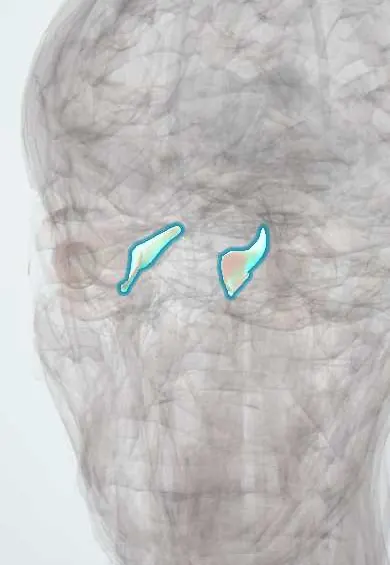
Internuclear ophthalmoplegia (INO) comes from a brainstem lesion of the medial longitudinal fasciculus (MLF): on side gaze the eye on the lesion side fails to adduct, the abducting eye shows nystagmus and convergence is often spared. Bilateral INO in a young adult suggests multiple sclerosis; unilateral INO in an older adult, stroke.
Who gets it
Multiple sclerosis is the main cause in young adults, often bilateral; brainstem infarction is the main cause in people over 50, often unilateral.
Causes
- Multiple sclerosis
- Brainstem infarction (paramedian branches of the basilar artery)
- Trauma
- Brainstem tumours, infection or Wernicke encephalopathy
- Drug toxicity and other causes (rare)
Risk factors
- Multiple sclerosis
- Vascular risk factors: hypertension, diabetes, smoking
- Head injury
Pathophysiology
For horizontal gaze, the abducens nucleus drives the ipsilateral lateral rectus and, through interneurons crossing in the MLF, the contralateral medial rectus subnucleus of the third nerve. A lesion of the MLF interrupts this signal, so the ipsilateral eye fails to adduct on gaze to the opposite side. Convergence uses a separate pathway and is usually spared. Adding a lesion of the abducens nucleus or PPRF gives the one-and-a-half syndrome.
Classification
- Unilateral or bilateral INO
- Wall-eyed bilateral INO (WEBINO): both eyes exotropic in primary gaze
- One-and-a-half syndrome: INO plus ipsilateral horizontal gaze palsy
Symptoms and signs
- Double vision on side gaze, or blurring
- Oscillopsia
- Other brainstem symptoms (vertigo, ataxia, numbness) depending on the cause
Diagnosis
- Clinical
- Slowed or absent adduction on horizontal gaze or fast saccades on the side of the lesion, with abducting nystagmus of the other eye; convergence often preserved; check for skew deviation and other brainstem signs.
- Tests
- Ice-pack or acetylcholine receptor antibody tests if myasthenia is possible; vascular risk factor screening; cerebrospinal fluid oligoclonal bands when demyelination is suspected.
- Imaging
- MRI of the brain with diffusion and fluid-attenuated sequences to show demyelinating plaques or infarction in the dorsal pons or midbrain.
Differential diagnosis
- Myasthenia gravis (pseudo-INO)
- Partial third nerve palsy
- Medial rectus restriction (thyroid eye disease, orbital trauma)
- Exotropia with poor convergence
Eye that will not adduct: INO vs its look-alikes
| Feature | INO | Third nerve palsy | Myasthenia (pseudo-INO) | Medial rectus restriction |
|---|---|---|---|---|
| Adduction on side gaze | Slow or absent, with slowed saccades | Absent or weak | Weak and variable | Limited |
| Convergence | Usually spared | Lost | Variable | Limited by tethering |
| Lids and pupil | Normal | Ptosis; pupil may be dilated | Fatigable ptosis; pupil normal | Normal; lid retraction if thyroid eye disease |
| Other eye | Abducting nystagmus | Normal | Other muscles may be weak | Normal |
| Forced duction | Free | Free | Free | Restricted |
| Key test | MRI brain with diffusion and FLAIR | Urgent CT or MR angiography if the pupil is involved | Ice-pack test, acetylcholine receptor antibodies | Orbital imaging, thyroid tests |
Goal of treatment
Treat the underlying disease and relieve double vision while the INO recovers.
Treatment
- Acute
- Urgent stroke pathway when onset is sudden in a patient with vascular risk factors.
- Medical
- Treatment of multiple sclerosis relapse and disease-modifying therapy through neurology.
- Conservative
- Temporary patching or prisms for persistent double vision.
- Follow-up
- Follow-up of motility; most cases improve over weeks to months.
Complications
- Persistent diplopia or oscillopsia
- Associated brainstem deficits
Common traps
- The INO is named after the eye with nystagmus: it is named after the eye that fails to adduct, which is on the side of the MLF lesion; the nystagmus is in the opposite, abducting eye
- Failure to adduct means a third nerve palsy: in INO convergence usually still adducts the eye and there is no ptosis, pupil change or vertical limitation, so the nerve and muscle work
- An apparent INO with ptosis and variable weakness is still an MLF lesion: myasthenia can mimic INO (pseudo-INO); fatigability, ptosis and an ice-pack or antibody test point to the neuromuscular junction
- Bilateral INO always means multiple sclerosis: MS is the usual cause in young adults, but in older people brainstem infarction is likelier and sudden onset calls for the stroke pathway
- A mild INO is obvious on slow pursuit: a subtle INO may show only as slowed adducting saccades, so test fast saccades side to side and compare the speed of both eyes
Prognosis
Most demyelinating cases recover well; recovery after stroke is common but slower and may be incomplete.
Test yourself
Think of the answer, then tap the question to see it.
On gaze to the right, the left eye stops at the midline and the right eye beats outward; convergence is normal. Where is the lesion?
The left MLF: a left INO. The left eye fails to adduct and the right abducting eye has nystagmus; normal convergence shows the left third nerve and medial rectus work.
Why is convergence usually preserved in INO?
Convergence is driven from midbrain near-response centres straight to the medial rectus subnuclei, bypassing the MLF.
A 28-year-old woman has bilateral INO and a past episode of optic neuritis. What is the likely cause and the key test?
Multiple sclerosis: MRI of the brain with FLAIR to find a dorsal pontine or midbrain plaque and others; CSF oligoclonal bands if needed.
A 70-year-old with diabetes develops sudden double vision from a right INO. What should happen next?
Treat it as a brainstem stroke until proved otherwise: urgent stroke pathway and MRI with diffusion.
In a right one-and-a-half syndrome, which horizontal movement is left?
Only abduction of the left eye: a right horizontal gaze palsy (right abducens nucleus or PPRF) plus a right INO.
In neurology
Connections
Educational information, not medical advice. For any symptom, see a health professional.
Sources: Internuclear Ophthalmoplegia (StatPearls Publishing (NCBI Bookshelf), 2023).
Spotted a mistake?We are always improving for the community. Tell us what is wrong and our team will review it.Report a mistake
Representative model, for educational purposes only.