Conditions · Metabolism (biochemistry)
Morquio syndrome (mucopolysaccharidosis type IV) !
Morquio syndrome is a mucopolysaccharidosis that mainly hits the skeleton: short stature, knock knees and a weak neck joint, with normal intelligence.
Updated 2026-11-01
Structures involved
Tap one to see what it is and open it in 3D.
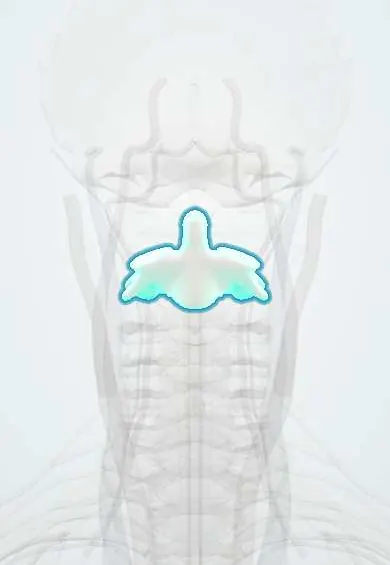
- Axis (C2)
- Atlas–axis joints
- Spinal cord
- Cornea
- Atlas (C1)
- Transverse ligament of the atlas
- Sternum
- Ribs (back part)
- Femur
- Tibia
- Aortic right coronary cusp
- Trachea
In biochemistry
What it is
An autosomal recessive lysosomal disease in which keratan sulfate (and, in type A, chondroitin 6-sulfate) cannot be broken down and builds up mainly in cartilage, bone and cornea.
Who gets it
Estimated at 1 in 200 000 to 300 000 people. No Colombian frequency is given in the sources consulted.
Causes
- MPS IVA: GALNS variants (N-acetylgalactosamine 6-sulfatase)
- MPS IVB: GLB1 variants (β-galactosidase, the same gene as GM1 gangliosidosis)
Risk factors
- Both parents carriers
- Consanguinity
Pathophysiology
GALNS removes a sulfate from keratan sulfate and chondroitin 6-sulfate, and β-galactosidase then removes galactose from keratan sulfate. When either step fails, these GAGs fill the lysosomes of chondrocytes, disturbing growth plates and producing a skeletal dysplasia. Keratan sulfate is abundant in cartilage and cornea, which explains the bone deformities and corneal clouding; the brain is spared.
Classification
- MPS IVA (GALNS): most cases
- MPS IVB (GLB1): clinically very similar
- Severe and attenuated forms on a continuum
Symptoms and signs
- Short stature with short trunk
- Knock knees (genu valgum) and loose, hypermobile joints
- Pectus carinatum and rib, spine, hip and wrist deformities
- Odontoid hypoplasia with neck instability
- Corneal clouding
- Thin tooth enamel and many cavities
- Hearing loss, narrow airway and sleep apnoea
- Normal intelligence
Diagnosis
- Clinical
- A child of normal intelligence with short-trunk dwarfism, knock knees, pectus carinatum, joint laxity and cloudy corneas.
- Tests
- Raised urine keratan sulfate (may be normal in older patients); low GALNS or β-galactosidase activity in leukocytes or fibroblasts; GALNS or GLB1 gene testing; audiometry and sleep study.
- Imaging
- Skeletal survey with flattened vertebrae (platyspondyly) and dysostosis; flexion–extension cervical X-rays and MRI for odontoid hypoplasia and cord compression; echocardiogram for valves.
Treatment
- Medical
- Intravenous enzyme replacement with recombinant GALNS for MPS IVA improves endurance and urinary keratan sulfate; it does not reverse established bone changes.
- Surgical
- Upper cervical (occipitocervical) fusion for instability or cord compression; osteotomies for knock knees; hip and spine surgery as needed.
- Procedure
- Non-invasive ventilation for sleep apnoea; anaesthesia planned by an experienced team with neck protection.
- Follow-up
- Regular neurological, cervical spine, respiratory, cardiac, eye and hearing follow-up.
Complications
- Cervical cord compression with paralysis
- Airway obstruction and respiratory failure
- Valve disease
- Vision and hearing loss
- Early joint degeneration
Prognosis
Severe forms may survive only to late childhood or adolescence; milder forms reach adulthood. Spinal cord compression and airway obstruction are the main causes of death.
Prevention
- Genetic counselling and carrier testing in families
- Early cervical screening to prevent cord injury
Test yourself
Think of the answer, then tap the question to see it.
Which GAG accumulates in Morquio syndrome?
Keratan sulfate (with chondroitin 6-sulfate in type A), abundant in cartilage and cornea.
Which spinal finding makes Morquio syndrome dangerous?
Odontoid hypoplasia: the C1–C2 joint becomes unstable and can compress the cervical spinal cord, causing paralysis.
How does Morquio syndrome differ from Hurler and Sanfilippo syndromes in the brain?
Intelligence is normal in Morquio syndrome, because keratan sulfate storage spares the brain.
Which enzymes are missing in MPS IVA and MPS IVB?
IVA: N-acetylgalactosamine 6-sulfatase (GALNS); IVB: β-galactosidase (GLB1).
Related conditions
- Sanfilippo syndrome (mucopolysaccharidosis type III)
- Hurler syndrome (mucopolysaccharidosis type I)
- GM1 gangliosidosis
- Obstructive sleep apnoea
- Degenerative cervical myelopathy
- Spinal cord injury
Educational information, not medical advice. For any symptom, see a health professional.
Sources: Mucopolysaccharidosis type IV: MedlinePlus Genetics (MedlinePlus, US National Library of Medicine, 2026); GALNS gene: MedlinePlus Genetics (MedlinePlus, US National Library of Medicine, 2026); GLB1 gene: MedlinePlus Genetics (MedlinePlus, US National Library of Medicine, 2026); Textbook of Biochemistry for Medical Students, 6th ed. (Jaypee Brothers Medical Publishers (Vasudevan DM, Sreekumari S, Vaidyanathan K), 2011).
Spotted a mistake?We are always improving for the community. Tell us what is wrong and our team will review it.Report a mistake
Representative model, for educational purposes only.