Spinocerebellar ataxias (autosomal dominant ataxias) !
A group of inherited diseases in which the cerebellum slowly degenerates, causing worsening clumsiness, unsteady walking and slurred speech in adults.
Updated 2026-11-01
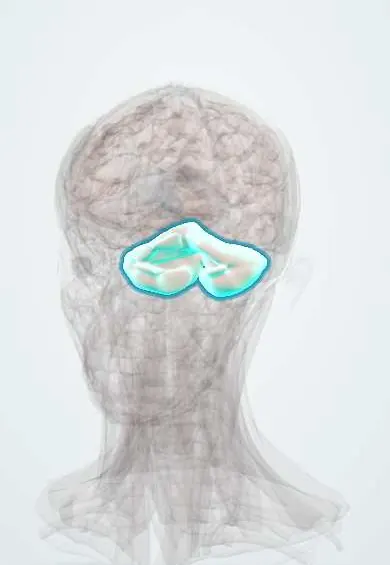
Structures involved
Tap one to see what it is and open it in 3D.
Why it happens
- Mendelian inheritance: autosomal dominant, recessive and X-linked
- Nonclassic inheritance: repeat expansions, mitochondrial genes, imprinting, mosaicism
- Functions of the cerebellum
- Trinucleotide repeat expansion disorders
What it is
A large group (more than 40 types) of autosomal dominant, progressive neurodegenerative disorders of the cerebellum and its connections in the brainstem and spinal cord. The most common types (SCA1, 2, 3, 6, 7 and 17) are caused by expanded CAG repeats that code for long polyglutamine stretches. They present mainly in adulthood with progressive gait ataxia, dysarthria and eye-movement problems, often with other neurological signs depending on the type.
Who gets it
Together they affect about 1 to 5 per 100,000 people worldwide, with large regional differences due to founder effects. SCA3 (Machado-Joseph disease) is the most common type worldwide and in Brazil; SCA2 has one of the highest prevalences in the world in Holguín, Cuba; SCA7 clusters are described in Mexico and Venezuela; and SCA10, a pentanucleotide repeat disorder, is described mainly in families of Amerindian ancestry in Mexico and Brazil. Colombian data are limited and families are often identified in specialist centres.
Causes
- Autosomal dominant inheritance: each child of an affected parent has a 50% risk
- CAG (polyglutamine) repeat expansions: SCA1 (ATXN1), SCA2 (ATXN2), SCA3 (ATXN3), SCA6 (CACNA1A), SCA7 (ATXN7), SCA17 (TBP)
- Non-coding repeat expansions (e.g. SCA10, SCA27B) and conventional point mutations in other types
- Anticipation: longer repeats, earlier onset and faster course in later generations, more marked with paternal transmission in some types
Risk factors
- Family history of adult-onset ataxia (sometimes hidden by early death, misdiagnosis or non-paternity)
- Ancestry from regions with founder mutations
- Inheriting the expansion from the father (greater repeat instability in some types)
Pathophysiology
Expanded CAG repeats produce proteins with abnormally long polyglutamine tracts that misfold, form nuclear aggregates and disturb transcription, protein clearance and ion-channel function. Purkinje cells of the cerebellar cortex and neurons of the pons, inferior olive, cerebellar peduncles, spinal cord tracts and, in some types, basal ganglia and retina degenerate. Cerebellar loss causes ataxia and dysarthria; brainstem involvement causes slow saccades and dysphagia; spinal and peripheral involvement causes sensory loss and areflexia. Longer repeats are more toxic, explaining earlier onset.
Classification
- Polyglutamine SCAs: SCA1, 2, 3, 6, 7, 17 (and dentatorubral-pallidoluysian atrophy)
- Non-coding repeat SCAs: SCA8, 10, 12, 27B, 36 and others
- Conventional mutation SCAs: channel and other gene variants
- Clinical clue types: SCA2 (very slow saccades, neuropathy), SCA3 (bulging eyes, dystonia, spasticity, neuropathy), SCA6 (late-onset, nearly pure cerebellar), SCA7 (retinal degeneration with vision loss)
- Episodic ataxias (EA1, EA2) are related dominant channelopathies with attacks rather than steady progression
Symptoms and signs
- Slowly progressive unsteady, broad-based gait and frequent falls
- Clumsy hands, intention tremor and dysmetria
- Slurred, scanning speech (dysarthria)
- Nystagmus, slow saccades or double vision
- Swallowing difficulty in later stages
- Type-specific features: neuropathy, spasticity, parkinsonism, dystonia, vision loss (SCA7), cognitive decline, sleep disorders such as REM sleep behaviour disorder
Diagnosis
- Clinical
- Suspected in an adult with slowly progressive cerebellar ataxia and a family history in several generations. Examination shows gait and limb ataxia, dysarthria and eye-movement abnormalities, plus extra-cerebellar signs that point to a type. Acquired causes must be excluded first.
- Tests
- Targeted genetic testing for repeat expansions in the common SCA genes, then broader panels or genome sequencing if negative. Exclude acquired ataxia: vitamin E and B12, thyroid function, alcohol history, celiac antibodies and, where relevant, paraneoplastic antibodies. Pre-symptomatic testing of at-risk relatives is done only with genetic counselling. Nerve conduction studies and eye examination help define the type.
- Imaging
- Brain MRI shows cerebellar atrophy, with or without pontine (olivopontocerebellar) atrophy, and excludes tumours, strokes and demyelination.
Differential diagnosis
- Friedreich ataxia and other recessive ataxias
- Multiple system atrophy, cerebellar type
- Alcohol-related cerebellar degeneration
- Wernicke encephalopathy and vitamin E or B12 deficiency
- Multiple sclerosis and posterior fossa stroke or tumour
- Paraneoplastic and immune-mediated cerebellar ataxias
Goal of treatment
No treatment slows most SCAs; care aims to preserve mobility and independence, prevent falls and aspiration, treat associated symptoms and offer genetic counselling to the family.
Treatment
- Rehabilitation
- Intensive physiotherapy focused on balance and coordination, occupational therapy and walking aids; speech and swallowing therapy.
- Medical
- Symptomatic drugs: dopaminergic drugs for parkinsonism, antispasticity drugs, treatment of neuropathic pain, depression and sleep disorders; carbonic anhydrase inhibitors for some episodic ataxias.
- Conservative
- Genetic counselling for the patient and relatives, including reproductive options and the choice of pre-symptomatic testing.
- Follow-up
- Regular ataxia rating scales, swallowing assessment, nutrition, fall risk and mood screening.
Complications
- Falls and injuries
- Aspiration pneumonia
- Loss of independent walking and wheelchair dependence
- Depression and cognitive decline in some types
- Blindness in SCA7
Prognosis
Steadily progressive over years to decades. Survival varies by type: SCA1, 2, 3 and 7 shorten life (often 10 to 20 years after onset in adults, less with juvenile onset), whereas SCA6 progresses slowly with near-normal life expectancy.
Prevention
- No primary prevention. Genetic counselling and, where available, prenatal or preimplantation testing allow families to make informed reproductive choices.
Test yourself
Think of the answer, then tap the question to see it.
What is the inheritance pattern of the spinocerebellar ataxias?
Autosomal dominant.
What type of mutation causes the most common SCAs, and what phenomenon does it produce across generations?
CAG (polyglutamine) repeat expansions; anticipation, with earlier and more severe disease in later generations.
Which SCA is the most common worldwide?
SCA3 (Machado-Joseph disease).
Which SCA type causes progressive visual loss from retinal degeneration?
SCA7.
Which recessive ataxia is the main differential in young patients?
Friedreich ataxia (GAA repeat in FXN), with areflexia, cardiomyopathy and diabetes.
Related conditions
- Friedreich ataxia
- Multiple system atrophy (MSA)
- Huntington disease
- Ataxia-telangiectasia
- Alcohol use disorder
- Wernicke encephalopathy (thiamine deficiency)
- Multiple sclerosis
- REM sleep behaviour disorder (RBD)
- Restless legs syndrome
Educational information, not medical advice. For any symptom, see a health professional.
Sources: Spinocerebellar ataxia type 3: MedlinePlus Genetics (MedlinePlus (U.S. National Library of Medicine), 2026).
Spotted a mistake?We are always improving for the community. Tell us what is wrong and our team will review it.Report a mistake
Representative model, for educational purposes only.