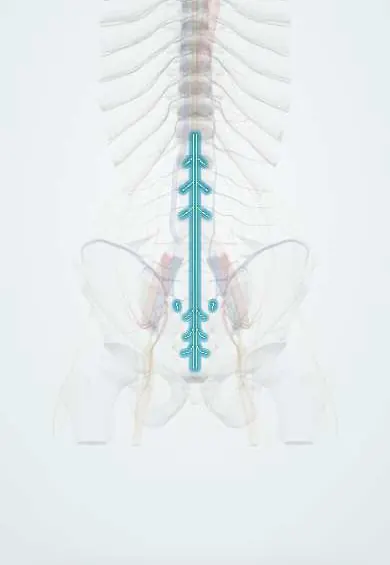
Cauda equina syndrome !
Cauda equina syndrome is compression of the nerve roots at the bottom of the spine; it causes numbness, bladder or bowel problems and is an emergency.
Updated 2026-10-29
Structures involved
Tap one to see what it is and open it in 3D.
- Cauda equina
- Conus medullaris
- Dura (dural sac)
- L4–L5 disc
- L5–S1 disc
- S1 nerve root
- Pudendal nerve
- Pelvic floor
- L5 vertebra
In the clinical exam
- Lasègue sign (straight leg raise) and Bragard sign
- Spinal cord syndromes: complete, Brown-Séquard, central, anterior
In physiology
Why it happens
- Upper versus lower motor neuron lesions
- Peripheral nerve: endoneurium, perineurium, epineurium; myelin
What it is
Compression of several lumbar and sacral nerve roots of the cauda equina, below the end of the spinal cord. It causes saddle anaesthesia, bladder, bowel and sexual dysfunction and leg weakness, and is a surgical emergency.
Who gets it
Rare, but one of the most important red flags in low back pain. It is most often seen in adults aged 30 to 50 with a large central lumbar disc herniation.
Causes
- Large central lumbar disc herniation, most often at L4–L5 or L5–S1 (the commonest cause)
- Lumbar spinal stenosis
- Spinal tumours and metastases
- Epidural abscess or haematoma
- Trauma, fractures, or complications of spinal surgery or procedures
Risk factors
- Known lumbar disc herniation or spinal stenosis
- Cancer with spread to bone
- Anticoagulation or recent spinal procedure (epidural haematoma)
- IV drug use, diabetes or immunosuppression (abscess)
Pathophysiology
Below the conus medullaris the canal holds only nerve roots. A mass in the canal compresses many roots at once, especially the sacral roots S2–S4 that supply the bladder, anal sphincter and perineal skin. The roots are lower motor neurones, so findings are flaccid weakness and reduced reflexes. Longer compression makes permanent damage more likely.
Classification
- Suspected: symptoms without objective deficit
- Incomplete: altered urinary sensation or difficulty voiding, with retained control
- With retention: painless urinary retention and overflow incontinence; worse outcome
- Conus medullaris syndrome: a related lesion of the end of the cord, with mixed signs
Symptoms and signs
- Saddle anaesthesia: numbness of the perineum, buttocks and inner thighs
- Urinary retention, difficulty starting the stream or overflow incontinence
- Faecal incontinence or loss of anal sensation
- Sexual dysfunction
- Low back pain with sciatica in one or both legs
- Leg weakness and reduced or absent ankle reflexes
Diagnosis
- Clinical
- High clinical suspicion. Examination includes saddle sensation, anal tone and the bulbocavernosus reflex, the neurological examination of the legs and a check for a palpable bladder.
- Tests
- Bladder ultrasound or catheter for post-void residual volume to detect retention. Blood tests if infection or cancer is suspected.
- Imaging
- Emergency MRI of the lumbosacral spine confirms compression and its cause; CT myelography if MRI is not available or contraindicated.
Differential diagnosis
- Conus medullaris syndrome
- Lumbar disc herniation without cauda equina involvement
- Urinary retention from other causes (prostate, drugs)
- Guillain–Barré syndrome
- Spinal cord compression or transverse myelitis
Goal of treatment
Decompress the nerve roots as early as possible to protect bladder, bowel, sexual and leg function, and treat the underlying cause.
Treatment
- Acute
- Urgent referral, emergency MRI and bladder catheterisation for retention.
- Surgical
- Emergency surgical decompression: discectomy, laminectomy or both, depending on the cause; earlier surgery is associated with better recovery.
- Medical
- Antibiotics for abscess; corticosteroids and radiotherapy are options for some tumour compressions; reversal of anticoagulation for haematoma.
- Rehabilitation
- Rehabilitation, bladder and bowel programmes and sexual health support after decompression.
Complications
- Permanent urinary or faecal incontinence
- Sexual dysfunction
- Chronic pain and persistent leg weakness
- Recurrent urinary tract infections
- Psychological distress and medicolegal disputes from delayed diagnosis
Prognosis
Patients decompressed before urinary retention develops usually recover better than those with established retention. Some bladder, bowel or sexual dysfunction can remain despite surgery.
Test yourself
Think of the answer, then tap the question to see it.
What is the most common cause of cauda equina syndrome?
A large central lumbar disc herniation, usually at L4–L5 or L5–S1.
What is saddle anaesthesia?
Loss of sensation over the perineum, buttocks and inner thighs (S2–S5), the area that would touch a saddle.
What is the investigation of choice in suspected cauda equina syndrome, and how urgent is it?
Emergency MRI of the lumbosacral spine, as soon as the diagnosis is suspected.
Why does cauda equina syndrome give lower motor neurone signs?
Because the cauda equina is made of nerve roots, not spinal cord: weakness is flaccid and reflexes are reduced.
Which bladder finding marks a worse prognosis in cauda equina syndrome?
Painless urinary retention with overflow incontinence, compared with incomplete loss of bladder sensation or control.
Related conditions
- Lumbar Disc Herniation
- Lumbar spinal stenosis
- Sciatica (Lumbar Radiculopathy)
- Spinal cord injury
- Mechanical low back pain
- Guillain-Barré syndrome
- Spondylolisthesis
- Spinal epidural abscess
Educational information, not medical advice. For any symptom, see a health professional.
Sources: Cauda Equina and Conus Medullaris Syndromes (StatPearls (NCBI Bookshelf), 2023).
Spotted a mistake?We are always improving for the community. Tell us what is wrong and our team will review it.Report a mistake
Representative model, for educational purposes only.