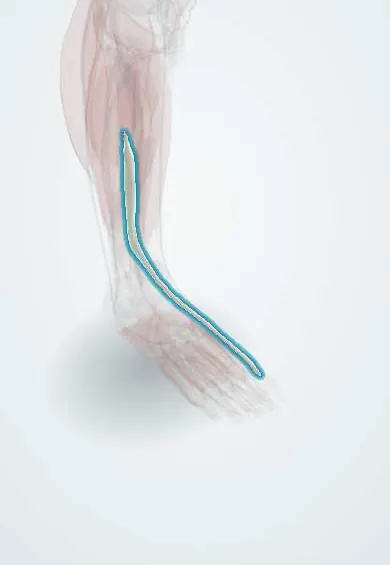
Extensor hallucis longus !
The extensor hallucis longus is a muscle at the front of the leg whose tendon runs to the big toe; it lifts the big toe.
Opens in the Durgical app, no sign-up needed.
What it is
A muscle on the front of the leg, between the tibialis anterior and the extensor digitorum longus. Its tendon runs to the big toe.
What it does
Lifts the big toe and helps lift the foot.
Key facts
- Origin
- Middle part of anterior surface of fibula; interosseous membrane
- Insertion
- Dorsal base of distal phalanx of big toe
- Action
- Extends big toe; dorsiflexes ankle
- Nerve
- Deep fibular nerve (L5–S1)
- Blood supply
- Anterior tibial artery
Relations
- Medial
- Tibialis anterior
- Lateral
- Extensor digitorum longus; on the dorsum of the foot, the dorsalis pedis artery and deep fibular nerve
- Deep
- Fibula and interosseous membrane, with the anterior tibial vessels and deep fibular nerve
- Course
- Its tendon runs under the superior and inferior extensor retinacula in its own sheath, crosses over the anterior tibial vessels and deep fibular nerve above the ankle and follows the first metatarsal to the distal phalanx of the big toe
How to find it
With the big toe lifted, the tendon stands out from the front of the ankle to the big toe, lateral to the tibialis anterior tendon. The dorsalis pedis pulse is felt just lateral to it over the middle of the dorsum.
Examination
- Resisted big-toe extension: weakness suggests L5 radiculopathy or a deep fibular nerve lesion; in a common fibular palsy it is weak together with the other dorsiflexors
- Passive flexion of the big toe is painful in anterior compartment syndrome
On imaging
Ultrasound is first line: the tendon lies in front of the ankle between tibialis anterior and the toe extensors, then runs along the dorsum to the big toe. A cut or rupture shows as a gap with retracted ends, which ultrasound locates before repair. MRI suits unclear cases; denervation oedema of the muscle belly supports a deep fibular nerve or L5 root lesion.
Clinical notes
- Lying just under the skin of the dorsum, its tendon is often cut by glass or falling sharp objects; the short extensor can still lift the toe at its base and mask the injury
- Anterior tarsal tunnel syndrome: the deep fibular nerve can be compressed under the inferior extensor retinaculum or where this tendon crosses it, causing numbness in the first web space
- Anterior compartment syndrome involves it with tibialis anterior and extensor digitorum longus
Anatomical variants
- Insertion: about two-thirds have a single tendon, about a quarter two tendons, and a few three slips
Development
It comes from the dorsal muscle mass of the limb bud, like all anterior and lateral leg muscles, which is why it is supplied by the fibular (dorsal division) nerve and not the tibial nerve.
Related conditions
Test yourself
Think of the answer, then tap the question to see it.
What are the origin, insertion and nerve supply of the extensor hallucis longus?
Middle anterior fibula and interosseous membrane, to the dorsal base of the big toe's distal phalanx; deep fibular nerve (L5–S1).
Which nerve root does resisted big-toe extension classically test?
L5; it is often weak with an L4–L5 disc herniation.
Where is the dorsalis pedis pulse felt in relation to the extensor hallucis longus tendon?
Just lateral to the tendon on the dorsum of the foot.
Why can a complete extensor hallucis longus laceration be missed?
The extensor hallucis brevis can still lift the toe at its base; only the long extensor lifts the tip (interphalangeal joint).
Educational information, not medical advice. For any symptom, see a health professional.
Its names
- Official Latin (TA2)
- extensor longus hallucis TA2 2650
- Official Spanish (DeCS)
- Músculo extensor largo del dedo gordo
- English (TA2)
- Extensor hallucis longus
- Also called
- extensor hallucis longus muscle
Related
- Extensor retinacula
- Extensor hallucis brevis
- Common fibular nerve
- Deep fibular nerve
- Anterior tibial artery
- Medial cuneiform
- Fibula
- First metatarsal
Sources: Terminologia Anatomica (TA2); Anatomy, Bony Pelvis and Lower Limb: Extensor Hallucis Longus Muscle.
Spotted a mistake?We are always improving for the community. Tell us what is wrong and our team will review it.Report a mistake
Representative model, for educational purposes only.