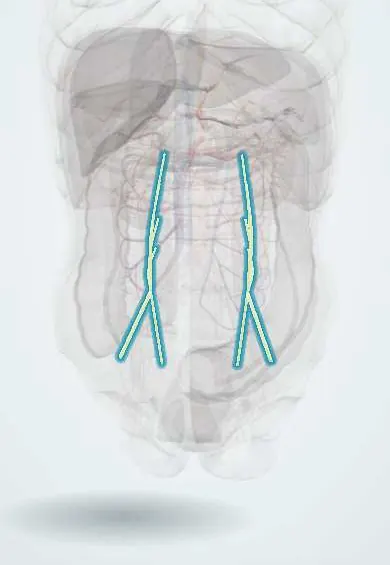
Lumbar plexus !
The lumbar plexus is a network of nerves from the lower spine, inside the psoas muscle; it supplies the lower belly wall, the groin and the front of the thigh.
Opens in the Durgical app, no sign-up needed.
What it is
A network of nerves (L1-L4) inside the psoas muscle.
What it does
Gives the nerves to the lower abdominal wall, groin and thigh. See the spine model for details.
Key facts
- Roots
- Ventral rami of L1–L4 (often a T12 contribution); forms within psoas major
- Moves
- Femoral nerve (L2–L4): iliacus, quadriceps; obturator nerve (L2–L4): thigh adductors; direct branches to psoas and quadratus lumborum
- Feeling from
- Iliohypogastric, ilioinguinal, genitofemoral, lateral femoral cutaneous (L2–L3), femoral and obturator: groin, anterior, lateral and medial thigh
Relations
- Course
- The ventral rami leave the intervertebral foramina and enter psoas major between its attachments to the vertebral bodies and transverse processes; the branches emerge from the muscle and cross quadratus lumborum and iliacus toward the inguinal ligament and obturator foramen
- In front
- The bulk of psoas major; in front of the muscle, the kidney, ureter and gonadal vessels
- Behind
- Lumbar transverse processes and quadratus lumborum
- Medial
- Lumbar vertebral bodies, with the lumbar sympathetic trunk along the medial edge of psoas major
- Below
- The lumbosacral trunk (L4–L5) descends over the ala of the sacrum, medial to psoas major, to join the sacral plexus
How to find it
It can't be felt. It lies in the back part of psoas major, in front of the lumbar transverse processes; for a block it is found from the back with ultrasound or nerve stimulation at about L3–L4, a few centimetres from the midline and deep to the transverse processes.
Examination
- Patellar reflex: reduced in femoral nerve or L3–L4 root lesions
- Knee extension and hip flexion strength: weak with a femoral nerve lesion; hip adduction weak with an obturator nerve lesion
- Cremasteric reflex: stroking the upper inner thigh lifts the testis on that side; lost with genitofemoral nerve or L1–L2 lesions
- Femoral nerve stretch test (prone, knee bent, hip extended): pain in the front of the thigh suggests irritation of the L2–L4 roots
- Skin map: iliohypogastric over the iliac crest and above the pubis; ilioinguinal to the upper inner thigh and front of the scrotum or labium; lateral femoral cutaneous to the outer thigh (meralgia paresthetica)
On imaging
Not seen on radiographs. It forms within psoas, so MRI is the best study: the roots and the femoral, obturator and lateral femoral cutaneous nerves can be traced in and around the muscle. CT or MRI shows what damages it, such as a psoas abscess or hematoma, a retroperitoneal tumor or enlarged nodes. Ultrasound guides blocks of the plexus at the lumbar level or of its branches in the groin.
Clinical notes
- The lateral transpsoas approach to the lumbar spine passes through the muscle and can injure the genitofemoral or femoral nerve, causing thigh numbness or weakness
- The iliohypogastric and ilioinguinal nerves can be cut or trapped in scar after lower abdominal incisions (appendectomy, Pfannenstiel), causing neuropathic groin pain
- Diabetic lumbosacral radiculoplexus neuropathy (diabetic amyotrophy): pain followed by wasting and weakness of the front of the thigh
- Retroperitoneal bleeding, tumours or enlarged nodes along the psoas can press on the plexus and present as groin or thigh pain
Anatomical variants
- Prefixed (more T12) or postfixed (more L5) plexus, shifting the root levels of its branches
- Accessory obturator nerve (L3–L4) in a minority of people (figures vary)
- The genitofemoral nerve may split into its two branches high, inside the muscle
Related conditions
Test yourself
Think of the answer, then tap the question to see it.
What are the roots of the lumbar plexus, and where does it form?
The ventral rami of L1–L4, often with a T12 contribution; it forms within psoas major.
Which lumbar plexus branches leave psoas major at its lateral, front and medial borders?
Lateral: iliohypogastric, ilioinguinal, lateral femoral cutaneous and femoral. Front: genitofemoral. Medial: obturator nerve and lumbosacral trunk.
Which muscles do the femoral and obturator nerves supply?
Femoral (L2–L4): iliacus and quadriceps. Obturator (L2–L4): the thigh adductors.
Which lumbar plexus nerve can a psoas abscess compress, and what is a classic cause?
The femoral nerve; spinal tuberculosis is a classic cause of psoas abscess.
What does loss of the cremasteric reflex suggest?
A lesion of the genitofemoral nerve or the L1–L2 roots; normally stroking the upper inner thigh lifts the testis on that side.
Educational information, not medical advice. For any symptom, see a health professional.
Its names
- Official Latin (TA2)
- plexus lumbalis TA2 6517
- Official Spanish (DeCS)
- Plexo lumbar DeCS D008160
- English (TA2)
- Lumbar plexus
Sources: Terminologia Anatomica (TA2); DeCS; Anatomy, Back, Lumbar Plexus.
Spotted a mistake?We are always improving for the community. Tell us what is wrong and our team will review it.Report a mistake
Representative model, for educational purposes only.