Conditions · Emergency medicine and toxicology
Coral snake envenomation (Micrurus) !
A coral snake bite injects a nerve poison that can slowly paralyse the eyelids, throat and breathing muscles, even when the bite looks minor.
Updated 2026-11-01
Structures involved
Tap one to see what it is and open it in 3D.
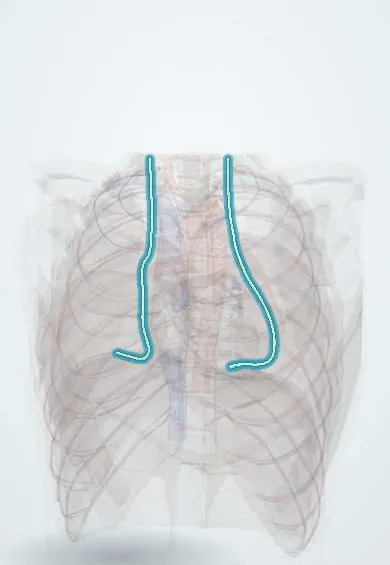
- Phrenic nerves
- Diaphragm
- Skin
- Intercostal nerves
- External intercostals
- Internal intercostals
- Trachea
- Main bronchi
- Tibialis anterior
- Levator palpebrae
- Oculomotor nerve (III)
- Pharynx
Why it happens
- The neuromuscular junction
- Hypoxemic and hypercapnic respiratory failure
- Neuromuscular junction: motor end plate and acetylcholine receptors
What it is
Envenomation by coral snakes (genus Micrurus, family Elapidae), called «accidente elapídico» in Colombia. The venom is mainly neurotoxic: it blocks transmission at the neuromuscular junction and causes a descending flaccid paralysis that can end in respiratory failure. Local signs are usually scant, so severity is easily underestimated.
Who gets it
Coral snake bites are a small fraction of snakebites in Colombia (most are by Bothrops), but they are notifiable to the national surveillance system (SIVIGILA) together with all snakebites. Several Micrurus species live across the Andean, Caribbean, Pacific, Orinoquía and Amazon regions. The Instituto Nacional de Salud produces a polyvalent anti-coral antivenom, and health institutions are urged to keep it available.
Causes
- Bite by a Micrurus species (red, black and yellow or white banded snakes; «coral», «rabo de ají»)
- Handling or trying to catch the snake (bites often on fingers and hands)
- Stepping on or reaching into leaf litter or soil where the snake hides
Risk factors
- Rural and agricultural work, especially in rainy seasons
- Handling snakes, including people who believe a snake is harmless because of its colours
- Children (more venom per kilogram of body weight)
- Delay in reaching a hospital with antivenom
Pathophysiology
Micrurus venom contains postsynaptic alpha-neurotoxins (three-finger toxins) that bind the nicotinic acetylcholine receptor of skeletal muscle, and in some species presynaptic phospholipase A2 toxins that damage the nerve terminal. Neuromuscular transmission fails, giving a descending flaccid paralysis: cranial nerve muscles first (ptosis, diplopia, dysphagia), then limbs, intercostal muscles and diaphragm. Onset can be delayed for hours, and once the toxin is bound, antivenom cannot reverse the established paralysis well.
Classification
- Possible envenomation: bite reported, no signs yet (observe, because onset may be delayed)
- Envenomation with local or cranial nerve signs only (ptosis, diplopia, paraesthesia)
- Severe envenomation: dysphagia, sialorrhoea, limb weakness or respiratory muscle weakness
Symptoms and signs
- Little pain, swelling or mark at the bite site; local paraesthesia
- Drooping eyelids (ptosis) and double vision
- Difficulty swallowing and speaking, drooling
- Generalised muscle weakness and myalgia
- Nausea and vomiting
Diagnosis
- Clinical
- Diagnosis is clinical: history of a bite, ideally with the snake or a photo identified, plus neurological signs. Because effects may appear hours later, every suspected coral bite is admitted and observed closely even without symptoms. Serial assessment of eyelids, swallowing, limb strength and respiratory effort guides care. There is no coagulopathy, which helps separate it from Bothrops envenomation.
- Tests
- Respiratory monitoring with pulse oximetry, arterial blood gases and bedside measures of respiratory muscle strength (vital capacity, negative inspiratory force where available). Blood count, renal function and creatine kinase as baseline; coagulation tests are expected to be normal.
- Imaging
- Not needed for diagnosis; chest X-ray if aspiration or pneumonia is suspected.
Differential diagnosis
- Bothrops (pit viper) envenomation, which causes local swelling, bleeding and coagulopathy
- Bite by a non-venomous mimic snake
- Myasthenia gravis crisis
- Botulism
- Guillain–Barré syndrome
- Organophosphate poisoning
Goal of treatment
Give antivenom early, before paralysis is established, and support breathing until neuromuscular function recovers.
Treatment
- Acute
- First aid: keep the person calm and still, remove rings and tight clothing, immobilise the limb and transfer quickly. No tourniquets, cutting, suction or traditional remedies.
- Medical
- Specific polyvalent anti-coral (anti-elapid) antivenom as early as possible in any confirmed or strongly suspected bite, given in a setting prepared to treat anaphylaxis. Tetanus prophylaxis and analgesia.
- Procedure
- Early airway protection and mechanical ventilation when respiratory muscle weakness appears; ventilation may be needed for days until recovery.
- Medical
- Acetylcholinesterase inhibitors (neostigmine with atropine pretreatment) may be tried for postsynaptic paralysis as an adjunct, never as a substitute for antivenom.
- Follow-up
- Nursing priorities: frequent neurological and respiratory checks (ptosis, swallowing, speech, breathing pattern, saturation), suction and aspiration precautions, watch for antivenom reactions, and mandatory notification to SIVIGILA.
Complications
- Respiratory failure from diaphragm and intercostal paralysis
- Aspiration pneumonia
- Anaphylactic or delayed (serum sickness) reactions to antivenom
- Complications of prolonged ventilation
- Death when ventilatory support is not available
Prognosis
With timely antivenom and ventilatory support, most patients recover fully because the paralysis is reversible over days. Deaths are mainly due to delayed care and lack of ventilation.
Prevention
- Do not handle snakes, even brightly coloured ones
- Wear boots and gloves in fields and when moving leaves or wood
- Health institutions in endemic areas should stock anti-coral antivenom
Test yourself
Think of the answer, then tap the question to see it.
What type of paralysis does Micrurus venom cause?
A descending flaccid paralysis from neuromuscular blockade, starting with ptosis and bulbar signs and potentially reaching the respiratory muscles.
Why is an asymptomatic patient with a suspected coral bite still admitted?
Neurotoxic signs can appear hours after the bite with very few local findings, and antivenom works best before paralysis is established.
Which laboratory feature helps distinguish coral from Bothrops envenomation?
Coral envenomation does not cause coagulopathy; Bothrops venom typically prolongs clotting times and causes bleeding and marked local swelling.
What is the main cause of death in coral snake envenomation?
Respiratory failure from paralysis of the diaphragm and intercostal muscles, particularly without timely ventilatory support.
Related conditions
- Snakebite envenomation (Bothrops, Lachesis, Crotalus)
- Acute respiratory failure (hypoxaemic and hypercapnic)
- Myasthenia gravis
- Botulism
- Guillain-Barré syndrome
- Organophosphate and carbamate poisoning
- Aspiration pneumonia and pneumonitis
- Anaphylaxis
- Scorpion envenomation (Tityus)
- Spider bites (loxoscelism and latrodectism)
Educational information, not medical advice. For any symptom, see a health professional.
Sources: Snakebite envenoming (World Health Organization, 2026); Instituciones de salud deben asegurar disponibilidad de antivenenos (Instituto Nacional de Salud (Colombia), 2026); Guía para el manejo de emergencias toxicológicas (Ministerio de Salud y Protección Social (Colombia) / OPS, 2017).
Spotted a mistake?We are always improving for the community. Tell us what is wrong and our team will review it.Report a mistake
Representative model, for educational purposes only.