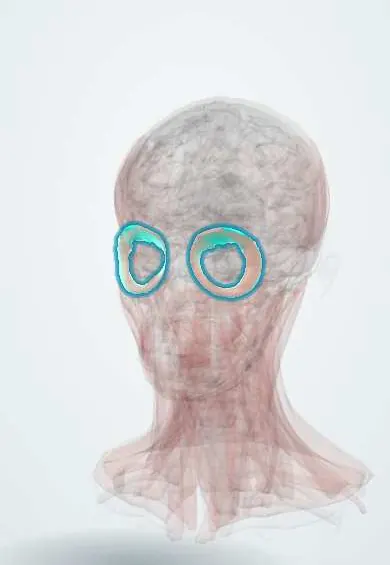
Facioscapulohumeral muscular dystrophy (FSHD) !
An inherited muscle disease that slowly weakens the face, the muscles that hold the shoulder blades and the upper arms, often on one side more.
Updated 2026-11-01
Structures involved
Tap one to see what it is and open it in 3D.
- Orbicularis oculi
- Serratus anterior
- Orbicularis oris
- Zygomaticus major
- Scapula
- Pectoralis major
- Lower trapezius
- Biceps (long head)
- Triceps (long head)
- Tibialis anterior
Why it happens
- Mendelian inheritance: autosomal dominant, recessive and X-linked
- Epigenetics: DNA and histone methylation
- Skeletal muscle: sarcomere and contraction
What it is
A common adult muscular dystrophy caused by inappropriate expression of the DUX4 gene in skeletal muscle. Weakness typically starts in the face, the scapular stabilisers and the upper arms, is often asymmetric, and may later spread to the abdominal muscles, ankle dorsiflexors and hip girdle. Most patients remain ambulant.
Who gets it
About 1 in 20,000 people (some studies report higher figures), making it one of the three most common muscular dystrophies with Duchenne and myotonic dystrophy. Symptoms usually start in adolescence or early adulthood; men tend to be more severely affected. It occurs in all populations, including Latin America, though local registries are limited.
Causes
- FSHD1 (about 95%): contraction of the D4Z4 repeat array on chromosome 4q35 to 1 to 10 units, autosomal dominant; about 10 to 30% are new mutations
- FSHD2 (about 5%): loss of D4Z4 methylation, usually from SMCHD1 variants, with digenic inheritance
- Both require a permissive 4qA allele carrying a polyadenylation signal that stabilises DUX4 transcripts
Risk factors
- Affected parent (50% transmission risk in FSHD1)
- Shorter D4Z4 residual size (more severe, earlier disease)
- Male sex (on average more severe)
- Somatic mosaicism in an apparently healthy parent
Pathophysiology
D4Z4 repeats normally keep the DUX4 gene silenced through dense chromatin and methylation. When the array is shortened or poorly methylated and lies on a permissive allele, DUX4, an embryonic transcription factor, is switched on in muscle. DUX4 activates genes that are toxic to adult muscle, leading to oxidative stress, inflammation, cell death and replacement of muscle by fat. Expression is sporadic, which helps explain the patchy and asymmetric pattern of weakness.
Classification
- FSHD1: D4Z4 contraction (most cases)
- FSHD2: SMCHD1-related hypomethylation
- Infantile-onset FSHD: severe, with facial diplegia, hearing loss and retinal vasculopathy
Symptoms and signs
- Facial weakness: inability to whistle, drink through a straw or bury the eyelashes; sleeping with eyes partly open; a transverse smile
- Scapular winging and difficulty raising the arms above shoulder level, with high-riding scapulae
- Wasting of the biceps and triceps with relatively preserved deltoids ("Popeye arms")
- Asymmetric weakness, which is characteristic
- Lower abdominal weakness with a positive Beevor sign and lumbar hyperlordosis
- Foot drop from tibialis anterior weakness; later, hip-girdle weakness
- Pain and fatigue; subclinical high-tone hearing loss and retinal telangiectasia in some
Diagnosis
- Clinical
- Suspected in a patient with facial weakness plus scapular winging and upper-arm weakness, often asymmetric, with a dominant family history. Classic examination signs: winging on arm elevation or pushing against a wall, transverse smile, incomplete eye closure, Beevor sign.
- Tests
- Genetic testing is the key test: sizing of the D4Z4 repeat on 4q35 (and the permissive allele) for FSHD1; methylation analysis and SMCHD1 testing for FSHD2. Creatine kinase is normal or mildly raised. Electromyography shows a myopathic pattern. Muscle biopsy is rarely needed. Baseline hearing test, dilated eye examination, pulmonary function tests and an ECG.
- Imaging
- Muscle MRI shows an asymmetric, patchy pattern of fatty replacement and oedema (e.g. hamstrings, trapezius, abdominal wall) and can guide biopsy.
Differential diagnosis
- Limb-girdle muscular dystrophies
- Inflammatory myopathies, including inclusion body myositis
- Myasthenia gravis
- Mitochondrial and congenital myopathies
- Isolated winged scapula from long thoracic nerve injury
- Scapuloperoneal syndromes and Pompe disease
Goal of treatment
No cure yet; care aims to keep function and independence, relieve pain and fatigue, protect the eyes, and detect respiratory, visual and hearing complications early.
Treatment
- Rehabilitation
- Aerobic and moderate strength exercise, physiotherapy and occupational therapy; ankle-foot orthoses for foot drop and mobility aids when needed.
- Surgical
- Scapulothoracic fixation (scapulopexy) in selected patients with good deltoid strength to improve arm elevation.
- Conservative
- Eye protection for incomplete eye closure (lubricants, night taping), pain management and genetic counselling for the family.
- Procedure
- Non-invasive ventilation when respiratory muscle weakness causes nocturnal hypoventilation.
- Follow-up
- Periodic pulmonary function tests, eye examinations in early-onset cases, hearing screening in children and functional scales.
Complications
- Shoulder pain and loss of arm function
- Falls from foot drop
- Exposure keratitis from incomplete eye closure
- Respiratory insufficiency in severe cases
- Hearing loss and retinal vasculopathy in early-onset disease
- Wheelchair dependence in about 20%
Prognosis
Slowly progressive, often with long stable periods. Life expectancy is usually normal. About one in five patients eventually needs a wheelchair; early onset and very short D4Z4 arrays predict a more severe course.
Test yourself
Think of the answer, then tap the question to see it.
Which gene is inappropriately expressed in FSHD?
DUX4, after contraction (FSHD1) or hypomethylation (FSHD2) of the D4Z4 repeat on chromosome 4q35.
What is the typical distribution of weakness in FSHD?
Face, scapular stabilisers (scapular winging) and upper arms, often asymmetric.
Which abdominal sign is commonly seen in FSHD?
Beevor sign: the umbilicus moves upward on flexing the neck because the lower abdominal muscles are weak.
Which extramuscular findings should be screened in early-onset FSHD?
High-tone hearing loss and retinal vasculopathy.
Related conditions
- Winged scapula
- Myotonic dystrophy (types 1 and 2)
- Duchenne muscular dystrophy
- Inflammatory myopathies (dermatomyositis, polymyositis)
- Myasthenia gravis
- Bell palsy
Educational information, not medical advice. For any symptom, see a health professional.
Sources: Facioscapulohumeral muscular dystrophy: MedlinePlus Genetics (MedlinePlus (U.S. National Library of Medicine), 2026).
Spotted a mistake?We are always improving for the community. Tell us what is wrong and our team will review it.Report a mistake
Representative model, for educational purposes only.