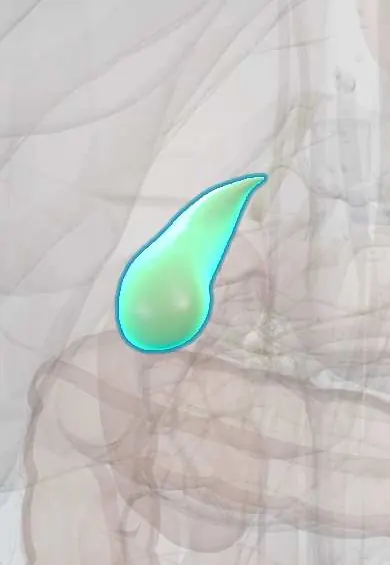
Gallstones (cholelithiasis) !
Gallstones (cholelithiasis) are hard stones that form in the gallbladder; most cause no symptoms, but some cause biliary colic or complications.
Updated 2026-10-29
Structures involved
Tap one to see what it is and open it in 3D.
- Gallbladder
- Cystic duct
- Common bile duct
- Liver
- Common hepatic duct
- Ampulla of Vater
- Pancreatic duct
- Duodenum
In biochemistry
- Heme breakdown and bilirubin: Step 6 · Urobilinogen oxidation (colonic bacteria and kidney)
- Classic bile acid synthesis pathway: Step 1 · Cholesterol 7α-hydroxylase (CYP7A1)
- Cholesterol 7α-hydroxylase (CYP7A1)
- Cholesterol
- Cholic acid
- Bile acid synthesis
- Bilirubin
In histology
In the clinical exam
In physiology
Why it happens
What it is
Stones (calculi) in the gallbladder, formed from cholesterol, bilirubin pigment or both. Most people have no symptoms; some develop biliary colic or complications.
Who gets it
Very common worldwide and especially frequent in Latin America, including Colombia, where Amerindian ancestry is linked to a higher risk. More common in women and with age.
Causes
- Bile supersaturated with cholesterol (cholesterol stones, the most common)
- Excess unconjugated bilirubin from haemolysis or cirrhosis (black pigment stones)
- Bile infection and stasis (brown pigment stones, often in the bile ducts)
- Gallbladder hypomotility (pregnancy, fasting, parenteral nutrition)
Risk factors
- The classic «4 F's», described neutrally: female sex, forty or older, fertile (pregnancy, oestrogens), and fat (obesity)
- Rapid weight loss, including after bariatric surgery
- Family history and ethnicity (high risk in Indigenous and Hispanic populations)
- Haemolytic diseases, cirrhosis, Crohn disease or ileal resection
- Diabetes, metabolic syndrome and some drugs (for example oestrogens, fibrates)
Pathophysiology
Stones form when bile holds more cholesterol than bile salts and lecithin can dissolve, when crystals nucleate, and when the gallbladder empties poorly. A stone that temporarily blocks the cystic duct causes biliary colic; persistent blockage causes cholecystitis, and stones that pass into the common bile duct cause obstruction, cholangitis or pancreatitis.
Classification
- Asymptomatic gallstones
- Symptomatic: biliary colic
- Complicated: acute cholecystitis, choledocholithiasis, cholangitis, gallstone pancreatitis, gallstone ileus
- By composition: cholesterol, black pigment, brown pigment, mixed
Symptoms and signs
- Often none (found by chance on ultrasound)
- Biliary colic: steady right upper quadrant or epigastric pain, usually after meals, lasting from about 30 minutes to a few hours, then easing
- Pain radiating to the right shoulder blade
- Nausea and vomiting during attacks
- No fever and a soft abdomen between attacks
Diagnosis
- Clinical
- A typical history of postprandial biliary-type pain. Uncomplicated colic causes no fever and no persistent tenderness.
- Tests
- Usually normal in simple colic. Blood count, liver tests, bilirubin and lipase look for complications.
- Imaging
- Ultrasound is the test of choice: mobile echogenic stones with acoustic shadowing. Endoscopic ultrasound can find small stones (microlithiasis) when ultrasound is normal.
Differential diagnosis
- Peptic ulcer disease or functional dyspepsia
- Gastro-oesophageal reflux disease
- Acute pancreatitis
- Irritable bowel syndrome
- Renal colic
- Angina or inferior myocardial infarction
Goal of treatment
Relieve attacks and prevent complications; silent stones are usually left alone.
Treatment
- Follow-up
- Asymptomatic stones are generally observed; preventive cholecystectomy is reserved for special cases (for example a porcelain gallbladder or very large stones), and criteria vary.
- Medical
- Biliary colic is treated with analgesia, often non-steroidal anti-inflammatory drugs; oral bile acids can dissolve small cholesterol stones in selected patients who cannot have surgery.
- Surgical
- Elective laparoscopic cholecystectomy is the definitive treatment for symptomatic gallstones.
- Lifestyle
- Healthy weight and avoiding very rapid weight loss; smaller, lower-fat meals may reduce attacks.
Drugs for this condition
Complications
- Acute cholecystitis
- Choledocholithiasis and obstructive jaundice
- Acute cholangitis
- Gallstone pancreatitis
- Gallstone ileus
- Mirizzi syndrome; long-standing stones are associated with gallbladder cancer
Prognosis
Most people with silent stones never develop symptoms. Once colic appears, attacks tend to recur and the yearly risk of complications rises; cholecystectomy is curative for gallbladder stones.
Prevention
- Healthy weight and regular physical activity
- Gradual rather than very rapid weight loss
- In selected patients after bariatric surgery, clinicians may use oral bile acids to prevent stones
Test yourself
Think of the answer, then tap the question to see it.
What are the classic «4 F's» risk factors for gallstones?
Female sex, forty or older, fertile (pregnancy or oestrogens) and fat (obesity). Ethnicity and rapid weight loss also matter.
How is biliary colic different from acute cholecystitis?
Colic is pain that eases within a few hours, without fever or persistent tenderness; cholecystitis is longer pain with fever, Murphy sign and inflammation.
What is the most common type of gallstone?
Cholesterol stones.
What is the imaging test of choice for gallstones?
Abdominal ultrasound, which shows echogenic stones with posterior acoustic shadowing.
What causes black pigment stones?
Excess unconjugated bilirubin, as in chronic haemolysis (for example sickle cell disease) or cirrhosis.
Related conditions
- Acute cholecystitis
- Choledocholithiasis
- Acute cholangitis
- Acute pancreatitis
- Gastro-oesophageal reflux disease (GERD)
- Peptic ulcer disease
- Irritable bowel syndrome
- Chronic pancreatitis
Educational information, not medical advice. For any symptom, see a health professional.
Sources: Gallstones (Cholelithiasis) (StatPearls (NCBI Bookshelf), 2026).
Spotted a mistake?We are always improving for the community. Tell us what is wrong and our team will review it.Report a mistake
Representative model, for educational purposes only.