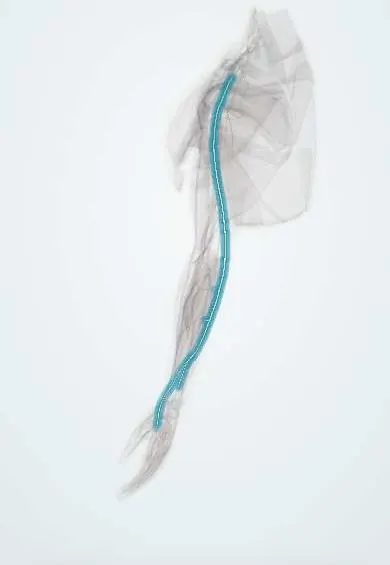
Cubital tunnel syndrome (ulnar neuropathy at the elbow) !
Cubital tunnel syndrome is pressure on the ulnar nerve at the inner elbow; it causes numbness in the ring and little fingers and weak hand muscles.
Updated 2026-10-29
Structures involved
Tap one to see what it is and open it in 3D.
- Ulnar nerve
- Flexor carpi ulnaris
- Humerus
- UCL (elbow)
- Adductor pollicis
- Dorsal interossei
- Ulnar nerve in the hand
- Lumbricals
In histology
Why it happens
What it is
Compression or irritation of the ulnar nerve at the elbow, behind the medial epicondyle and under the two heads of flexor carpi ulnaris. It is the second most common entrapment neuropathy of the upper limb.
Who gets it
Second only to carpal tunnel syndrome among upper limb nerve entrapments. Seen in manual workers, people who lean on their elbows or keep them bent for long periods, and after elbow trauma.
Causes
- Prolonged elbow flexion (sleeping with bent elbows, phone use) which stretches and compresses the nerve
- Direct pressure from leaning on the elbow
- Nerve subluxation over the medial epicondyle
- Elbow arthritis, bone spurs, old fractures (tardy ulnar palsy) or ganglia
Risk factors
- Repetitive or sustained elbow flexion at work
- Previous elbow fracture or dislocation
- Diabetes mellitus
- Elbow osteoarthritis or rheumatoid arthritis
- Throwing sports
Pathophysiology
Bending the elbow lengthens the nerve and narrows the cubital tunnel, raising pressure on the nerve. Repeated compression and traction impair its blood flow, causing demyelination and later axonal loss. The ulnar nerve supplies most intrinsic hand muscles, so weakness affects pinch and fine finger movements.
Classification
- Mild: intermittent tingling
- Moderate: constant numbness or measurable weakness
- Severe: intrinsic muscle wasting and clawing (McGowan and other grading systems are used)
Symptoms and signs
- Numbness and tingling in the little finger and the ulnar half of the ring finger
- Symptoms worse with the elbow bent, often at night
- Medial elbow ache
- Weak grip and pinch, clumsiness with fine tasks
- Wasting of the first dorsal interosseous and claw deformity of the ring and little fingers in advanced cases
Diagnosis
- Clinical
- Tinel sign over the cubital tunnel and the elbow flexion test. Froment sign: thumb IP flexion when gripping paper, as the weak adductor pollicis is replaced by flexor pollicis longus. Wartenberg sign: little finger drifts into abduction. Numbness on the dorsal ulnar hand points to a lesion above the wrist.
- Tests
- Nerve conduction studies and electromyography locate the lesion at the elbow and grade severity; glucose testing can look for diabetes.
- Imaging
- Elbow X-ray for arthritis, spurs or old fractures. Ultrasound can show a swollen or subluxing nerve; MRI for masses.
Differential diagnosis
- Ulnar nerve compression at the wrist (Guyon canal)
- C8–T1 cervical radiculopathy
- Thoracic outlet syndrome (neurogenic)
- Medial epicondylitis
- Motor neuron disease or peripheral polyneuropathy
Goal of treatment
Take pressure off the ulnar nerve, relieve symptoms and prevent permanent loss of hand strength and sensation.
Treatment
- Conservative
- Avoiding prolonged elbow flexion and leaning on the elbow; a night splint or padded wrap that keeps the elbow fairly straight.
- Medical
- Analgesics or NSAIDs for symptom relief; evidence for injections here is limited.
- Surgical
- Surgical decompression (in situ release) or anterior transposition of the nerve for failed conservative care, constant numbness or weakness; medial epicondylectomy is an alternative.
- Rehabilitation
- Hand therapy and nerve gliding exercises.
Complications
- Permanent numbness
- Intrinsic muscle wasting, weak pinch and claw hand
- Persistent or recurrent symptoms after surgery
- Injury to the medial antebrachial cutaneous nerve during surgery
Prognosis
Mild cases often improve with activity changes and splinting. After surgery sensory symptoms usually improve, but recovery of muscle wasting is slow and often incomplete.
Prevention
- Avoiding sustained elbow flexion and direct pressure on the elbow
- Ergonomic workstation set-up
Test yourself
Think of the answer, then tap the question to see it.
What is Froment sign and which muscle weakness does it show?
Flexion of the thumb IP joint when pinching paper; it shows weakness of adductor pollicis (ulnar nerve), with flexor pollicis longus compensating.
What is Wartenberg sign?
Persistent abduction of the little finger due to weakness of the third palmar interosseous, innervated by the ulnar nerve.
Why is ulnar claw hand worse in a distal ulnar lesion than in a proximal one (ulnar paradox)?
A proximal lesion also weakens the ulnar half of flexor digitorum profundus, so the fingers flex less and the claw looks milder.
Which elbow position worsens cubital tunnel syndrome?
Sustained elbow flexion, which stretches the ulnar nerve and narrows the cubital tunnel.
Related conditions
- Carpal tunnel syndrome
- Medial epicondylitis (golfer's elbow)
- Cervical radiculopathy
- Thoracic outlet syndrome
- Elbow dislocation
- Type 2 diabetes mellitus
Educational information, not medical advice. For any symptom, see a health professional.
Sources: Ulnar Neuropathy (StatPearls (NCBI Bookshelf), 2025).
Spotted a mistake?We are always improving for the community. Tell us what is wrong and our team will review it.Report a mistake
Representative model, for educational purposes only.