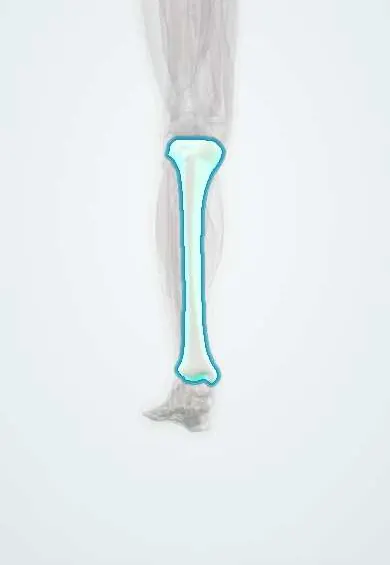
Tibial shaft fracture !
A tibial shaft fracture is a break in the middle of the shin bone, often with the fibula; it is the most common long-bone fracture and is often open.
Updated 2026-10-29
Structures involved
Tap one to see what it is and open it in 3D.
- Tibia
- Fibula
- Interosseous membrane
- Crural fascia
- Tibialis anterior
- Anterior tibial artery
- Posterior tibial artery
- Deep fibular nerve
- Common fibular nerve
In the clinical exam
What it is
A fracture of the middle part (diaphysis) of the tibia, often with a fibular fracture. It is the most common long-bone fracture and frequently open.
Who gets it
Frequent after road traffic accidents, notably motorcycle crashes common in Colombia, and after sport and falls. Young men are most affected.
Causes
- High-energy trauma: motorcycle and car crashes, pedestrians hit by vehicles
- Twisting injuries in sport (spiral fractures)
- Falls from height
- Stress or pathological fractures (less common)
Risk factors
- Motorcycle use and road traffic exposure
- Contact sport
- Osteoporosis
- Smoking and diabetes (slower healing, more infection)
Pathophysiology
The front-inner surface of the tibia lies just under the skin, so fractures easily break through it (open fractures). Its blood supply in the lower third is limited, which slows healing. The leg's tight fascial compartments make swelling dangerous.
Classification
- Open or closed
- Gustilo-Anderson grade for open fractures (I, II, IIIA–C)
- Tscherne grade for soft-tissue injury in closed fractures
- Fracture pattern: transverse, oblique, spiral, comminuted (AO/OTA 42)
Symptoms and signs
- Severe leg pain after injury
- Inability to bear weight
- Deformity, swelling and crepitus
- Wound with exposed bone in open fractures
Diagnosis
- Clinical
- Inspect the skin for wounds, check pulses, nerves and compartments repeatedly, and assess the knee and ankle. Trauma survey (ATLS) in high-energy injury.
- Tests
- Pre-operative bloods; creatine kinase and potassium if compartment syndrome or crush injury is suspected.
- Imaging
- Full-length tibia and fibula X-rays in two views including knee and ankle. CT if the fracture extends into a joint; angiography if vascular injury is suspected.
Differential diagnosis
- Tibial plateau fracture
- Pilon (distal tibia) fracture
- Isolated fibular fracture
- Severe calf contusion
- Stress fracture
Goal of treatment
Achieve union with correct length, alignment and rotation, prevent infection and compartment syndrome, and return the patient to walking.
Treatment
- Acute
- Open fractures: early intravenous antibiotics, tetanus prophylaxis, wound cover, then urgent debridement and stabilisation.
- Conservative
- Stable, well-aligned closed fractures may be treated in a long-leg cast followed by a functional brace.
- Surgical
- Most displaced fractures are fixed with an intramedullary nail; plates or external fixators are used in selected cases (e.g. severe soft-tissue damage).
- Rehabilitation
- Physiotherapy and progressive weight bearing; soft-tissue reconstruction may be needed for open fractures.
Complications
- Acute compartment syndrome
- Infection and osteomyelitis, especially in open fractures
- Delayed union, non-union or malunion
- Anterior knee pain after nailing
- Deep vein thrombosis
- Nerve or artery injury
Prognosis
Most closed fractures heal within months. Open, high-grade fractures heal more slowly and carry higher risks of infection, non-union and, rarely, amputation.
Prevention
- Road safety: helmet and protective gear for motorcycle riders, speed control
Test yourself
Think of the answer, then tap the question to see it.
Why are tibial shaft fractures so often open?
The anteromedial surface of the tibia is covered only by skin and subcutaneous tissue, with no muscle in between.
Which classification grades open fractures?
The Gustilo-Anderson classification (types I, II, IIIA, IIIB, IIIC), based on wound size, contamination, soft tissue and vascular injury.
Which complication must be monitored for after every tibial shaft fracture?
Acute compartment syndrome; the tibia is its most common fracture cause.
What is the usual surgical fixation for a displaced tibial shaft fracture?
Intramedullary nailing.
Related conditions
- Acute compartment syndrome
- Osteomyelitis
- Deep vein thrombosis
- Tibial Plateau Fracture
- Medial tibial stress syndrome (shin splints)
Educational information, not medical advice. For any symptom, see a health professional.
Sources: Tibia Diaphyseal Fracture (StatPearls (NCBI Bookshelf), 2025).
Spotted a mistake?We are always improving for the community. Tell us what is wrong and our team will review it.Report a mistake
Representative model, for educational purposes only.