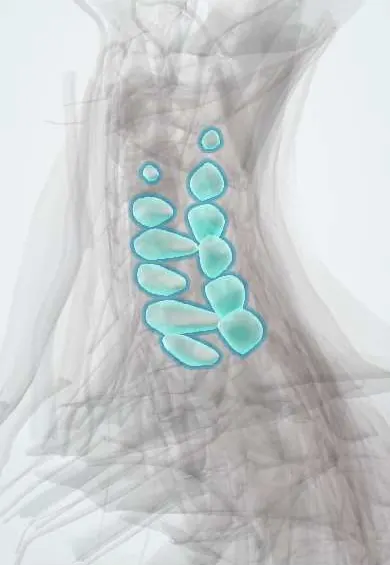
Whiplash (cervical sprain) !
Whiplash is a neck sprain from a sudden jolt of the head, most often in a rear-end car crash; it causes neck pain, stiffness and headache.
Updated 2026-10-29
Structures involved
Tap one to see what it is and open it in 3D.
- Neck facet joints
- Nuchal ligament
- Sternocleidomastoid
- Splenius
- C5 vertebra
- C6 vertebra
- Longus colli
- Trapezius
- Semispinalis
- Suboccipital muscles
What it is
Soft-tissue injury of the neck from sudden acceleration and deceleration, most often in a rear-end car crash. Its range of symptoms is called whiplash-associated disorder.
Who gets it
Very common after road traffic crashes, a leading cause of injury in Colombia and Latin America. Most patients are young or middle-aged adults; women report it more often.
Causes
- Rear-end vehicle collision (the classic mechanism)
- Side or front collisions
- Contact sports, falls and diving
Risk factors
- Female sex
- Head turned at the moment of impact or unprepared for the impact
- Previous neck pain or injury
- High initial pain and disability, psychological distress or catastrophising (predict slow recovery)
Pathophysiology
On impact the lower neck extends while the upper neck flexes, forming an S-shaped curve before the whole neck extends. This strains the facet joint capsules, ligaments, discs and muscles. Most injuries are soft-tissue sprains and strains; altered pain processing contributes to persistent symptoms.
Classification
- Quebec Task Force grade 0: no neck complaints or signs
- Grade I: neck pain, stiffness or tenderness only, with no physical signs
- Grade II: neck complaints plus musculoskeletal signs (reduced range of motion, point tenderness)
- Grade III: neck complaints plus neurological signs (reduced reflexes, weakness, sensory loss)
- Grade IV: neck complaints with fracture or dislocation
Symptoms and signs
- Neck pain and stiffness, often starting hours after the crash
- Headache, usually at the base of the skull
- Pain in the shoulders and between the shoulder blades
- Dizziness, tinnitus, poor concentration or sleep problems
- Arm tingling or numbness in some patients
Diagnosis
- Clinical
- History of the mechanism and a focused exam of range of motion, tenderness and neurology to assign a Quebec grade. Validated decision rules (Canadian C-spine rule, NEXUS) decide who needs imaging.
- Imaging
- No imaging for low-risk grade I–II patients who meet the decision rules. CT is the first study when fracture is suspected; MRI if there are neurological signs or suspected ligament or cord injury.
Differential diagnosis
- Cervical spine fracture or dislocation
- Cervical radiculopathy
- Vertebral or carotid artery dissection
- Concussion
- Muscle strain without a crash mechanism
Goal of treatment
Rule out serious injury, relieve pain, keep the patient active and prevent the move to chronic pain and disability.
Treatment
- Acute
- Spine precautions and immobilisation in the emergency setting until the decision rules or imaging clear the neck.
- Conservative
- Reassurance and education about the usually good outcome; early return to normal activity. Prolonged soft collar use is discouraged.
- Medical
- Simple analgesics and NSAIDs for a short period; muscle relaxants are sometimes used.
- Rehabilitation
- Guided exercise and physiotherapy for range of motion, strength and posture, with attention to psychological factors when recovery is slow.
Complications
- Chronic neck pain (chronic whiplash-associated disorder)
- Chronic headache
- Anxiety, depression or post-traumatic stress
- Work loss and medico-legal disputes
Prognosis
Most patients improve within weeks to a few months, but a significant minority keep symptoms long term; reported proportions vary. High early pain, disability and distress predict a slower recovery.
Prevention
- Head restraints adjusted to the height of the head
- Seat belt use and road safety measures
Test yourself
Think of the answer, then tap the question to see it.
What is the classic mechanism of whiplash injury?
Sudden acceleration-deceleration of the neck, typically in a rear-end car collision.
What defines Quebec Task Force grade II whiplash?
Neck complaints plus musculoskeletal signs, such as reduced range of motion and point tenderness, without neurological signs.
What distinguishes Quebec grade III from grade IV?
Grade III has neurological signs; grade IV has a fracture or dislocation.
Which decision rules help decide who needs cervical spine imaging after trauma?
The Canadian C-spine rule and the NEXUS criteria.
Is prolonged use of a soft collar recommended after whiplash?
No. Staying active and early return to normal activity are favoured; prolonged immobilisation may slow recovery.
Related conditions
Educational information, not medical advice. For any symptom, see a health professional.
Sources: Cervical Sprain (StatPearls (NCBI Bookshelf), 2026).
Spotted a mistake?We are always improving for the community. Tell us what is wrong and our team will review it.Report a mistake
Representative model, for educational purposes only.