Varicose veins !
Varicose veins are swollen, twisted surface veins of the leg, caused by weak valves that let blood flow backward and pool.
Updated 2026-10-29
Structures involved
Tap one to see what it is and open it in 3D.
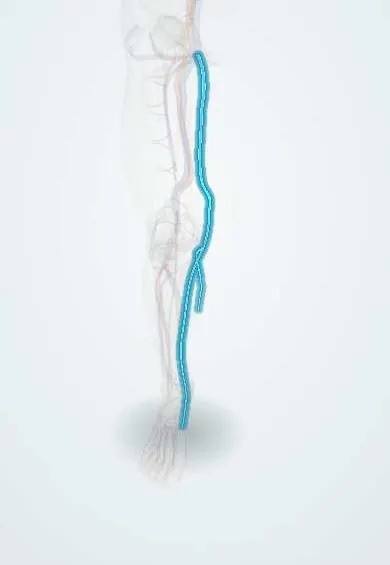
- Great saphenous vein
- Small saphenous vein
- Perforating veins
- Leg veins
- Femoral vein
- Popliteal vein
- Saphenous nerve
- Sural nerves
In histology
In the clinical exam
In physiology
Why it happens
What it is
Dilated, twisted superficial leg veins, usually of the great or small saphenous system, caused by failure of the venous valves and reflux of blood.
Who gets it
Very common in adults, more often in women and with age. A frequent reason for consultation in Latin America, especially in people who stand for long periods at work.
Causes
- Primary weakness of the vein wall and valves
- Secondary to previous deep vein thrombosis
- Rarely congenital venous malformations
Risk factors
- Family history
- Female sex and pregnancy
- Older age
- Long periods of standing
- Obesity
- Previous deep vein thrombosis
Pathophysiology
Leaky valves at the saphenofemoral or saphenopopliteal junction, or in perforating veins, let blood flow backwards. Pressure in the superficial veins rises, so they stretch and become tortuous. Long-standing venous hypertension damages the skin, leading to oedema, pigmentation and ulcers.
Classification
- CEAP classification: Clinical (C0–C6), Etiology, Anatomy and Pathophysiology
- C2 varicose veins, C3 oedema, C4 skin changes, C5 healed ulcer, C6 active ulcer
Symptoms and signs
- Visible bulging, twisted veins
- Heaviness, aching and tiredness of the legs, worse at the end of the day
- Ankle swelling
- Itching and night cramps
- Brown skin pigmentation, eczema or hardened skin around the ankle
Diagnosis
- Clinical
- Inspection standing up, palpation along the saphenous veins and description of skin changes using the CEAP scale.
- Tests
- Usually none; coagulation tests only if thrombosis is suspected.
- Imaging
- Venous duplex ultrasound maps reflux in the saphenous and perforating veins and checks the deep veins before treatment.
Differential diagnosis
- Deep vein thrombosis
- Lymphoedema
- Post-thrombotic syndrome
- Heart, kidney or liver causes of leg swelling
- Telangiectasias and reticular veins
Goal of treatment
Relieve symptoms, prevent skin damage and ulcers, and remove reflux in veins that cause problems.
Treatment
- Conservative
- Graduated compression stockings, leg elevation and exercise.
- Lifestyle
- Weight control and avoiding long periods standing still.
- Procedure
- Endovenous thermal ablation (laser or radiofrequency) or foam sclerotherapy of refluxing veins.
- Surgical
- Ligation and stripping of the saphenous vein or ambulatory phlebectomy.
Complications
- Superficial thrombophlebitis
- Bleeding
- Venous eczema and lipodermatosclerosis
- Venous ulcer
- Recurrence after treatment
Prognosis
A chronic condition that tends to progress slowly. Treatment relieves symptoms well, but new varicose veins can appear over the years.
Prevention
- Regular walking and calf muscle exercise
- Healthy weight
- Compression in high-risk occupations, as advised by a clinician
Test yourself
Think of the answer, then tap the question to see it.
What is the basic mechanism behind primary varicose veins?
Venous valve failure causing reflux and high pressure in the superficial veins.
Which classification is used to describe chronic venous disease?
CEAP: Clinical, Etiology, Anatomy and Pathophysiology; clinical classes run from C0 to C6.
Which imaging test is the standard for assessing varicose veins before treatment?
Venous duplex ultrasound, which shows reflux and confirms the deep veins are patent.
In CEAP, what does C6 mean?
An active venous ulcer; C5 is a healed ulcer.
Related conditions
Educational information, not medical advice. For any symptom, see a health professional.
Sources: Varicose Veins (StatPearls (NCBI Bookshelf), 2023).
Spotted a mistake?We are always improving for the community. Tell us what is wrong and our team will review it.Report a mistake
Representative model, for educational purposes only.