Conditions · Surgery and trauma
Chronic mesenteric ischemia !
Narrowed gut arteries cannot carry enough blood after meals, so eating causes belly pain. People eat less from fear of pain and lose weight.
Updated 2026-11-01
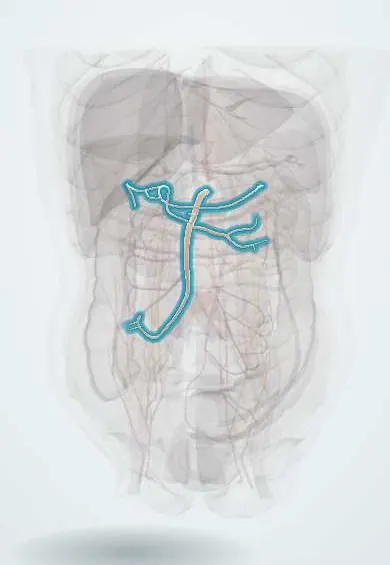
Structures involved
Tap one to see what it is and open it in 3D.
- Superior mesenteric artery
- Celiac trunk
- Inferior mesenteric artery
- Abdominal aorta
- Jejunum
- Ileum
- Colic arteries
- Stomach
- Diaphragm
- Celiac plexus
- Transverse colon
Why it happens
- Hypoxia, ischemia and reperfusion injury
- Splanchnic and portal circulation
- Flow, pressure and resistance: Poiseuille and turbulent flow
What it is
Recurrent intestinal ischaemia caused by gradual narrowing of the mesenteric arteries, usually from atherosclerosis. Because the gut has rich collaterals, symptoms usually appear only when at least two of the three main vessels (coeliac trunk, superior and inferior mesenteric arteries) are severely narrowed or occluded.
Who gets it
Uncommon; it typically affects people over 60, more often women, with atherosclerosis elsewhere (coronary, carotid or leg arteries). Diagnosis is often delayed for months because the symptoms are mistaken for peptic or biliary disease or cancer. With population ageing, smoking and diabetes in Colombia and Latin America, it is likely under-recognised.
Causes
- Atherosclerosis at the origin of the mesenteric arteries (most common)
- Vasculitis, such as Takayasu arteritis
- Fibromuscular dysplasia
- Median arcuate ligament compression of the coeliac trunk
- Aortic dissection extending into the mesenteric vessels
Risk factors
- Smoking
- Arterial hypertension
- Dyslipidaemia
- Diabetes mellitus
- Older age
- Known peripheral, coronary or carotid artery disease
Pathophysiology
After a meal, intestinal blood flow normally rises sharply. Fixed stenoses prevent this increase, so the mucosa becomes ischaemic during digestion, much as stable angina appears with exercise ('intestinal angina'). Pain leads to food avoidance and weight loss; chronic underperfusion may also impair absorption. A narrowed artery can thrombose suddenly, converting the chronic disease into acute mesenteric ischaemia.
Classification
- Atherosclerotic versus non-atherosclerotic (vasculitis, fibromuscular dysplasia, extrinsic compression)
- By vessels involved: single-vessel versus multivessel disease
- Acute-on-chronic mesenteric ischaemia
Symptoms and signs
- Postprandial abdominal pain starting 15–60 minutes after eating and lasting a few hours
- Fear of eating (sitophobia) and smaller meals
- Unintentional weight loss
- Nausea, diarrhoea or bloating
- Abdominal bruit in some patients
Diagnosis
- Clinical
- Classic triad: postprandial pain, food fear and weight loss, in an older smoker with vascular disease. Other causes such as cancer and peptic or biliary disease are usually excluded in parallel.
- Tests
- Laboratory tests are often normal; they may show malnutrition (low albumin). Endoscopy helps exclude other diagnoses and may show ischaemic gastritis or colitis.
- Imaging
- CT angiography is the first-line test and shows stenosis or occlusion of the coeliac trunk and mesenteric arteries and collaterals. Duplex ultrasound is a useful screening test. Catheter angiography is reserved for treatment planning and endovascular therapy.
Differential diagnosis
- Gastric or pancreatic cancer
- Peptic ulcer disease
- Biliary colic or chronic cholecystitis
- Chronic pancreatitis
- Median arcuate ligament syndrome
- Functional dyspepsia or irritable bowel syndrome
Goal of treatment
Restore blood flow to the intestine to relieve pain, recover weight and prevent progression to acute bowel infarction, while treating the systemic atherosclerosis.
Treatment
- Procedure
- Endovascular revascularisation (angioplasty and stenting, usually of the superior mesenteric artery) is the usual first choice in most patients.
- Surgical
- Open surgical revascularisation (bypass or endarterectomy) for lesions unsuitable for stenting, younger fit patients or recurrent stenosis.
- Medical
- Secondary prevention of atherosclerosis: antiplatelet agents and statins, with control of blood pressure and diabetes; nutritional support, sometimes parenteral, in malnourished patients before revascularisation.
- Lifestyle
- Stopping smoking, small frequent meals while awaiting revascularisation, and a heart-healthy diet.
- Follow-up
- Follow-up with duplex ultrasound to detect restenosis; nursing priorities include weight and nutritional status and teaching to report recurrent postprandial pain.
Complications
- Acute mesenteric ischaemia and bowel infarction
- Severe malnutrition and cachexia
- Restenosis after stenting
- Ischaemic colitis
Prognosis
Relief of symptoms after successful revascularisation is good, but restenosis is common after stenting and needs surveillance. Untreated disease can progress to bowel infarction, which carries high mortality. Long-term survival is limited by coexisting coronary and cerebrovascular disease.
Prevention
- Not smoking
- Control of blood pressure, cholesterol and blood sugar
- Regular physical activity and a healthy diet
Test yourself
Think of the answer, then tap the question to see it.
What is the classic clinical triad of chronic mesenteric ischaemia?
Postprandial abdominal pain, fear of eating (sitophobia) and weight loss.
Why do symptoms usually require disease in more than one mesenteric vessel?
The coeliac, superior and inferior mesenteric territories are linked by rich collaterals, so a single stenosis is often compensated.
What is the first-line imaging test for suspected chronic mesenteric ischaemia?
CT angiography of the abdominal aorta and its visceral branches.
What is the usual first-line treatment in most patients with symptomatic disease?
Endovascular revascularisation (angioplasty and stenting), with open bypass for unsuitable lesions.
Related conditions
- Acute mesenteric ischaemia
- Peripheral artery disease
- Atherosclerosis and dyslipidaemia
- Carotid artery stenosis
- Abdominal aortic aneurysm
- Takayasu arteritis
- Gastric cancer
- Peptic ulcer disease
- Chronic pancreatitis
- Subclavian steal syndrome
Educational information, not medical advice. For any symptom, see a health professional.
Sources: Mesenteric artery ischemia: MedlinePlus Medical Encyclopedia (MedlinePlus (U.S. National Library of Medicine), 2024); Management of the Diseases of Mesenteric Arteries and Veins: Clinical Practice Guidelines of the European Society of Vascular Surgery (ESVS) (European Journal of Vascular and Endovascular Surgery, 2017).
Spotted a mistake?We are always improving for the community. Tell us what is wrong and our team will review it.Report a mistake
Representative model, for educational purposes only.