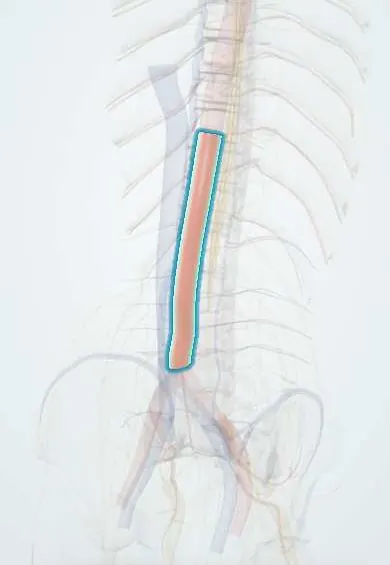
Abdominal aortic aneurysm !
An abdominal aortic aneurysm is a permanent bulge of the main artery in the abdomen; it often grows without symptoms and its main risk is rupture.
Updated 2026-10-29
Structures involved
Tap one to see what it is and open it in 3D.
- Abdominal aorta
- Common iliac arteries
- Inferior vena cava
- Lumbar arteries
- L3 vertebra
- L4 vertebra
- Ureters
- Peritoneum
In biochemistry
In the clinical exam
- Abdominal inspection
- Abdominal auscultation: bowel sounds and bruits
- Abdominal palpation: light and deep, guarding and masses
- Cullen and Grey Turner signs
- Peripheral pulses and the ankle–brachial index
- Acute abdomen and peritoneal irritation
Why it happens
- When leukocytes injure tissue: proteases, oxidants and NETs
- Arterial vs venous thrombi; mural thrombi and lines of Zahn
- Thrombosis and Virchow's triad
- Tobacco: how smoking injures tissue
- Collagen
- Blood vessels: artery, vein and capillary layers
What it is
Permanent dilation of the abdominal aorta to 3 cm or more (about 1.5 times normal), most often below the renal arteries. It usually grows silently and its main risk is rupture.
Who gets it
Typical of men over 65, especially smokers; less frequent but more prone to rupture in women. Several guidelines recommend one-time ultrasound screening for older men who have ever smoked; screening programmes vary between countries, and in Colombia it is not a routine national programme.
Causes
- Degenerative (most cases): breakdown of the aortic wall linked to atherosclerosis and inflammation
- Genetic connective tissue disorders: Marfan, Ehlers–Danlos (vascular type), Loeys–Dietz
- Infection (mycotic aneurysm) or inflammatory aortitis
- Trauma (rare)
Risk factors
- Smoking (the strongest modifiable factor)
- Male sex and age over 65
- Family history of aneurysm
- Hypertension
- Atherosclerotic disease: coronary or peripheral artery disease
- Dyslipidaemia; diabetes is associated with lower risk
Pathophysiology
Chronic inflammation and protease activity break down elastin and collagen in the media, and the wall weakens and expands. By the law of Laplace, wall tension rises as the diameter grows, so growth speeds up and the rupture risk rises with size. Mural thrombus can embolise to the legs.
Classification
- By location: infrarenal (most), juxtarenal, suprarenal, thoracoabdominal
- By shape: fusiform (most) or saccular
- Intact asymptomatic, symptomatic (tender, painful) or ruptured
Symptoms and signs
- Usually asymptomatic, found on imaging done for another reason
- Pulsatile mass in the abdomen above the umbilicus
- Vague abdominal, flank or low back pain when expanding
- Leg ischaemia from distal embolisation (blue toe)
Diagnosis
- Clinical
- Palpation of a pulsatile, expansile mass; sensitivity is low in obese patients and for small aneurysms.
- Tests
- In suspected rupture: haemoglobin, crossmatch, coagulation and renal function; ECG and cardiac risk evaluation before planned repair.
- Imaging
- Abdominal ultrasound is the screening and surveillance test. Bedside ultrasound helps in the unstable patient. CT angiography defines size, extent and anatomy for repair and confirms rupture in a stable patient.
Differential diagnosis
- Renal colic
- Acute pancreatitis
- Perforated viscus or mesenteric ischaemia
- Mechanical low back pain or disc herniation
- Aortic dissection
- Diverticulitis
Goal of treatment
Prevent rupture by surveillance and elective repair at the right size, reduce cardiovascular risk, and repair a rupture as fast as possible.
Treatment
- Follow-up
- Ultrasound surveillance of small aneurysms at intervals that shorten as the aneurysm grows.
- Lifestyle
- Stopping smoking and control of blood pressure and lipids.
- Medical
- Antiplatelet agents and statins to reduce overall cardiovascular risk.
- Surgical
- Elective repair once the diameter reaches the threshold set by guidelines (around 5.5 cm in men, lower in women), with rapid growth or with symptoms: open surgical repair or endovascular repair (EVAR).
- Acute
- Ruptured aneurysm: emergency repair (open or endovascular), with controlled (permissive) hypotension until the aorta is clamped or sealed.
Complications
- Rupture with haemorrhagic shock and high mortality
- Distal embolisation and limb ischaemia
- Aortoenteric or aortocaval fistula
- After repair: endoleak (EVAR), graft infection, renal or bowel ischaemia
Prognosis
Small aneurysms rarely rupture and are watched. Rupture risk rises sharply with diameter. Ruptured aneurysm has very high mortality, many patients dying before reaching hospital, while elective repair carries a much lower risk.
Prevention
- Not smoking or stopping smoking
- Blood pressure and lipid control
- Ultrasound screening of older men who have ever smoked, where programmes exist
Test yourself
Think of the answer, then tap the question to see it.
What diameter defines an abdominal aortic aneurysm?
An abdominal aorta of 3 cm or more, or about 1.5 times its normal diameter.
What is the classic triad of a ruptured abdominal aortic aneurysm?
Sudden abdominal or back pain, hypotension or shock, and a pulsatile abdominal mass.
Who is the main target of abdominal aortic aneurysm screening?
Older men (around 65–75 years) who have ever smoked, with a single abdominal ultrasound.
What is the strongest modifiable risk factor for abdominal aortic aneurysm?
Smoking: it raises both the risk of developing an aneurysm and the rate of growth.
Which test is used for screening and surveillance of an abdominal aortic aneurysm?
Abdominal ultrasound. CT angiography is used for planning repair.
Related conditions
- Aortic dissection
- Peripheral artery disease
- Mechanical low back pain
- Acute pancreatitis
- Kidney stones (urolithiasis)
- Incisional (ventral) hernia
- Giant cell arteritis
- Lumbar spinal stenosis
Educational information, not medical advice. For any symptom, see a health professional.
Sources: Abdominal Aortic Aneurysm (StatPearls (NCBI Bookshelf), 2025).
Spotted a mistake?We are always improving for the community. Tell us what is wrong and our team will review it.Report a mistake
Representative model, for educational purposes only.