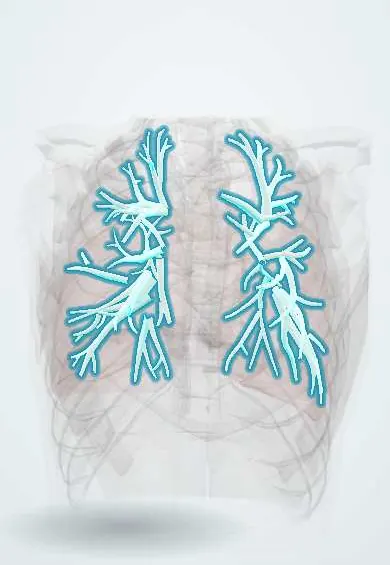
Cystic fibrosis !
An inherited disease that makes mucus thick and sticky, damaging the lungs, pancreas and other organs. It is usually found in infancy.
Updated 2026-11-01
Structures involved
Tap one to see what it is and open it in 3D.
- Segmental bronchi
- Lobar bronchi
- Pancreas
- Right upper lobe
- Left upper lobe
- Liver
- Gallbladder
- Ileum
- Nasal cavity
- Maxillary sinus
- Ductus deferens
In embryology
In the clinical exam
Why it happens
- Cystic fibrosis: from the CFTR channel to organ damage
- Mendelian inheritance: autosomal dominant, recessive and X-linked
- Endoplasmic reticulum stress and the unfolded protein response
- How a single gene causes disease: enzymes, receptors and structural proteins
- Airway defenses, cough and mucociliary clearance
- Membrane transport
Show 1 more
What it is
An autosomal recessive disease caused by mutations in the CFTR gene, which encodes a chloride channel in epithelial cells. Thick secretions block the airways, pancreatic ducts, bile ducts, intestine and vas deferens.
Who gets it
The most common life-limiting autosomal recessive disease in people of European ancestry. It occurs in Latin America too, with varied mutation profiles from mixed ancestry; it is probably underdiagnosed in Colombia and the region, where access to sweat testing and newborn screening is uneven. Survival has improved steadily with specialised care.
Causes
- Biallelic mutations in the CFTR gene on chromosome 7 (autosomal recessive)
- F508del is the most common mutation worldwide; it causes misfolding and degradation of the protein
- Mutation classes range from no protein to reduced function, which partly explains severity
Risk factors
- Both parents carriers of a CFTR mutation (25% risk for each child)
- Family history of cystic fibrosis
- European ancestry, although it occurs in all populations
Pathophysiology
Faulty CFTR reduces chloride and bicarbonate secretion and increases sodium absorption in the airways, so the surface liquid dehydrates and mucus becomes thick. Mucociliary clearance fails, leading to chronic infection (Staphylococcus aureus in childhood, later Pseudomonas aeruginosa), neutrophilic inflammation and bronchiectasis, predominantly in the upper lobes. In sweat glands the channel cannot reabsorb chloride, so sweat is salty. Blocked pancreatic ducts cause exocrine insufficiency and later CF-related diabetes.
Symptoms and signs
- Chronic productive cough, wheeze and recurrent chest infections
- Meconium ileus in the newborn
- Bulky, greasy, foul-smelling stools (steatorrhoea) and failure to thrive despite a good appetite
- Salty-tasting skin
- Nasal polyps and chronic sinusitis
- Digital clubbing
- Male infertility from congenital absence of the vas deferens
Diagnosis
- Clinical
- Suspected from a positive newborn screen, meconium ileus, recurrent respiratory infections with malabsorption or poor growth, or a family history.
- Tests
- Sweat chloride test (pilocarpine iontophoresis) is the key test: 60 mmol/L or more supports the diagnosis. CFTR genetic testing identifies the mutations. Newborn screening measures immunoreactive trypsinogen. Faecal elastase for pancreatic insufficiency; sputum cultures; spirometry (FEV1) to follow lung disease.
- Imaging
- Chest X-ray and CT show hyperinflation, bronchial wall thickening, mucus plugging and bronchiectasis, often in the upper lobes; abdominal X-ray or ultrasound for meconium ileus, liver or pancreatic disease.
Differential diagnosis
- Primary ciliary dyskinesia
- Bronchiectasis from other causes (post-infectious, immunodeficiency)
- Asthma
- Coeliac disease or other causes of malabsorption and failure to thrive
- Immunodeficiency with recurrent infections
Goal of treatment
Clear airway secretions, control infection and inflammation, maintain nutrition and growth, correct the underlying protein defect where possible, and treat complications in a multidisciplinary specialised centre.
Treatment
- Rehabilitation
- Daily airway clearance by chest physiotherapy, devices and exercise.
- Medical
- Inhaled mucolytics and airway hydrators (dornase alfa, hypertonic saline), bronchodilators, inhaled and oral antibiotics for chronic Pseudomonas, and intravenous antibiotics for exacerbations; azithromycin as an anti-inflammatory.
- Medical
- CFTR modulators (correctors and potentiators such as elexacaftor-tezacaftor-ivacaftor) for eligible mutations, which improve lung function and other organs.
- Lifestyle
- High-calorie, high-fat diet with pancreatic enzyme replacement at meals, fat-soluble vitamins (A, D, E, K) and extra salt.
- Follow-up
- Regular spirometry, sputum cultures, growth, screening for CF-related diabetes and liver disease; infection control between patients.
- Surgical
- Lung transplantation for end-stage lung disease.
Drugs for this condition
Complications
- Bronchiectasis and progressive respiratory failure
- Haemoptysis and pneumothorax
- Allergic bronchopulmonary aspergillosis
- Exocrine pancreatic insufficiency, pancreatitis and CF-related diabetes
- Focal biliary cirrhosis and gallstones
- Meconium ileus and distal intestinal obstruction syndrome
- Male infertility, osteoporosis and fat-soluble vitamin deficiency
Prognosis
Life expectancy has risen markedly with specialised care and, more recently, CFTR modulators; many patients now reach adulthood and middle age. Respiratory failure remains the main cause of death, and outcomes depend on mutation, access to care and timely diagnosis.
Prevention
- Newborn screening for early diagnosis
- Genetic counselling and carrier testing for affected families
- Vaccination and infection control to prevent cross-infection
Test yourself
Think of the answer, then tap the question to see it.
What is the gene and inheritance pattern of cystic fibrosis?
Mutations in the CFTR gene on chromosome 7, inherited in an autosomal recessive pattern; F508del is the most common.
What is the key diagnostic test for cystic fibrosis?
The sweat chloride test, with a value of 60 mmol/L or more supporting the diagnosis, confirmed with CFTR genetic testing.
What is the typical neonatal gastrointestinal presentation of cystic fibrosis?
Meconium ileus, an obstruction of the terminal ileum by thick meconium.
Which organism typically causes chronic lung infection in adults with cystic fibrosis?
Pseudomonas aeruginosa (Staphylococcus aureus predominates in early childhood).
Why are most men with cystic fibrosis infertile?
Congenital bilateral absence of the vas deferens causes obstructive azoospermia, while sperm production is usually normal.
Related conditions
- Bronchiectasis
- Chronic pancreatitis
- Acute pancreatitis
- Small bowel obstruction
- Cirrhosis
- Gallstones (cholelithiasis)
- Acute rhinosinusitis
- Pneumothorax
- Acute respiratory failure (hypoxaemic and hypercapnic)
Educational information, not medical advice. For any symptom, see a health professional.
Sources: Cystic fibrosis: MedlinePlus Genetics (MedlinePlus (U.S. National Library of Medicine), 2023); Cystic Fibrosis (National Heart, Lung, and Blood Institute (NHLBI, NIH), 2023).
Spotted a mistake?We are always improving for the community. Tell us what is wrong and our team will review it.Report a mistake
Representative model, for educational purposes only.