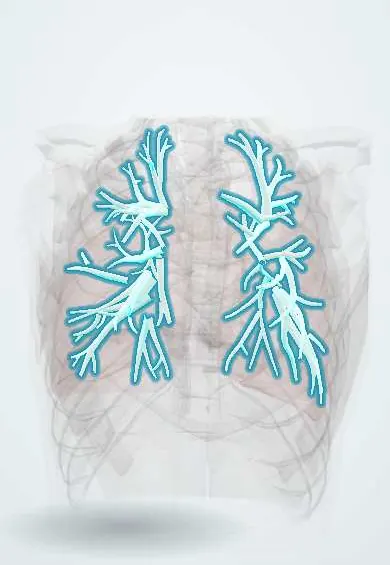
Chronic obstructive pulmonary disease (COPD) !
Chronic obstructive pulmonary disease (COPD) is a lasting lung disease, mostly from tobacco or smoke, that narrows the airways and causes breathlessness.
Updated 2026-10-30
Structures involved
Tap one to see what it is and open it in 3D.
- Segmental bronchi
- Right upper lobe
- Left upper lobe
- Lobar bronchi
- Diaphragm
- Right ventricle
- Pulmonary arteries
- Scalenes
In biochemistry
- Bicarbonate–CO₂ buffer system
- Acid–base compensation rules
- pH, buffers and the Henderson–Hasselbalch equation
- Elastin
- α1-antitrypsin
Microorganisms that cause it
In histology
- The airway: from nose to bronchioles
- The alveolus: type I and II pneumocytes, surfactant, the blood–air barrier
In the clinical exam
- Abnormal pulses: paradoxus, alternans, parvus et tardus, bounding
- Pulse oximetry
- Medicines, allergies and habits: tobacco, alcohol and other substances
- Chest inspection: shape, expansion, accessory muscles and retractions
- Chest percussion: resonance, dullness and hyperresonance
- Lung auscultation: normal breath sounds
- Adventitious sounds: crackles, wheezes, rhonchi, stridor and pleural rub
- Respiratory symptoms: cough, sputum, hemoptysis and dyspnea
- The pleuropulmonary syndromes: the comparison table to know
- Pneumothorax syndrome
- Bronchial obstruction syndrome
- Respiratory distress and respiratory failure: the signs
- Pulmonary hyperinflation syndrome (emphysema)
In physiology
- Erythropoiesis and erythropoietin
- Polycythemia: physiological causes
- Reading an arterial blood gas step by step
- Respiratory acidosis and alkalosis
- Mixed acid–base disorders
- Lung volumes, capacities and spirometry
- Obstructive and restrictive patterns, and flow–volume loops
- Dead space and alveolar ventilation
- The alveolar gas equation and the A–a gradient
- Ventilation–perfusion matching and West zones
- The causes of hypoxemia
- CO₂ transport and the Haldane effect
- Control of breathing, chemoreceptors and lung reflexes
- Oxygenation: SpO₂, PaO₂, cyanosis and oxygen therapy
- Lung and chest wall compliance
- Airway resistance
- Diffusion across the respiratory membrane and DLCO
- The work of breathing
- The pulmonary circulation and hypoxic vasoconstriction
- Hypoxemic and hypercapnic respiratory failure
- Airway defenses, cough and mucociliary clearance
Why it happens
- When leukocytes injure tissue: proteases, oxidants and NETs
- Tobacco: how smoking injures tissue
- Air pollution and occupational exposures
- Metaplasia
- Health effects of climate change
- How organs age: normal changes vs disease
What it is
Common, preventable lung disease with persistent respiratory symptoms and airflow limitation that is not fully reversible, caused by chronic bronchitis and/or emphysema after long exposure to noxious particles or gases.
Who gets it
A leading cause of chronic illness and death worldwide. In Colombia and Latin America, besides tobacco, long exposure to wood smoke from cooking (biomass) matters, especially in rural women. In the PUMA study (primary care in Argentina, Colombia, Venezuela and Uruguay), 309 of 1,540 at-risk adults aged 40 or older had COPD on spirometry.
Causes
- Cigarette smoking
- Biomass smoke: cooking or heating with wood or charcoal indoors
- Occupational dusts and chemicals
- Outdoor air pollution
- Alpha-1 antitrypsin deficiency (rare, genetic)
- History of severe childhood respiratory infections or tuberculosis
Risk factors
- Smoking history (pack-years)
- Years of wood-smoke exposure in poorly ventilated kitchens
- Older age
- Low birth weight and poor lung growth
- Chronic asthma
- Low socioeconomic status
Pathophysiology
Chronic inflammation from inhaled irritants causes mucus hypersecretion and narrowing of small airways (chronic bronchitis) and destruction of alveolar walls (emphysema). Loss of elastic recoil leads to airway collapse in expiration, air trapping and hyperinflation. Advanced disease causes hypoxaemia, pulmonary hypertension and right heart failure.
Classification
- GOLD grades 1–4 by post-bronchodilator FEV1
- GOLD groups by symptoms and exacerbation history
- Phenotypes: predominant emphysema, chronic bronchitis, frequent exacerbator
Symptoms and signs
- Progressive breathlessness on exertion
- Chronic cough
- Sputum production
- Wheeze
- Barrel chest, prolonged expiration and pursed-lip breathing in advanced disease
- Weight loss and fatigue in severe disease
Diagnosis
- Clinical
- Breathlessness, cough or sputum in a person with exposure to smoke or other risk factors.
- Tests
- Spirometry is required: a post-bronchodilator FEV1/FVC below 0.70 confirms persistent airflow limitation, and FEV1 grades severity (GOLD). Pulse oximetry or blood gases; alpha-1 antitrypsin level in young patients.
- Imaging
- Chest X-ray may show hyperinflation and flat diaphragms and excludes other causes; CT shows emphysema and is used for complicated cases and lung cancer screening.
Differential diagnosis
- Asthma
- Heart failure
- Bronchiectasis
- Pulmonary tuberculosis or its sequelae
- Lung cancer
- Interstitial lung disease
Goal of treatment
Reduce symptoms and exacerbations, slow decline, improve exercise capacity and quality of life, and correct chronic hypoxaemia.
Treatment
- Lifestyle
- Stopping smoking and ending exposure to wood-smoke (improved stoves, ventilation): the measures that most change the course of the disease.
- Medical
- Inhaled long-acting bronchodilators (antimuscarinics and beta-2 agonists), alone or combined; inhaled corticosteroids added for frequent exacerbations with raised eosinophils.
- Rehabilitation
- Pulmonary rehabilitation with exercise training and education.
- Medical
- Long-term oxygen therapy for chronic severe hypoxaemia, which improves survival.
- Acute
- Exacerbation: short-acting bronchodilators, systemic corticosteroids, antibiotics when sputum becomes purulent, and non-invasive ventilation for hypercapnic respiratory failure.
- Follow-up
- Regular review of spirometry, symptoms, exacerbations and inhaler technique.
Drugs for this condition
- Oxygen
- Salbutamol
- Ipratropium bromide
- Tiotropium bromide
- Budesonide
- Budesonide + formoterol
- Fluticasone
- Formoterol
- Salmeterol
- Terbutaline
Complications
- Acute exacerbations and respiratory failure
- Cor pulmonale (right heart failure)
- Pneumonia
- Secondary pneumothorax from ruptured bullae
- Lung cancer
- Depression, muscle loss and osteoporosis
Prognosis
A chronic, progressive disease, but quitting exposure slows decline. Frequent exacerbations, low FEV1, hypoxaemia and low body weight predict worse survival.
Prevention
- Not smoking, and quitting at any age
- Clean cookstoves and kitchen ventilation in homes using wood
- Occupational protection
- Influenza and pneumococcal vaccination
Test yourself
Think of the answer, then tap the question to see it.
What spirometry result confirms COPD?
A post-bronchodilator FEV1/FVC ratio below 0.70, showing persistent airflow limitation.
Besides tobacco, what exposure is an important cause of COPD in rural Colombia?
Long-term wood-smoke (biomass) exposure from cooking or heating indoors, especially affecting women.
Which treatment has been shown to improve survival in COPD with chronic severe hypoxaemia?
Long-term oxygen therapy for many hours a day; stopping smoking also changes the course of the disease.
What does the GOLD system use to grade airflow limitation in COPD?
The post-bronchodilator FEV1 as a percentage of predicted, from GOLD 1 (mild) to GOLD 4 (very severe).
What is cor pulmonale?
Right ventricular enlargement and failure caused by pulmonary hypertension from chronic lung disease such as COPD.
Related conditions
- Asthma
- Community-acquired pneumonia
- Pneumothorax
- Heart failure
- Bronchiectasis
- Pulmonary tuberculosis
- Lung cancer
- Interstitial lung disease
Educational information, not medical advice. For any symptom, see a health professional.
Sources: Chronic Obstructive Pulmonary Disease (COPD) (StatPearls (NCBI Bookshelf), 2026); Asthma-COPD overlap syndrome (ACOS) in primary care of four Latin America countries: the PUMA study (BMC pulmonary medicine, 2017) · adapted, CC BY 4.0.
Spotted a mistake?We are always improving for the community. Tell us what is wrong and our team will review it.Report a mistake
Representative model, for educational purposes only.