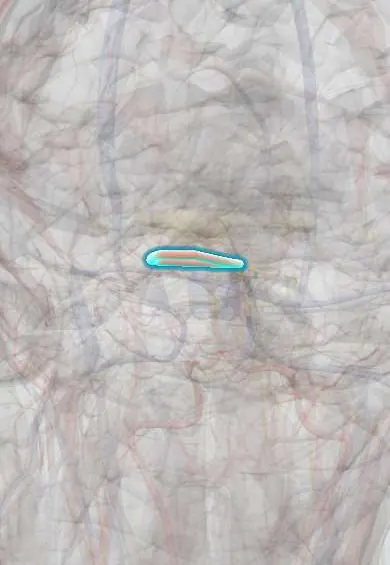
Subarachnoid haemorrhage !
A subarachnoid haemorrhage is bleeding around the brain, often from a burst aneurysm; it causes a sudden, extremely severe headache.
Updated 2026-10-29
Structures involved
Tap one to see what it is and open it in 3D.
- Circle of Willis
- Anterior communicating artery
- Posterior communicating artery
- Middle cerebral artery
- Basilar artery
- Internal carotid artery
- Oculomotor nerve (III)
- Fourth ventricle
In the clinical exam
- Meningeal signs: neck stiffness, Kernig and Brudzinski
- Pupils: light reflex and abnormal pupils (Marcus Gunn, Horner, Argyll Robertson)
- Recognising a stroke: BE-FAST and the NIH Stroke Scale
- Meningeal syndrome
In physiology
Why it happens
- Hemorrhage: petechiae, purpura, ecchymosis, hematoma, and what blood loss does
- Cerebral blood flow, brain metabolism and intracranial pressure
- Gray and white matter, cerebellar cortex, meninges
What it is
Bleeding into the subarachnoid space around the brain. Non-traumatic cases are most often due to a ruptured berry (saccular) aneurysm and present with a sudden, severe «thunderclap» headache.
Who gets it
Affects relatively young adults compared with other strokes, more often women. Trauma is the commonest cause of subarachnoid blood overall; aneurysms cause most spontaneous cases.
Causes
- Ruptured saccular (berry) aneurysm of the circle of Willis
- Trauma
- Arteriovenous malformation
- Perimesencephalic non-aneurysmal bleeding
- Less common: dissection, vasculitis
Risk factors
- Smoking
- Hypertension
- Heavy alcohol or cocaine use
- Family history of aneurysm
- Polycystic kidney disease and connective tissue disorders
- Female sex
Pathophysiology
Aneurysms form at arterial branch points, most often the anterior communicating, posterior communicating and middle cerebral arteries. Rupture sends arterial blood into the subarachnoid space, abruptly raising intracranial pressure. Blood breakdown products later irritate the arteries, causing vasospasm and delayed ischaemia.
Classification
- Clinical grade: Hunt and Hess or WFNS scales
- CT blood load: Fisher or modified Fisher scales
- Aneurysmal vs non-aneurysmal vs traumatic
Symptoms and signs
- Sudden, severe headache reaching peak intensity within about a minute («worst headache of my life»)
- Nausea, vomiting, neck stiffness, photophobia
- Brief loss of consciousness or seizure
- Third-nerve palsy (posterior communicating artery aneurysm)
- Sometimes a smaller warning (sentinel) headache days before
Diagnosis
- Clinical
- Thunderclap headache is investigated as possible SAH. Decision rules such as the Ottawa SAH rule help. Severity is graded with Hunt and Hess or WFNS.
- Tests
- If CT is negative and clinical suspicion remains, lumbar puncture: raised red cells that do not clear, and xanthochromia when timed some hours after onset. ECG and electrolytes (hyponatraemia).
- Imaging
- Non-contrast CT first: very sensitive in the first hours, less so later. CT angiography or digital subtraction angiography finds the aneurysm.
Differential diagnosis
- Migraine
- Reversible cerebral vasoconstriction syndrome
- Bacterial meningitis
- Intracerebral haemorrhage
- Cerebral venous thrombosis
- Pituitary apoplexy
Goal of treatment
Secure the aneurysm early to prevent rebleeding, prevent and treat delayed cerebral ischaemia, and manage hydrocephalus and medical complications.
Treatment
- Acute
- Airway and circulation support, analgesia, blood pressure control as a principle, reversal of anticoagulation.
- Procedure
- Endovascular coiling of the aneurysm, chosen by aneurysm shape and location with a multidisciplinary team.
- Surgical
- Microsurgical clipping of the aneurysm; external ventricular drain for acute hydrocephalus.
- Medical
- A calcium channel blocker (nimodipine class) to improve outcome from delayed ischaemia; keep normal blood volume and sodium.
- Follow-up
- Intensive care monitoring for vasospasm (neurological checks, transcranial Doppler), hyponatraemia and seizures.
Drugs for this condition
Complications
- Rebleeding (highest early)
- Vasospasm and delayed cerebral ischaemia
- Acute and chronic hydrocephalus
- Hyponatraemia
- Seizures and cardiac dysfunction
Prognosis
Serious: a notable share die before or soon after reaching hospital, and many survivors have cognitive problems. Outcome depends on clinical grade at admission, age and complications such as rebleeding and delayed ischaemia.
Prevention
- Stopping smoking and controlling blood pressure
- Screening of selected relatives or patients with polycystic kidney disease, as advised by specialists
Test yourself
Think of the answer, then tap the question to see it.
What is the classic headache of aneurysmal subarachnoid haemorrhage?
A thunderclap headache: sudden, severe and maximal within about a minute.
If CT is negative but suspicion of SAH remains, what is the next test?
Lumbar puncture, looking for persistent red cells and xanthochromia.
Where are berry aneurysms most commonly found?
At branch points of the circle of Willis, mainly anterior communicating, posterior communicating and middle cerebral arteries.
What complication typically appears several days after SAH?
Cerebral vasospasm with delayed cerebral ischaemia.
Which cranial nerve palsy suggests a posterior communicating artery aneurysm?
Oculomotor nerve (III) palsy, often with a dilated pupil.
Related conditions
- Intracerebral haemorrhage
- Ischaemic stroke
- Migraine
- Bacterial meningitis
- Traumatic brain injury
- Hydrocephalus
- Autosomal dominant polycystic kidney disease
- Coarctation of the aorta
Educational information, not medical advice. For any symptom, see a health professional.
Sources: Subarachnoid Hemorrhage (StatPearls (NCBI Bookshelf), 2023).
Spotted a mistake?We are always improving for the community. Tell us what is wrong and our team will review it.Report a mistake
Representative model, for educational purposes only.