Conditions · Surgery and trauma
Penetrating trauma (stab and gunshot wounds) !
Penetrating trauma is an injury from a knife, bullet or other object that pierces the body. It can damage vessels and organs deep below a small wound.
Updated 2026-11-01
Structures involved
Tap one to see what it is and open it in 3D.
- Peritoneum
- Diaphragm
- Pleura
- Common carotid artery
- Internal jugular vein
- Trachea
- Esophagus
- Pericardium
- Right ventricle
- Liver
- Spleen
- Jejunum
- Transverse colon
- Skin
Why it happens
- Hemorrhage: petechiae, purpura, ecchymosis, hematoma, and what blood loss does
- Mechanical and electrical injury: abrasion, contusion, laceration, wounds
- Shock physiology
What it is
Injury caused by an object that breaks the skin and enters the body, mainly stab wounds and gunshot wounds. Damage depends on the path through the tissues; gunshot wounds also cause cavitation and are more often fatal than stab wounds.
Who gets it
Interpersonal violence makes penetrating trauma a leading reason for emergency surgery in Colombia and much of Latin America, mostly in young men. In a Bogotá trauma referral hospital, stab wounds outnumbered gunshot wounds roughly three to one among stable patients with penetrating abdominal injury, matching national data that bladed weapons are the most common instrument in assaults.
Causes
- Stab wounds from knives and other bladed or sharp objects
- Gunshot wounds (low and high velocity)
- Impalement in falls or work accidents
- Shotgun and shrapnel injuries
Risk factors
- Young male sex
- Urban violence and gang involvement
- Alcohol and drug use
- Access to firearms
- Previous victimisation
Pathophysiology
A blade injures only the tissues along its track, while a bullet transfers kinetic energy and creates a temporary cavity that damages tissue well beyond its path. Death comes mainly from bleeding from major vessels or solid organs, from tamponade or tension pneumothorax in chest wounds, and later from peritonitis when hollow organs are perforated.
Classification
- Neck zones: zone I (clavicles to cricoid), zone II (cricoid to angle of the mandible), zone III (above the angle of the mandible)
- Thoracoabdominal wounds: below the nipples (fourth intercostal space) in front or the tip of the scapula behind, which can cross the diaphragm
- Precordial (cardiac box) wounds, at high risk of heart injury
- Anterior abdomen, flank and back wounds
Symptoms and signs
- Visible wound with external bleeding
- Pain, pallor, fast pulse and low blood pressure
- Shortness of breath or absent breath sounds in chest wounds
- Abdominal pain, guarding and distension
- In neck wounds: voice change, difficulty swallowing, subcutaneous emphysema or a growing haematoma
Diagnosis
- Clinical
- ATLS primary survey, then a complete count of entry and exit wounds front and back, including armpits, perineum and scalp. Unstable patients, peritonitis, evisceration or hard vascular signs go straight to surgery; stable patients may be observed with serial examinations.
- Tests
- Blood group and crossmatch, haemoglobin, blood gas with lactate, coagulation tests, and urinalysis for blood. Local wound exploration in stab wounds of the anterior abdomen to see if the fascia is breached.
- Imaging
- eFAST to look for tamponade, haemothorax and free abdominal fluid; chest X-ray. Contrast CT (with CT angiography for the neck) in stable patients. Diagnostic laparoscopy can assess the diaphragm and peritoneal breach in stable thoracoabdominal wounds.
Differential diagnosis
- Superficial wound without penetration of the fascia or pleura
- Blunt injury from the same assault
- Shock from tension pneumothorax or tamponade rather than bleeding
- Intoxication altering the examination
Goal of treatment
Control bleeding and restore perfusion, identify every injured structure along the wound track, avoid unnecessary operations in stable patients and prevent infection.
Treatment
- Acute
- ATLS resuscitation: airway, chest decompression and chest tubes, direct pressure on bleeding wounds, early blood products and permissive hypotension until bleeding is controlled.
- Surgical
- Exploratory laparotomy for instability, peritonitis or evisceration, and for most abdominal gunshot wounds; damage control when the patient is in extremis.
- Surgical
- Emergency thoracotomy or sternotomy for cardiac wounds with tamponade, and neck exploration for unstable zone II injuries.
- Procedure
- In stable patients: selective nonoperative management with serial examinations, diagnostic or therapeutic laparoscopy, and endovascular repair for selected vascular injuries.
- Medical
- Tetanus prophylaxis as needed and antibiotic prophylaxis when hollow organs may be injured.
- Follow-up
- Nursing priorities: vital signs and urine output, serial abdominal examinations, chest-tube output and wound care; impaled objects are stabilised, never removed outside the operating room.
Complications
- Haemorrhagic shock and death
- Missed hollow-organ injury with peritonitis and sepsis
- Missed diaphragmatic injury with later diaphragmatic hernia
- Cardiac tamponade, haemothorax and empyema
- Wound infection and intra-abdominal abscess
- Stroke after carotid injury; airway loss in neck wounds
Prognosis
Most stab wounds that reach hospital alive are survivable; gunshot wounds, cardiac injuries and major vessel injuries carry higher mortality. Rapid transport, early bleeding control and avoiding missed injuries are the main determinants of outcome.
Prevention
- Community violence prevention programmes
- Control of firearms and bladed weapons
- Reducing harmful alcohol use
Test yourself
Think of the answer, then tap the question to see it.
What are the boundaries of zone II of the neck?
From the cricoid cartilage to the angle of the mandible; it is the most exposed zone and the easiest to explore surgically.
What are the main indications for immediate laparotomy after a penetrating abdominal wound?
Haemodynamic instability, peritonitis and evisceration (and, in most centres, abdominal gunshot wounds that breach the peritoneum).
Why do thoracoabdominal stab wounds need special attention?
They can cross the diaphragm and injure both chest and abdominal organs; small diaphragmatic tears are easily missed and can later cause a diaphragmatic hernia.
What is the classic triad of cardiac tamponade after a precordial stab wound?
Beck's triad: hypotension, distended neck veins and muffled heart sounds.
What should be done with an impaled knife on arrival at the emergency department?
Stabilise it in place and remove it only in the operating room, where bleeding can be controlled.
Related conditions
- Major trauma (polytrauma): ATLS primary survey
- Haemothorax
- Pneumothorax
- Cardiac tamponade
- Peritonitis
- Hypovolaemic shock
- Blunt abdominal trauma
Educational information, not medical advice. For any symptom, see a health professional.
Sources: Laparoscopy has better performance than laparotomy in the treatment of stable penetrating abdominal trauma: A retrospective cross-sectional study in a trauma referral hospital in Colombia (Health Science Reports, 2022); Advanced Trauma Life Support | ACS (American College of Surgeons, 2025).
Spotted a mistake?We are always improving for the community. Tell us what is wrong and our team will review it.Report a mistake
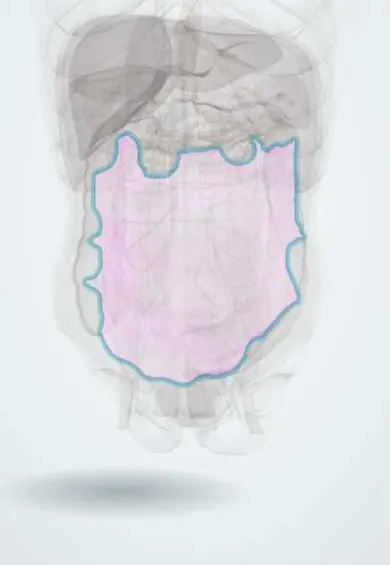
Representative model, for educational purposes only.