Conditions · Surgery and trauma
Major trauma (polytrauma): ATLS primary survey !
Major trauma means serious injuries to several body areas at once. A fixed ABCDE order finds and treats what kills first: airway, breathing, bleeding.
Updated 2026-11-01
Structures involved
Tap one to see what it is and open it in 3D.
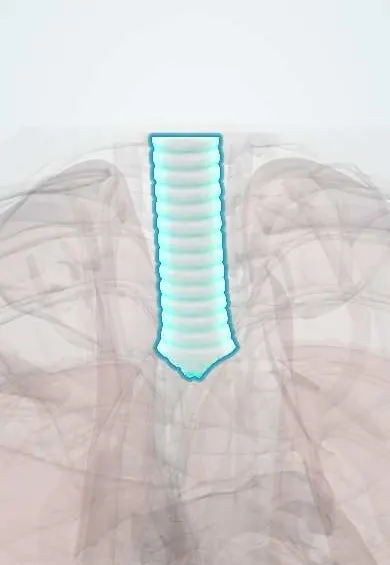
- Trachea
- Spinal cord
- Pleura
- Peritoneum
- Cricothyroid membrane
- Axis (C2)
- Common carotid artery
- Pericardium
- Diaphragm
- Ribs (back part)
- Liver
- Spleen
- Hip bone
- Dura mater
Why it happens
- Shock: types, stages and the organs it damages
- Hemorrhage: petechiae, purpura, ecchymosis, hematoma, and what blood loss does
- Mechanical and electrical injury: abrasion, contusion, laceration, wounds
- Fat, air and amniotic fluid embolism
- Disseminated intravascular coagulation: how consumption causes both clots and bleeding
- Shock physiology
Show 1 more
What it is
Severe injury affecting two or more body regions or systems, at least one of them life-threatening. Care follows the ATLS approach: a rapid primary survey (ABCDE) with simultaneous resuscitation, then a head-to-toe secondary survey.
Who gets it
Injuries cause millions of deaths a year worldwide, mostly from road traffic crashes, falls and violence, and they are a leading cause of death in people aged 5–29. In Colombia, motorcycle crashes and interpersonal violence (stab and gunshot wounds) make trauma a daily problem in emergency departments.
Causes
- Road traffic crashes, especially motorcycle riders and pedestrians
- Falls from height
- Interpersonal violence: stab and gunshot wounds, assaults
- Crush injuries, explosions and work accidents
Risk factors
- Young adult men
- Alcohol or drug use
- Motorcycle use without protective gear, no seatbelt
- Older age and anticoagulant use (more bleeding from minor mechanisms)
- Delayed access to a trauma centre
Pathophysiology
Deaths cluster early: within minutes from airway loss, major brain injury or massive bleeding, and within hours from treatable haemorrhage, tension pneumothorax or tamponade. Ongoing blood loss drives the lethal triad of hypothermia, acidosis and coagulopathy, each worsening the others, so early bleeding control matters more than early complete repair.
Classification
- Primary survey: A airway with cervical spine protection, B breathing and ventilation, C circulation with haemorrhage control, D disability (neurological status), E exposure and environment control
- Mechanism: blunt versus penetrating
- Haemorrhagic shock classes I–IV by estimated blood loss and vital signs
- Response to initial fluids: rapid, transient or no response
Symptoms and signs
- Airway noise, hoarseness or blood in the mouth
- Shortness of breath, unequal chest movement or absent breath sounds
- Pale, cold, sweaty skin, fast pulse and falling blood pressure
- Reduced level of consciousness (low Glasgow Coma Scale score) or unequal pupils
- Visible external bleeding, deformed limbs, abdominal or pelvic pain
Diagnosis
- Clinical
- Primary survey in strict ABCDE order, treating each problem as it is found, with spinal motion restriction. The secondary survey follows only once the patient is stabilised: AMPLE history, full head-to-toe examination and log-roll of the back.
- Tests
- Blood group and crossmatch, haemoglobin, arterial or venous blood gas with lactate and base deficit, coagulation tests, pregnancy test in women of reproductive age, and toxicology when relevant. Continuous monitoring of vital signs, pulse oximetry, capnography and urine output.
- Imaging
- Adjuncts to the primary survey: chest and pelvic X-rays and eFAST ultrasound (pericardium, abdomen, pleura). Whole-body CT once the patient is haemodynamically stable; unstable patients go to the operating room or angiography rather than the scanner.
Differential diagnosis
- Non-haemorrhagic shock: tension pneumothorax, cardiac tamponade, neurogenic shock
- A medical event causing the crash (syncope, seizure, hypoglycaemia, myocardial infarction)
- Intoxication masking or mimicking head injury
- Isolated traumatic brain injury versus hypoxia or hypotension as the cause of low consciousness
Goal of treatment
Find and treat immediate threats to life in priority order, stop bleeding as early as possible, keep oxygen delivery and perfusion, prevent secondary brain injury and move the patient quickly to definitive care.
Treatment
- Acute
- Airway: chin lift or jaw thrust with cervical spine protection, suction, and a definitive airway (rapid-sequence intubation, or a surgical cricothyroidotomy when intubation fails).
- Procedure
- Breathing: needle or finger decompression followed by a chest tube for tension pneumothorax; chest tube for massive haemothorax; occlusive dressing for an open (sucking) chest wound.
- Acute
- Circulation: direct pressure and tourniquets for limb bleeding, pelvic binder, two large-bore lines, warmed fluids kept to a minimum, early balanced blood transfusion (massive transfusion protocol) and tranexamic acid early in bleeding patients.
- Surgical
- Damage control surgery for unstable patients: a short operation to stop bleeding and contamination, then correction of physiology in the ICU and definitive repair later.
- Follow-up
- Nursing priorities: repeated ABCDE reassessment, vital signs, GCS and pupils, urine output via catheter (unless urethral injury is suspected), temperature and warming, and documentation of the time of each intervention.
Drugs for this condition
Complications
- Haemorrhagic shock and death
- Lethal triad: hypothermia, acidosis and coagulopathy
- Secondary brain injury from hypoxia and hypotension
- Acute respiratory distress syndrome and multiple organ failure
- Abdominal compartment syndrome
- Venous thromboembolism, infection and sepsis
- Long-term disability and post-traumatic stress
Prognosis
Outcome depends mainly on the severity of brain and haemorrhagic injury and on the time to definitive care. Organised trauma systems, early bleeding control and structured protocols such as ATLS reduce preventable deaths.
Prevention
- Helmets for motorcyclists and cyclists, seatbelts and child seats
- Speed and drink-driving enforcement
- Violence prevention programmes and control of weapons
- Fall prevention at work and in older adults
Test yourself
Think of the answer, then tap the question to see it.
What is the order of the ATLS primary survey?
ABCDE: Airway with cervical spine protection, Breathing, Circulation with haemorrhage control, Disability (neurological status) and Exposure with prevention of hypothermia.
Which three conditions make up the lethal triad of trauma?
Hypothermia, metabolic acidosis and coagulopathy.
Which bedside ultrasound is used during the primary survey to look for free fluid, tamponade and pneumothorax?
eFAST (extended focused assessment with sonography for trauma).
A trauma patient is hypotensive with distended neck veins, absent breath sounds on one side and tracheal deviation. What is the immediate step?
Immediate decompression of a tension pneumothorax (needle or finger thoracostomy), followed by a chest tube; it is a clinical diagnosis, not one that waits for an X-ray.
What is damage control surgery?
A short operation in an unstable patient that only controls bleeding and contamination, followed by ICU resuscitation and a planned definitive operation later.
Related conditions
- Traumatic brain injury
- Spinal cord injury
- Pneumothorax
- Haemothorax
- Cardiac tamponade
- Flail chest
- Hypovolaemic shock
- Splenic injury
- Burns (thermal, chemical, electrical; inhalation injury)
- Penetrating trauma (stab and gunshot wounds)
- Blunt abdominal trauma
- Pelvic fracture
Educational information, not medical advice. For any symptom, see a health professional.
Sources: Advanced Trauma Life Support | ACS (American College of Surgeons, 2025); Injuries and violence (World Health Organization, 2024).
Spotted a mistake?We are always improving for the community. Tell us what is wrong and our team will review it.Report a mistake
Representative model, for educational purposes only.