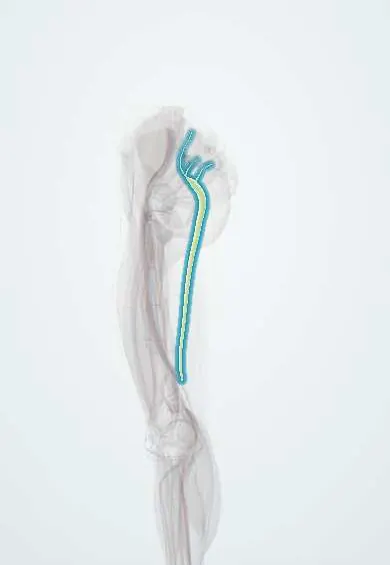
Critical illness polyneuropathy and myopathy (ICU-acquired weakness) !
Severe weakness that develops in very sick patients in intensive care because nerves and muscles are damaged, making it hard to wean from the ventilator.
Updated 2026-11-01
Structures involved
Tap one to see what it is and open it in 3D.
- Sciatic nerve
- Vastus lateralis
- Diaphragm
- Tibial nerve
- Common fibular nerve
- Femoral nerve
- Rectus femoris
- Tibialis anterior
- Soleus
- Phrenic nerves
- Intercostal nerves
- External intercostals
Why it happens
What it is
ICU-acquired weakness is generalised, symmetric, flaccid weakness that appears during critical illness with no other explanation. It includes critical illness polyneuropathy (axonal damage to sensory and motor nerves), critical illness myopathy (primary muscle damage) and, often, both together (polyneuromyopathy).
Who gets it
Common in intensive care: it is reported in roughly a quarter to a half of patients ventilated for a week or more and in up to two thirds of patients with sepsis and multiple organ failure. It is seen in ICUs across Colombia and Latin America, where long ventilation and sepsis are frequent; it is often recognised only when weaning fails.
Causes
- Sepsis and systemic inflammatory response
- Multiple organ failure
- Prolonged mechanical ventilation and immobility
- Corticosteroids, especially combined with non-depolarising neuromuscular blockers (mainly myopathy)
- Hyperglycaemia
Risk factors
- Severity of illness and multiple organ dysfunction
- Sepsis
- Long duration of ventilation and bed rest
- High-dose corticosteroids
- Prolonged neuromuscular blockade
- Poor glucose control
- Older age and pre-existing frailty
Pathophysiology
Inflammation impairs the microcirculation of nerves and muscles, increases vascular permeability and leads to energy failure in axons, producing axonal degeneration. In muscle, sodium channels become inexcitable (an acquired channelopathy), thick (myosin) filaments are lost, and catabolism and disuse cause atrophy. Corticosteroids and denervation from blockers make muscle more susceptible. Respiratory muscles are involved, which delays weaning.
Classification
- Critical illness polyneuropathy (CIP): axonal sensorimotor neuropathy
- Critical illness myopathy (CIM): including thick-filament myosin loss and necrotising forms
- Combined critical illness polyneuromyopathy
Symptoms and signs
- Symmetric flaccid weakness of the limbs, worse proximally in myopathy and distally in neuropathy
- Reduced or absent tendon reflexes (often preserved in pure myopathy)
- Muscle wasting
- Failure to wean from the ventilator
- Distal sensory loss in polyneuropathy
- Facial muscles relatively spared; patient may grimace to pain but not move limbs
Diagnosis
- Clinical
- Suspected in an alert, cooperative ICU patient with generalised weakness. Manual muscle testing with the Medical Research Council (MRC) sum score; a score below 48 out of 60, measured more than once, defines ICU-acquired weakness. Handgrip dynamometry is a quick alternative.
- Tests
- Nerve conduction studies and EMG: reduced motor and sensory amplitudes in polyneuropathy; reduced motor amplitudes with normal sensory responses and inexcitable muscle on direct stimulation in myopathy. CK is normal or mildly raised. Muscle biopsy (loss of myosin filaments) is reserved for unclear cases. Electrolytes, magnesium and phosphate are checked.
- Imaging
- Not routinely needed; brain or spine MRI when central causes are suspected. Muscle ultrasound can track loss of muscle thickness.
Differential diagnosis
- Guillain-Barré syndrome
- Myasthenia gravis and prolonged neuromuscular blockade
- Botulism and Lambert-Eaton syndrome
- Spinal cord injury or compression
- Brainstem stroke
- Electrolyte disorders (low potassium, phosphate or magnesium) and rhabdomyolysis
Goal of treatment
There is no specific drug; the aim is to treat the critical illness, limit risk factors, and rehabilitate early to restore breathing and walking.
Treatment
- Acute
- Rapid control of sepsis and organ support; avoid prolonged neuromuscular blockade and unnecessary high-dose corticosteroids.
- Medical
- Avoid hyperglycaemia without causing hypoglycaemia; daily sedation minimisation or interruption; adequate nutrition and correction of electrolytes.
- Rehabilitation
- Early mobilisation and physiotherapy in the ICU (passive then active exercise, cycle ergometry, sitting and standing), inspiratory muscle training and staged weaning.
- Follow-up
- Nursing priorities: daily strength and weaning assessments, repositioning and pressure-injury prevention, thromboprophylaxis, aspiration prevention and delirium screening.
Complications
- Prolonged mechanical ventilation and tracheostomy
- Longer ICU and hospital stay and higher mortality
- Pressure injuries and venous thromboembolism
- Long-term weakness, fatigue and disability (post-intensive care syndrome)
- Contractures and foot drop
Prognosis
Pure myopathy often recovers within weeks to months; polyneuropathy recovers more slowly and may leave lasting weakness or sensory loss. Many survivors have reduced physical function for a year or longer.
Prevention
- Early treatment of sepsis
- Minimal sedation with daily interruption
- Limited use of neuromuscular blockers and high-dose corticosteroids
- Avoidance of hyperglycaemia
- Early mobilisation in the ICU
Test yourself
Think of the answer, then tap the question to see it.
A septic patient ventilated for two weeks is awake but cannot lift his arms or be weaned, with absent reflexes. What is the likely diagnosis?
ICU-acquired weakness from critical illness polyneuropathy and/or myopathy.
What MRC sum score defines ICU-acquired weakness?
Below 48 out of 60.
Which drug combination is classically linked to critical illness myopathy?
Corticosteroids together with non-depolarising neuromuscular blockers.
How do nerve studies distinguish neuropathy from myopathy?
Neuropathy reduces both motor and sensory amplitudes; myopathy spares sensory responses and muscle is inexcitable on direct stimulation.
Which intervention has the best evidence for prevention?
Early mobilisation, together with minimal sedation and avoidance of hyperglycaemia.
Related conditions
- Sepsis and septic shock
- Acute respiratory distress syndrome (ARDS)
- Acute respiratory failure (hypoxaemic and hypercapnic)
- Guillain-Barré syndrome
- Myasthenia gravis
- Botulism
- Lambert-Eaton myasthenic syndrome
- Rhabdomyolysis
- Spinal cord injury
- Pressure injury (pressure ulcer)
- Delirium
- Hospital-acquired and ventilator-associated pneumonia
- Peripheral neuropathy (diabetic and other)
Educational information, not medical advice. For any symptom, see a health professional.
Sources: Intensive Care Unit Acquired Weakness (ICU-AW): a brief and practical review (Reviews in Health Care (Godoy DA, Vaz de Mello L, Masotti L, Di Napoli M), 2015).
Spotted a mistake?We are always improving for the community. Tell us what is wrong and our team will review it.Report a mistake
Representative model, for educational purposes only.