
Pancreas and islet transplantation
Replaces insulin-making cells in type 1 diabetes: a whole pancreas (often with a kidney) or islets infused into the liver, at the cost of immunosuppression.
Quick facts
- Key signs
- Before transplant · After a successful graft
- Diagnosis
- Graft biopsy
Red flags ↓
No doses: the clinician sets them by the current guideline.
What it is
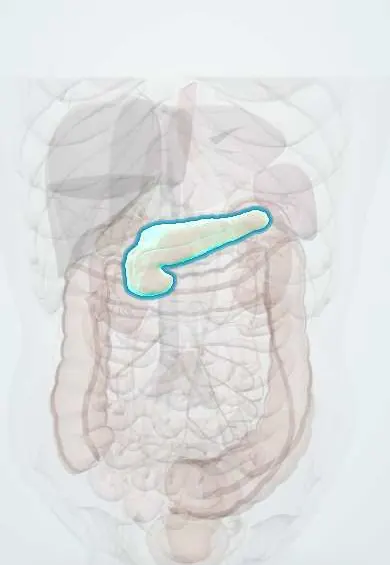
Transplantation that restores the patient's own insulin production, mainly in type 1 diabetes. A whole pancreas from a deceased donor is placed in the lower abdomen, most often together with a kidney (simultaneous pancreas–kidney), or after a kidney, or alone. In islet transplantation, the insulin-producing islets are separated from a donor pancreas and infused into the portal vein, where they lodge in the liver.
Who gets it
Pancreas transplantation is far less common than kidney or liver transplantation and is done in specialised centres; most are simultaneous pancreas–kidney transplants in adults with type 1 diabetes and kidney failure. Islet transplantation is offered in a limited number of programmes worldwide. In Colombia, pancreas and islet transplants are performed in very few centres, and most people with diabetes and kidney failure receive a kidney alone.
Causes
- Type 1 diabetes with end-stage kidney disease: simultaneous pancreas–kidney transplant (the commonest indication)
- Type 1 diabetes with a functioning kidney transplant: pancreas after kidney
- Type 1 diabetes with recurrent severe hypoglycaemia and hypoglycaemia unawareness despite optimal insulin therapy: pancreas alone or islet transplant
- Selected insulin-requiring type 2 diabetes with kidney failure (some centres)
- Autologous islet transplant after total pancreatectomy for chronic pancreatitis (the patient's own islets, no immunosuppression)
Risk factors
- Older donor or recipient age and donor obesity (more graft thrombosis and failure)
- Significant coronary or peripheral arterial disease in the recipient
- Obesity in the recipient
- Previous transplants and high antibody sensitisation
- Poor adherence to immunosuppression
Pathophysiology
In type 1 diabetes, autoimmune destruction of beta cells → no insulin → hyperglycaemia, insulin dependence and, over years, kidney, eye and nerve damage; intensive insulin brings a risk of severe hypoglycaemia, and some patients lose their warning symptoms. A transplanted pancreas or islets → insulin released in response to glucose → normal or near-normal glucose without injections and without severe hypoglycaemia. The graft is foreign → immunosuppression is needed to prevent rejection, and the original autoimmunity can attack the new beta cells. A whole pancreas has low blood flow through its vessels → venous thrombosis in the first days is the main technical cause of early loss. The exocrine part still makes enzymes → they are drained into the bowel (enteric drainage) or bladder.
Classification
- Simultaneous pancreas–kidney (SPK): both organs from the same deceased donor; best long-term pancreas graft survival
- Pancreas after kidney (PAK): pancreas added after a living- or deceased-donor kidney transplant
- Pancreas transplant alone (PTA): for life-threatening hypoglycaemia with preserved kidney function
- Exocrine drainage: enteric (to small bowel, now the usual) or bladder (allows urinary amylase monitoring, but causes cystitis, dehydration and acidosis)
- Islet transplantation: allogeneic (donor islets, needs immunosuppression, often more than one infusion) or autologous (own islets after pancreatectomy)
Symptoms and signs
- Before transplant: unstable glucose, recurrent severe hypoglycaemia without warning, symptoms of kidney failure
- After a successful graft: no insulin needed, normal glucose and HbA1c
- Graft thrombosis: sudden rise in glucose, pain and swelling over the graft, sometimes haematuria (bladder drainage)
- Graft pancreatitis or leak: abdominal pain, fever, ileus
- Rejection: often silent at first; later rising glucose, or a rising creatinine in the kidney from the same donor
Diagnosis
- Clinical
- Selection by a transplant team: type and duration of diabetes, frequency and severity of hypoglycaemia, kidney function, cardiovascular fitness (coronary disease is common and screened for), weight and ability to adhere to treatment. After transplant: glucose, graft site, fever and drug adverse effects.
- Tests
- Before: C-peptide (absent in type 1 diabetes), HbA1c, kidney function, blood group, HLA typing and antibody screen, infection serologies, cardiac testing. After: glucose, C-peptide, amylase and lipase, urinary amylase in bladder-drained grafts, creatinine, immunosuppressant drug levels, donor-specific antibodies, CMV and BK virus monitoring. Graft biopsy confirms rejection.
- Imaging
- Doppler ultrasound or CT angiography of the graft to detect vessel thrombosis, collections or pancreatitis; CT for suspected leak or abscess. For islet infusion, ultrasound or fluoroscopy guides the percutaneous portal vein puncture; Doppler afterwards checks for portal vein thrombosis.
Differential diagnosis
- For worsening glucose after transplant: graft thrombosis, rejection, recurrent autoimmunity, drug-induced diabetes (tacrolimus, steroids)
- For pain and fever: graft pancreatitis, enteric leak, abscess, opportunistic infection
- For rising creatinine: kidney rejection, calcineurin-inhibitor toxicity, BK virus nephropathy, urinary obstruction
- Alternatives to transplant for hypoglycaemia: insulin pumps with continuous glucose monitoring and automated insulin delivery
Whole pancreas or islets?
| Feature | Whole pancreas transplant | Islet transplant |
|---|---|---|
| Procedure | Major abdominal surgery; graft in the lower abdomen joined to iliac vessels | Islets infused into the portal vein through the skin; they settle in the liver |
| Usual candidate | Type 1 diabetes with kidney failure (SPK) or after kidney | Type 1 diabetes with severe hypoglycaemia unawareness, not fit for or not wanting major surgery |
| Insulin independence | Most at one year, often lasting many years | Often achieved, but frequently wanes; protection from severe hypoglycaemia lasts longer |
| Main risks | Graft thrombosis, leak, pancreatitis, surgical complications | Bleeding or portal vein thrombosis; often needs more than one donor |
| Immunosuppression | Lifelong | Lifelong (except autologous islets) |
Goal of treatment
Restore insulin production so the patient is free of severe hypoglycaemia and, ideally, of insulin, with a kidney if needed, while preventing rejection and limiting the harms of immunosuppression.
Treatment
- Surgical
- Whole pancreas transplant: the donor pancreas with a segment of donor duodenum is placed in the lower abdomen, its artery and vein joined to the iliac vessels (or venous drainage into the portal system), and its duodenal segment joined to small bowel or bladder; in SPK the kidney goes on the other side.
- Procedure
- Islet transplant: islets are isolated from a donor pancreas in a laboratory and infused slowly into the portal vein through a percutaneous catheter, under ultrasound or fluoroscopic guidance.
- Medical
- Immunosuppression: induction with antibody therapy, then maintenance with a calcineurin inhibitor (tacrolimus), an antiproliferative agent (mycophenolate) and sometimes corticosteroids; prophylaxis against CMV, Pneumocystis and fungal infection.
- Medical
- Early anticoagulation or antiplatelet therapy in many centres to reduce graft thrombosis, balanced against bleeding risk.
- Follow-up
- Lifelong follow-up of glucose, C-peptide, pancreatic enzymes, creatinine, drug levels, infections, skin cancers and cardiovascular risk.
- Surgical
- Return to theatre for graft thrombosis (usually graft removal), leaks or bleeding.
Complications
- Graft thrombosis and early graft loss
- Graft pancreatitis, enteric or bladder leak, intra-abdominal abscess
- Bleeding, especially with anticoagulation
- Acute and chronic rejection
- Opportunistic infection (CMV, BK virus, fungal) and post-transplant lymphoproliferative disorder
- Drug toxicity: kidney damage, new-onset hypertension, bone marrow suppression
- Bladder-drainage problems: cystitis, haematuria, dehydration and metabolic acidosis
- Islet infusion: bleeding from the liver puncture, portal vein thrombosis
Common traps
- Pancreas transplant is a cure for anyone with diabetes: it is offered mainly to people with type 1 diabetes and kidney failure or life-threatening hypoglycaemia, because lifelong immunosuppression outweighs the benefit in most others
- The recipient's own pancreas is removed: it is left in place; the new pancreas is added in the lower abdomen
- Islets are transplanted into the pancreas: they are infused into the portal vein and live in the liver
- A normal glucose means no rejection: pancreas rejection is often silent until most of the graft is damaged; in SPK, a rising creatinine from the same donor kidney can be the first clue
- Islet transplant means insulin freedom for life: insulin independence often fades over years, though protection from severe hypoglycaemia tends to persist
Prognosis
Patient survival after simultaneous pancreas–kidney transplant is high, and most pancreas grafts still work at five years; a working pancreas stabilises or slows diabetic complications and improves quality of life. Islet grafts often stop giving full insulin independence over a few years but usually continue to prevent severe hypoglycaemia.
Prevention
- Good glucose control and kidney protection in type 1 diabetes to delay kidney failure
- Use of continuous glucose monitoring and automated insulin delivery, which reduce severe hypoglycaemia and may avoid the need for transplant
- Early referral to a transplant centre when kidney failure approaches in type 1 diabetes
- Adherence to immunosuppression and infection prophylaxis after transplant
- Organ donation programmes that increase available donors
Test yourself
Think of the answer, then tap the question to see it.
A 38-year-old with type 1 diabetes since childhood is starting dialysis. Why is a simultaneous pancreas–kidney transplant often preferred over a kidney alone?
He will need lifelong immunosuppression for the kidney anyway, so adding a pancreas frees him from insulin and hypoglycaemia and protects the new kidney from diabetic damage, for little extra immunological cost.
Two days after a pancreas transplant, glucose suddenly rises and the graft is tender. What is the likely cause, and how is it confirmed?
Graft vessel thrombosis, the main early technical failure. Doppler ultrasound or CT angiography shows absent flow; it usually needs urgent surgery and often graft removal.
Where do infused islets end up, and why that route?
In the liver: they are infused into the portal vein and lodge in small portal branches, where they get a blood supply, with only a percutaneous procedure instead of major surgery.
Why is pancreas rejection monitored partly by watching the kidney in an SPK recipient?
Both organs come from the same donor and are often rejected together; creatinine rises earlier than glucose, which climbs only after most of the pancreas is damaged.
Connections
Educational information, not medical advice. For any symptom, see a health professional.
Sources: Pancreas Transplantation (StatPearls (NCBI Bookshelf), 2023); Pancreatic Islet Transplantation (National Institute of Diabetes and Digestive and Kidney Diseases (NIDDK), 2018); Pancreas Transplant (MedlinePlus (U.S. National Library of Medicine), 2026).
Spotted a mistake?We are always improving for the community. Tell us what is wrong and our team will review it.Report a mistake
Representative model, for educational purposes only.