Conditions · Hematology and oncology
Pancreatic neuroendocrine tumours (VIPoma, glucagonoma, somatostatinoma, non-functioning) !
Rare tumours of the hormone-making islet cells of the pancreas. Some flood the body with a hormone; most make none and are found late or by chance.
Updated 2026-11-01
Structures involved
Tap one to see what it is and open it in 3D.
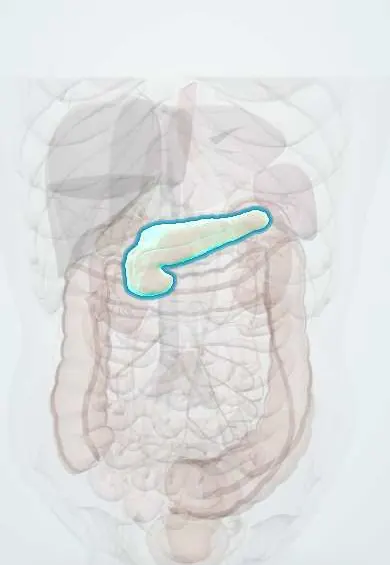
- Pancreas
- Duodenum
- Pancreatic duct
- Common bile duct
- Gallbladder
- Liver
- Portal vein
- Splenic vein
- Superior mesenteric artery
- Celiac and gastric lymph nodes
Why it happens
- Hereditary cancer syndromes: the table to know
- Immunohistochemistry: the principle and the markers to know
- Gastrointestinal hormones
- Water and electrolyte absorption and how diarrhea happens
- Islets of Langerhans: α, β, δ cells
What it is
Neoplasms arising from the endocrine (islet) cells of the pancreas. Functioning tumours cause a syndrome from excess hormone (insulinoma and gastrinoma have their own pages; VIPoma, glucagonoma and somatostatinoma are covered here), while non-functioning tumours, now the majority, present with mass effect, metastases or as incidental findings.
Who gets it
Rare, under 2–3% of pancreatic tumours, but rising in number as more abdominal CT scans are done. Peak age is 40–60. VIPoma, glucagonoma and somatostatinoma are very rare. Most cases are sporadic; about 10% are linked to hereditary syndromes. Growth is usually slow, and survival is much better than for pancreatic adenocarcinoma.
Causes
- Mostly sporadic (MEN1, DAXX/ATRX and mTOR pathway mutations in the tumour)
- Multiple endocrine neoplasia type 1 (often multiple tumours)
- Von Hippel–Lindau disease
- Neurofibromatosis type 1 (duodenal somatostatinoma)
- Tuberous sclerosis
Risk factors
- Family history of MEN1 or von Hippel–Lindau disease
- Personal history of hyperparathyroidism or pituitary tumour (MEN1)
- Middle age
Pathophysiology
Islet cells that turn malignant keep their ability to store and release peptide hormones. VIP stimulates intestinal secretion of water, potassium and bicarbonate and inhibits gastric acid, causing massive watery diarrhoea. Excess glucagon breaks down protein and fat, raising blood sugar and lowering amino acid levels, which produces the typical skin rash, weight loss and a clotting tendency. Somatostatin inhibits insulin, pancreatic enzymes and gallbladder contraction. Non-functioning tumours secrete nothing that causes symptoms, so they grow until they press on bile ducts or spread to the liver.
Classification
- Functioning: insulinoma, gastrinoma, VIPoma, glucagonoma, somatostatinoma and rarer types (ACTH, PTHrP, GHRH)
- Non-functioning
- WHO grade by Ki-67 index and mitotic rate: well-differentiated NET G1, G2, G3; poorly differentiated neuroendocrine carcinoma
- TNM stage; sporadic versus hereditary
Symptoms and signs
- VIPoma (WDHA): large-volume watery diarrhoea that continues with fasting, hypokalaemia with weakness, and low gastric acid; also flushing and dehydration
- Glucagonoma: necrolytic migratory erythema (a spreading, blistering red rash on the groin, buttocks and legs), new diabetes, weight loss, sore red tongue, venous thrombosis and depression
- Somatostatinoma: diabetes, gallstones, steatorrhoea and diarrhoea, weight loss
- Non-functioning: abdominal pain, weight loss, jaundice or an incidental mass
- Liver enlargement from metastases
Diagnosis
- Clinical
- Think of a pNET in secretory diarrhoea that persists while fasting, in a typical migratory rash with new diabetes, or in a well-defined pancreatic mass. Look for features of MEN1.
- Tests
- Fasting serum VIP, glucagon or somatostatin according to the syndrome; chromogranin A as a general marker; electrolytes (low potassium, normal anion gap acidosis in VIPoma), glucose and HbA1c. Biopsy, often by endoscopic ultrasound, confirms the diagnosis and gives the Ki-67 grade. Calcium, parathyroid hormone and genetic testing when MEN1 is possible.
- Imaging
- Multiphase contrast CT or MRI (tumours enhance brightly in the arterial phase); endoscopic ultrasound for small tumours; somatostatin receptor PET (gallium-68 labelled analogues) to stage and to select patients for receptor-targeted therapy.
Differential diagnosis
- Pancreatic ductal adenocarcinoma
- Solid pseudopapillary neoplasm and other cystic pancreatic tumours
- Infectious or inflammatory causes of chronic diarrhoea, laxative misuse
- Other causes of necrolytic rash (zinc deficiency, pellagra)
- Gastrinoma and insulinoma
- Metastases to the pancreas (for example from renal cell carcinoma)
Goal of treatment
Resect the tumour when possible, control hormone excess and its metabolic effects, and slow growth of metastatic disease.
Treatment
- Acute
- Intravenous fluids and potassium replacement for VIPoma diarrhoea; anticoagulation or prophylaxis for thrombosis in glucagonoma; glucose control.
- Surgical
- Surgery is the only cure: enucleation, distal pancreatectomy or pancreaticoduodenectomy according to site, with node dissection; resection of liver metastases in selected patients. Small non-functioning tumours under about 2 cm may be followed.
- Medical
- Somatostatin analogues (octreotide, lanreotide) control hormone symptoms and slow growth; targeted therapy (everolimus, sunitinib), chemotherapy (capecitabine–temozolomide) and peptide receptor radionuclide therapy for advanced disease.
- Procedure
- Liver-directed treatments such as ablation, chemoembolisation or radioembolisation for unresectable liver metastases.
- Follow-up
- Long-term imaging and tumour marker follow-up; nursing care monitors fluid balance, daily weight, potassium and glucose, skin care for the rash and screening of relatives in hereditary forms.
Complications
- Severe dehydration and hypokalaemia (VIPoma)
- Venous thromboembolism and malnutrition (glucagonoma)
- Diabetes and gallstones (somatostatinoma, glucagonoma)
- Liver metastases
- Pancreatic insufficiency or diabetes after pancreatic surgery
Prognosis
Much better than pancreatic adenocarcinoma. Low-grade localised tumours are often cured by surgery, and even patients with liver metastases may live many years; outlook worsens with higher grade, large size and widespread metastases. Glucagonoma and somatostatinoma are usually malignant and metastatic at diagnosis.
Test yourself
Think of the answer, then tap the question to see it.
What does WDHA stand for in VIPoma?
Watery diarrhoea, hypokalaemia and achlorhydria.
Which rash is characteristic of glucagonoma?
Necrolytic migratory erythema.
What triad suggests somatostatinoma?
Diabetes, gallstones and steatorrhoea.
Which hereditary syndrome most often causes multiple pancreatic neuroendocrine tumours?
Multiple endocrine neoplasia type 1 (MEN1).
Which drug class controls hormone symptoms in most functioning pNETs?
Somatostatin analogues such as octreotide.
Related conditions
- Insulinoma
- Zollinger-Ellison syndrome (gastrinoma)
- Carcinoid syndrome
- Multiple endocrine neoplasia (MEN 1, 2A, 2B)
- Neurofibromatosis (types 1 and 2)
- Pancreatic cancer
- Chronic pancreatitis
- Type 2 diabetes mellitus
- Gallstones (cholelithiasis)
- Deep vein thrombosis
- Hypokalaemia
- Normal anion gap (hyperchloraemic) metabolic acidosis
- Hypoglycaemia (including insulin-induced)
Educational information, not medical advice. For any symptom, see a health professional.
Sources: Pancreatic Neuroendocrine Tumors (Islet Cell Tumors) Treatment (PDQ®)–Health Professional Version (National Cancer Institute, 2025); European Neuroendocrine Tumor Society 2023 guidance paper for functioning pancreatic neuroendocrine tumour syndromes (Journal of Neuroendocrinology (PubMed), 2023).
Spotted a mistake?We are always improving for the community. Tell us what is wrong and our team will review it.Report a mistake
Representative model, for educational purposes only.