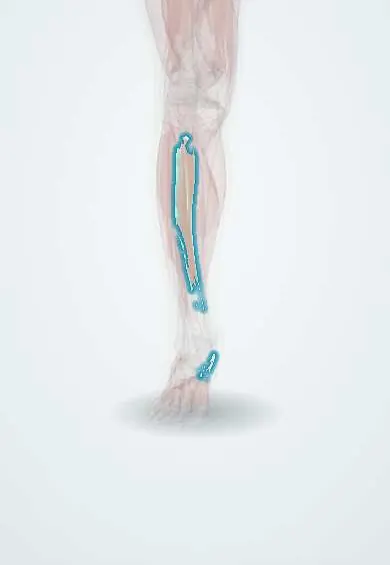
Flatfoot (pes planus) !
Flatfoot (pes planus) is a low or absent inner arch of the foot; it can be flexible, with the arch returning on tiptoe, or rigid.
Updated 2026-10-29
Structures involved
Tap one to see what it is and open it in 3D.
- Tibialis posterior
- Navicular
- Spring ligament
- Talus
- Calcaneus
- Deltoid ligament
- Flexor digitorum longus
- Plantar fascia
- Medial cuneiform
- First metatarsal
What it is
Loss or lowering of the medial longitudinal arch of the foot, often with heel valgus and forefoot abduction. It is described as flexible, when the arch reappears off weight bearing or on tiptoe, or rigid.
Who gets it
Flexible flatfoot is normal in infants and young children and is usually painless. Adult-acquired flatfoot is most common in middle-aged and older women and is mostly due to posterior tibial tendon dysfunction.
Causes
- Flexible flatfoot: normal development and ligament laxity
- Rigid flatfoot in children: tarsal coalition, congenital vertical talus, neuromuscular disease
- Adult-acquired: posterior tibial tendon dysfunction, spring ligament failure
- Inflammatory arthritis, Charcot neuroarthropathy or trauma
Risk factors
- Obesity
- Female sex and older age (adult-acquired form)
- Hypertension and diabetes
- Corticosteroid injections or use
- Rheumatoid arthritis
- Generalized joint laxity
Pathophysiology
The arch is held by bones, the spring ligament and plantar fascia, and the tibialis posterior tendon. In adults, degeneration of this tendon behind the medial malleolus lets the spring ligament stretch and the talar head drop, so the heel moves into valgus and the forefoot abducts. Over time the deformity becomes fixed and the joints wear out.
Classification
- Flexible or rigid
- Pediatric (physiologic, tarsal coalition, vertical talus) or adult-acquired
- Posterior tibial tendon dysfunction is staged from tendon inflammation to fixed deformity and ankle involvement (Johnson–Strom stages and newer systems)
Symptoms and signs
- Low or absent arch on standing
- Pain and swelling behind the medial malleolus along the tibialis posterior tendon
- Later pain on the outer side of the hindfoot from impingement
- Fatigue, difficulty walking far or on uneven ground
- Many children and adults have no symptoms
Diagnosis
- Clinical
- Standing inspection from behind (heel valgus, «too many toes» sign), the tiptoe or great-toe raise test to see if the arch reappears (flexible), the single-leg heel rise test for tibialis posterior function, and subtalar motion.
- Tests
- Usually no lab tests; inflammatory markers if inflammatory arthritis is suspected.
- Imaging
- Weight-bearing X-rays assess the arch and alignment (for example the talus–first metatarsal angle). MRI or ultrasound show the tibialis posterior tendon; CT shows tarsal coalition.
Differential diagnosis
- Tarsal coalition
- Congenital vertical talus
- Charcot neuroarthropathy
- Tarsal tunnel syndrome
- Inflammatory arthritis of the midfoot
Goal of treatment
Relieve pain and keep function. A painless flexible flatfoot in a child needs no treatment; in adults, the aim is to stop progression and keep a stable, plantigrade foot.
Treatment
- Follow-up
- Painless flexible flatfoot in children: reassurance and observation, since most arches develop with growth.
- Conservative
- Supportive shoes and orthoses for symptomatic cases; a boot for a short period in early tendon inflammation, then an ankle-foot orthosis if needed.
- Rehabilitation
- Calf stretching and strengthening of the tibialis posterior and intrinsic foot muscles.
- Medical
- NSAIDs for pain; weight control and treatment of inflammatory disease.
- Surgical
- Flexible deformity: tendon transfer with heel-bone osteotomy or lateral column lengthening. Rigid or arthritic deformity: hindfoot fusion. Tarsal coalition: resection or fusion.
Complications
- Rupture of the tibialis posterior tendon
- Fixed deformity and arthritis of the hindfoot
- Lateral impingement pain
- Ankle valgus from deltoid ligament failure
- Hallux valgus
Prognosis
Flexible flatfoot in children rarely causes problems. Adult-acquired flatfoot tends to progress without treatment; early care can control it, while late stages need surgery.
Prevention
- Weight control
- Early assessment of medial ankle pain in adults
Test yourself
Think of the answer, then tap the question to see it.
How is a flexible flatfoot told apart from a rigid one?
In a flexible flatfoot the arch reappears on tiptoe or with a big-toe raise; in a rigid flatfoot it does not.
What is the most common cause of adult-acquired flatfoot?
Posterior tibial tendon dysfunction.
What is the «too many toes» sign?
Viewed from behind, more lateral toes are visible on the affected side because the forefoot is abducted.
Which bedside test checks tibialis posterior function?
The single-leg heel rise; patients cannot rise or the heel does not swing into varus.
Which cause should be suspected in an adolescent with a painful rigid flatfoot?
Tarsal coalition, best seen on CT.
Related conditions
- Tarsal tunnel syndrome
- Hallux valgus (bunion)
- Plantar Fasciitis
- Obesity
- Rheumatoid arthritis
- Type 2 diabetes mellitus
- Medial tibial stress syndrome (shin splints)
- Clubfoot (talipes equinovarus)
Educational information, not medical advice. For any symptom, see a health professional.
Sources: Pes Planus (StatPearls (NCBI Bookshelf), 2026).
Spotted a mistake?We are always improving for the community. Tell us what is wrong and our team will review it.Report a mistake
Representative model, for educational purposes only.