
Thyroidectomy and its complications
Removing all or half of the thyroid. Know three risks: a hoarse voice (nerve), low calcium (parathyroids) and a neck bleed that blocks the airway.
What it is
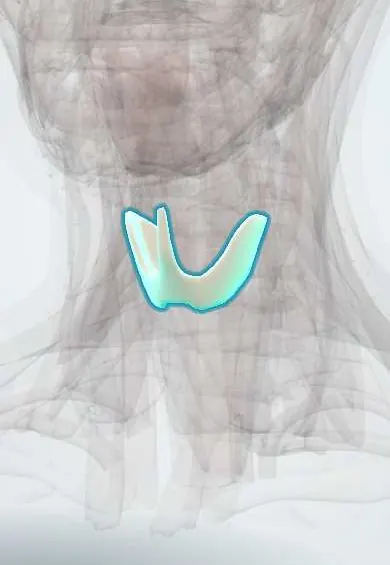
Surgical removal of the thyroid gland: one lobe with the isthmus (hemithyroidectomy or lobectomy) or the whole gland (total thyroidectomy), sometimes with removal of the lymph nodes of the central or lateral neck. It is done for cancer or suspicious nodules, goitres that compress or grow behind the sternum, and hyperthyroidism that needs definitive treatment.
Who gets it
One of the commonest operations in general and endocrine surgery. Thyroid nodules are very common, and thyroid cancer diagnoses have risen with ultrasound use; goitre remains relevant in parts of Latin America, including Colombia, despite salt iodisation. Experienced, high-volume surgeons have markedly lower rates of nerve injury and permanent hypoparathyroidism.
Causes
- Thyroid cancer or a nodule with indeterminate or suspicious cytology
- Goitre causing compression (breathlessness, swallowing difficulty), retrosternal extension or cosmetic concern
- Graves disease or toxic nodular goitre needing definitive treatment (failed or unsuitable antithyroid drugs or radioiodine, large goitre, eye disease, pregnancy planning)
- Prophylactic thyroidectomy in RET mutation carriers (multiple endocrine neoplasia type 2)
- Combined thyroid and parathyroid disease operated at the same time
Risk factors
- Total thyroidectomy, reoperation and central neck dissection (higher nerve and parathyroid risk)
- Large or retrosternal goitre
- Graves disease (vascular, inflamed gland)
- Locally invasive cancer
- Low surgeon volume
- Vitamin D deficiency before surgery (more postoperative hypocalcaemia)
Pathophysiology
Removing the gland ends thyroid hormone production → after total thyroidectomy, lifelong levothyroxine. Dissection near the parathyroids bruises, devascularises or removes them (their blood comes from the inferior thyroid artery) → parathyroid hormone falls → serum calcium drops within 24 to 48 hours → perioral and fingertip tingling, cramps, tetany, laryngospasm, seizures and long QT. Traction, heat or cutting of the recurrent laryngeal nerve → paralysis of the vocal fold on that side → hoarseness; both sides → the folds lie near the midline → stridor and airway obstruction. Bleeding under the strap muscles in a closed space → pressure on the veins and lymphatics of the larynx → laryngeal oedema → airway obstruction, often within hours of surgery.
Classification
- Hemithyroidectomy (lobectomy plus isthmus): for a single-sided nodule or low-risk small cancer; usually keeps enough thyroid function
- Total or near-total thyroidectomy: for bilateral disease, higher-risk cancer, Graves disease and large multinodular goitre
- Completion thyroidectomy: removing the remaining lobe after a lobectomy showed cancer
- Neck dissection: central compartment (level VI) or lateral neck, for nodal disease
- Approach: conventional collar incision, minimally invasive or remote-access (endoscopic, transoral) in selected centres
- Complications: early (haematoma, hypocalcaemia, nerve palsy, thyroid storm if hyperthyroid) and late (permanent hypoparathyroidism, permanent palsy, hypothyroidism)
Symptoms and signs
- Normal recovery: sore throat, mild neck pain and slight voice tiredness for a few days
- Hypocalcaemia: tingling around the mouth and in the fingers, muscle cramps, carpal spasm; Chvostek and Trousseau signs
- Recurrent laryngeal nerve injury: hoarse, breathy or weak voice, weak cough, choking on liquids
- Superior laryngeal nerve (external branch) injury: loss of high notes and voice fatigue, often subtle
- Neck haematoma: rapidly increasing neck swelling, tightness, pain, difficulty swallowing, then noisy breathing
Diagnosis
- Clinical
- Before surgery: confirm the indication (nodule cytology, hyperthyroidism control), document the voice and examine the vocal folds by laryngoscopy, especially if the voice is abnormal, the cancer is invasive or the neck has been operated on before. After surgery: ask about tingling and cramps, test Chvostek and Trousseau signs, listen to the voice, and inspect the neck and drain regularly in the first hours.
- Tests
- Before: thyroid function and, in hyperthyroidism, a euthyroid state before operating; calcium and vitamin D; fine-needle aspiration cytology of nodules; calcitonin when medullary cancer is suspected. After total thyroidectomy: serum calcium and parathyroid hormone (an early low PTH predicts hypocalcaemia), magnesium, and ECG if calcium is low. Thyroid function some weeks later to adjust levothyroxine; thyroglobulin for cancer follow-up.
- Imaging
- Neck ultrasound of the thyroid and lymph nodes before surgery; CT of the neck and chest (iodinated contrast used only with care in hyperthyroidism and before planned radioiodine) for retrosternal goitre or invasive cancer. Flexible laryngoscopy shows vocal fold movement before and after surgery.
Differential diagnosis
- Hoarseness from intubation trauma or laryngeal oedema rather than nerve injury
- Hypocalcaemia from hungry bone syndrome after surgery for long-standing hyperthyroidism or hyperparathyroidism
- Hypomagnesaemia worsening hypocalcaemia
- Seroma or wound infection rather than haematoma
- Anxiety-related hyperventilation causing tingling
- Thyroid storm versus sepsis or malignant hyperthermia in the early postoperative period
After thyroidectomy: which neighbour was hurt?
| Problem | When | Clue | First action |
|---|---|---|---|
| Neck haematoma | Hours, usually the first 6 to 24 | Tense, growing swelling, then stridor | Open skin and strap sutures at the bedside, then theatre |
| Hypocalcaemia (parathyroid injury) | 24 to 72 hours | Tingling, cramps, Chvostek and Trousseau signs, low PTH | Calcium and calcitriol; intravenous calcium if severe |
| Unilateral recurrent nerve palsy | On waking | Hoarse, breathy voice, weak cough | Laryngoscopy, voice therapy; most recover |
| Bilateral recurrent nerve palsy | At extubation | Stridor with a near-normal voice | Reintubate; tracheostomy if no recovery |
| Thyroid storm | During surgery or first day, if hyperthyroid | Fever, tachycardia, agitation | Beta-blocker, antithyroid drug, steroid, cooling, ICU |
Goal of treatment
Remove the diseased thyroid with the right extent for the disease, keep the recurrent laryngeal nerves and parathyroids working, and recognise a neck haematoma or low calcium before they become dangerous.
Treatment
- Medical
- Before surgery for hyperthyroidism: make the patient euthyroid with antithyroid drugs and a beta-blocker; in Graves disease, potassium iodide is often given for a short time before surgery to reduce gland vascularity. Correct vitamin D deficiency.
- Surgical
- Thyroidectomy through a collar incision: the strap muscles are separated in the midline, the superior pole vessels are tied close to the gland to spare the superior laryngeal nerve, the recurrent laryngeal nerve is identified and protected, and the parathyroids are preserved with their blood supply; a devascularised parathyroid is minced and reimplanted into a neck muscle.
- Follow-up
- Intraoperative nerve monitoring is used by many surgeons, especially for reoperations and large goitres; if signal is lost on the first side, the second side may be postponed to avoid bilateral palsy. After surgery, the neck is observed closely and calcium or PTH is checked.
- Acute
- Neck haematoma with airway compromise: open the skin and strap-muscle sutures at the bedside to release the blood and pressure, give oxygen, call for help, then return to theatre to stop the bleeding and secure the airway.
- Medical
- Hypocalcaemia: oral calcium, with calcitriol (active vitamin D) when PTH is low; intravenous calcium gluconate for tetany, laryngospasm, seizures or prolonged QT; correct magnesium. Most cases are temporary.
- Medical
- Thyroid hormone replacement with levothyroxine after total thyroidectomy (and after lobectomy if the remaining lobe is insufficient); in cancer, the target is set by risk, and radioiodine may follow.
- Rehabilitation
- Voice therapy for vocal fold palsy; injection or medialisation of a paralysed fold if the voice does not recover; tracheostomy or lateralisation procedures for bilateral palsy.
Complications
- Neck haematoma with airway obstruction
- Temporary or permanent hypoparathyroidism and hypocalcaemia
- Unilateral or bilateral recurrent laryngeal nerve palsy
- External branch of the superior laryngeal nerve injury (loss of vocal pitch)
- Hypothyroidism
- Thyroid storm in inadequately prepared hyperthyroid patients
- Wound infection, seroma, hypertrophic scar
- Chyle leak after lateral neck dissection, tracheal injury (rare)
Common traps
- A neck haematoma should first go to CT or theatre: if the airway is threatened, open the wound and strap sutures at the bedside immediately; the delay of transfer can be fatal
- A normal voice after surgery rules out recurrent nerve injury: in bilateral palsy the folds sit near the midline, so the voice can be near normal while the airway is critically narrowed
- Hypocalcaemia appears in the recovery room: it usually starts 24 to 48 hours after surgery, which is why calcium or PTH is checked before discharge and patients are told the symptoms
- Lobectomy carries the same parathyroid risk as total thyroidectomy: permanent hypoparathyroidism needs all parathyroids affected, which is very unlikely when one side is untouched
- Hyperthyroid patients can go straight to surgery: operating on an uncontrolled gland risks thyroid storm; make them euthyroid first
Prognosis
Most patients go home within a day or two and recover fully. Temporary hypocalcaemia and voice change are fairly common after total thyroidectomy and usually recover within weeks to months; permanent hypoparathyroidism and permanent nerve palsy are uncommon in experienced hands. Long-term outcome is mainly that of the underlying disease, with lifelong levothyroxine after total thyroidectomy.
Prevention
- Choose the right extent: lobectomy when it is enough avoids most parathyroid and bilateral nerve risk
- Surgery by experienced, high-volume thyroid surgeons
- Make hyperthyroid patients euthyroid before operating
- Routinely identify the recurrent laryngeal nerve and preserve the parathyroids with their blood supply
- Check calcium or PTH after total thyroidectomy and teach patients the symptoms of low calcium and of a neck bleed before discharge
Test yourself
Think of the answer, then tap the question to see it.
Four hours after total thyroidectomy, the neck is swelling and the patient is stridulous. What do you do first, and why there?
Open the skin and strap-muscle sutures at the bedside to evacuate the haematoma, give oxygen and call for help, then go to theatre. The blood compresses laryngeal veins and causes airway oedema; minutes count.
On day two after total thyroidectomy, a patient has perioral tingling and a positive Trousseau sign. Cause and management?
Hypocalcaemia from parathyroid injury or devascularisation. Check calcium, PTH and magnesium, give oral calcium with calcitriol, and intravenous calcium gluconate if there is tetany, laryngospasm or long QT.
Why can bilateral recurrent laryngeal nerve palsy present with stridor but a nearly normal voice?
Both vocal folds lie close to the midline (paramedian), so they still meet for voice but cannot open, leaving a very narrow airway.
Why is the inferior thyroid artery handled close to the gland rather than tied at its trunk?
The parathyroids draw most of their blood from its branches, and the recurrent laryngeal nerve crosses near it; ligating close to the gland protects both.
Why it happens
- Papillary thyroid carcinoma
- Goitre: diffuse and multinodular
- Follicular thyroid carcinoma and NIFTP
- Graves disease
- Thyroid nodule and follicular adenoma
- Medullary thyroid carcinoma
Connections
Educational information, not medical advice. For any symptom, see a health professional.
Sources: Thyroidectomy (StatPearls (NCBI Bookshelf), 2024); Recurrent Laryngeal Nerve Injury (StatPearls (NCBI Bookshelf), 2023); Thyroid gland removal (MedlinePlus (U.S. National Library of Medicine), 2026).
Spotted a mistake?We are always improving for the community. Tell us what is wrong and our team will review it.Report a mistake
Representative model, for educational purposes only.