
Vertebrobasilar insufficiency (posterior circulation TIA)
Short spells of too little blood to the back of the brain: dizziness with double vision, slurred speech or unsteadiness. It can warn of a stroke.
What it is
Transient ischaemia of the territory of the vertebral and basilar arteries (brainstem, cerebellum, thalami and occipital lobes), causing brief episodes of brainstem or visual symptoms that resolve completely. It is a posterior circulation transient ischaemic attack and, like any TIA, a warning of stroke.
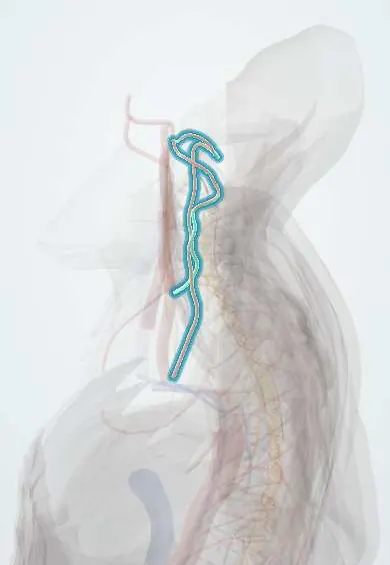
Who gets it
About one in five strokes involves the posterior circulation, and vertebrobasilar ischaemia shares its risk factors. It is more frequent in men from middle age onward.
Causes
- Atherosclerosis of the vertebral arteries (especially at their origin) or of the basilar artery: the commonest cause
- Embolism from the heart (for example atrial fibrillation) or from a plaque upstream
- Vertebral artery dissection
- Subclavian steal: a stenosis of the subclavian artery before the vertebral origin reverses vertebral flow when the arm works
- Less common: fibromuscular dysplasia, clotting disorders, drug use, compression of a vertebral artery on head turning
Risk factors
- Hypertension
- Smoking
- Diabetes and dyslipidaemia
- Obesity
- Older age and male sex
- Atrial fibrillation and other sources of cardiac emboli
Pathophysiology
A vertebral or basilar plaque narrows the lumen or sheds emboli, or a dissection or a cardiac clot reaches the posterior circulation → a branch (basilar perforators, the posterior inferior or anterior inferior cerebellar artery, the superior cerebellar or posterior cerebral artery) briefly loses flow → the neurons it feeds stop working but do not die → the structures packed into that territory fail together, and recover within minutes once flow returns. The inner ear is fed by the labyrinthine artery, a small end-artery usually from the anterior inferior cerebellar artery, so vertigo can be an early sign; but a vascular cause usually adds other signs. In subclavian steal, arm exercise lowers pressure beyond a proximal subclavian stenosis and blood is drawn down the vertebral artery, away from the brainstem.
Classification
- Transient (TIA: full recovery, no infarct on diffusion MRI) versus established posterior circulation stroke
- By mechanism: large-artery atherosclerosis, embolism, dissection, or low flow (subclavian steal, severe stenosis of both vertebral arteries)
- By site: vertebral origin and intracranial vertebral artery, basilar artery, top of the basilar and posterior cerebral arteries
Symptoms and signs
- The 5 Ds: dizziness (vertigo), diplopia, dysarthria, dysphagia and dystaxia (unsteady gait or clumsy limbs), usually several together
- Loss of vision in both eyes or in one half of the visual field (occipital lobes)
- Weakness or numbness on one or both sides, sometimes crossed (face on one side, body on the other)
- Drop attacks: sudden falls from leg weakness without loss of consciousness
- Nausea, vomiting and nystagmus; less often headache, confusion or tinnitus
- Arm pain or tiredness with brainstem symptoms while using the arm (subclavian steal)
Diagnosis
- Clinical
- Brief episodes with two or more posterior circulation features, complete recovery and vascular risk factors. Isolated, brief or positional dizziness, or chronic imbalance, rarely means vertebrobasilar ischaemia. A clear difference in blood pressure between the arms suggests subclavian steal. The bedside approach to acute vertigo is on the page «Acute vertigo: the stroke hiding as an ear problem».
- Tests
- Capillary glucose to exclude hypoglycaemia; blood count, clotting, electrolytes, lipids and HbA1c; ECG and cardiac rhythm monitoring for atrial fibrillation; echocardiography when an embolic source is suspected.
- Imaging
- Diffusion MRI is the most accurate way to show or exclude a small infarct; CT often misses small infarcts, especially in the posterior fossa. The vertebral and basilar arteries are shown with CT angiography or MR angiography; Doppler ultrasound can show reversed vertebral flow in subclavian steal. Catheter angiography is kept for unclear cases or treatment.
Differential diagnosis
- Benign paroxysmal positional vertigo
- Vestibular neuritis
- Ménière disease
- Vestibular migraine
- Orthostatic hypotension and presyncope
- Cardiac arrhythmia
- Hypoglycaemia
- Anxiety-related dizziness
Spells of dizziness: the arteries or the ear?
| Condition | Pattern of the dizziness | Company it keeps | What tells it apart |
|---|---|---|---|
| Vertebrobasilar insufficiency | Sudden spells of minutes, not set off by lying down | Diplopia, dysarthria, dysphagia, ataxia, visual or limb symptoms | Vascular risk factors; CT or MR angiography shows vertebrobasilar disease |
| Benign paroxysmal positional vertigo | Seconds, on rolling over in bed or looking up | No neurological signs | A positional test (Dix–Hallpike) reproduces it with typical nystagmus |
| Ménière disease | Attacks lasting hours | Fluctuating hearing loss, tinnitus, fullness in one ear | Hearing test shows low-frequency hearing loss |
| Subclavian steal | Brainstem symptoms while working the arm | Pain or tiredness in that arm | Lower blood pressure in that arm; reversed vertebral flow on Doppler |
Goal of treatment
Find the mechanism quickly and start secondary prevention, because the risk of stroke is highest in the first days after the episode.
Treatment
- Acute
- Urgent assessment as for any TIA: admission or a rapid-access clinic, imaging of the brain and of the vertebral and basilar arteries, and cardiac rhythm monitoring.
- Medical
- Antiplatelet treatment for atherosclerotic disease, or anticoagulation when a cardiac source of emboli such as atrial fibrillation is found.
- Medical
- A statin, blood pressure control, diabetes control and stopping smoking.
- Procedure
- Angioplasty and stenting of a vertebral, basilar or subclavian stenosis is considered for selected patients whose symptoms recur despite medical treatment.
- Lifestyle
- Regular physical activity, a healthy diet and a healthy weight.
Complications
- Posterior circulation ischaemic stroke, including brainstem and cerebellar infarction
- Basilar artery occlusion, with coma or a locked-in state
- Falls and injuries from drop attacks or ataxia
Common traps
- Isolated dizziness in an older patient is probably vertebrobasilar insufficiency: brief or positional dizziness alone is rarely vascular; vertebrobasilar ischaemia almost always brings company such as diplopia, dysarthria, ataxia or visual loss
- A normal head CT clears a posterior TIA: CT sees the posterior fossa poorly; diffusion MRI and imaging of the vertebral and basilar arteries are needed
- A posterior TIA is less urgent than a carotid one: it needs the same urgent work-up, and a missed basilar artery occlusion is devastating
- Drop attacks are a form of fainting: in vertebrobasilar ischaemia the patient falls from sudden leg weakness and stays conscious
- Subclavian steal is a heart problem: it is a stenosis of the subclavian artery before the vertebral origin; arm work draws blood down the vertebral artery, and unequal arm pressures are the clue
Prognosis
The symptoms resolve, but the episode marks an artery or a heart at risk. Stroke risk is highest in the first 24 to 48 hours and the following days; prompt work-up and secondary prevention lower it.
Prevention
- Blood pressure control
- Not smoking
- Statin and diabetes control when indicated
- Anticoagulation for atrial fibrillation when indicated
- Physical activity and a healthy weight
Test yourself
Think of the answer, then tap the question to see it.
A 68-year-old smoker has three 5-minute spells of vertigo with double vision and slurred speech, now resolved. What is the working diagnosis?
Vertebrobasilar insufficiency, a posterior circulation TIA: dizziness with other brainstem signs. He needs urgent diffusion MRI, imaging of the vertebral and basilar arteries and cardiac monitoring.
Why is dizziness alone rarely caused by vertebrobasilar ischaemia?
The brainstem packs many pathways close together, so ischaemia there usually causes several symptoms at once; isolated dizziness is far more often vestibular, orthostatic or cardiac.
A man gets dizzy and his left arm aches when he paints a ceiling. His left arm blood pressure is lower. What is happening?
Subclavian steal: a left subclavian stenosis before the vertebral origin; arm work reverses flow down the left vertebral artery and takes blood from the brainstem.
Which test best shows or excludes a small brainstem infarct after a posterior TIA?
Diffusion-weighted MRI; CT often misses small infarcts, especially in the posterior fossa.
What are the main secondary prevention measures after an atherosclerotic vertebrobasilar TIA?
Antiplatelet treatment, a statin, blood pressure and diabetes control and stopping smoking; anticoagulation instead if a cardiac source such as atrial fibrillation is found.
Connections
Educational information, not medical advice. For any symptom, see a health professional.
Sources: Pathophysiology and Diagnosis of Vertebrobasilar Insufficiency: A Review of the Literature (International Archives of Otorhinolaryngology (open access, PMC), 2017); Transient Ischemic Attack (TIA) (MSD Manual Professional Edition, 2026).
Spotted a mistake?We are always improving for the community. Tell us what is wrong and our team will review it.Report a mistake
Representative model, for educational purposes only.