
Exocrine pancreatic insufficiency
When the pancreas cannot make enough digestive enzymes, fat passes undigested: greasy stools, weight loss and missing vitamins A, D, E and K.
What it is
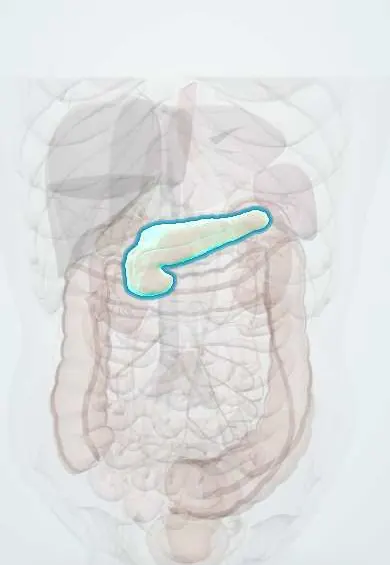
Too little pancreatic enzyme activity in the duodenum to digest food normally, above all too little lipase. Fat is digested poorly first, then protein, and the fat-soluble vitamins are lost with the undigested fat. Clear symptoms usually appear only when about 90% of enzyme output has been lost.
Who gets it
Its frequency in the general population is unknown, but it is common in pancreatic disease: chronic pancreatitis (30–90%, rising with years of disease), cystic fibrosis (80–90%), after a pancreaticoduodenectomy (about 80–95%) and with tumours of the pancreatic head (60–90%). It also occurs outside the pancreas, in type 1 and type 2 diabetes, after gastrectomy, in untreated coeliac disease and in older age. Because symptoms are vague, it is under-diagnosed.
Causes
- Loss of pancreatic tissue: chronic pancreatitis (alcohol, smoking, hereditary forms), severe necrotising acute pancreatitis, cystic fibrosis, autoimmune pancreatitis and Shwachman–Diamond syndrome
- Blocked main pancreatic duct: cancer of the pancreatic head or another tumour
- Surgery: pancreaticoduodenectomy (Whipple procedure) or distal pancreatectomy remove tissue; gastrectomy and other upper gastrointestinal surgery make food and enzymes meet at the wrong time
- Diabetes, type 1 and type 2: loss of the trophic effect of insulin on the acinar cells and microvascular damage shrink the gland; diabetes secondary to pancreatic disease (type 3c) is itself a clue
- Other: untreated coeliac disease, inflammatory bowel disease, somatostatin analogues and advanced age
Risk factors
- Long-standing chronic pancreatitis, especially alcohol-related, with calcifications or duct obstruction
- Smoking and alcohol use
- Cystic fibrosis with severe CFTR variants
- Pancreatic surgery, above all pancreaticoduodenectomy
- Long-standing diabetes with poor control or insulin need
Pathophysiology
Acinar cells are lost, the duct is blocked, or food and enzymes no longer meet at the right time → lipase delivered to the duodenum falls to about a tenth of normal → triglycerides are not split into fatty acids and monoglycerides that the gut can absorb → fat stays in the stool (steatorrhoea) and carries the fat-soluble vitamins A, D, E and K with it → protein digestion also falls, so weight, muscle and bone are lost → less bicarbonate leaves the duodenum more acidic, which inactivates even more lipase.
Classification
- Pancreatic causes (loss of tissue or blocked duct) versus extrapancreatic causes (gastrectomy, coeliac disease, diabetes), in which the gland may be normal
- Mild, moderate and severe: faecal elastase is reliable in moderate and severe disease and often misses mild disease
Symptoms and signs
- Pale, bulky, greasy, foul-smelling stools that float or are hard to flush
- Bloating, flatulence, abdominal discomfort and diarrhoea
- Weight loss despite eating; poor growth in children with cystic fibrosis
- Fat-soluble vitamin deficiency: night blindness (vitamin A), bone pain, osteomalacia and fractures (vitamin D), neuropathy and ataxia (vitamin E), easy bruising and a high INR (vitamin K)
- Mild disease may show no steatorrhoea, only low vitamin levels, weight loss or low bone density
Diagnosis
- Clinical
- Suspected in anyone with a predisposing condition (chronic pancreatitis, cystic fibrosis, pancreatic surgery or cancer, long-standing diabetes) who has steatorrhoea, weight loss or an unexplained nutritional deficiency. The symptoms overlap with coeliac disease, bile acid diarrhoea and small intestinal bacterial overgrowth, so the diagnosis rests on risk plus a supportive test, and on the response to enzymes.
- Tests
- Faecal elastase on a formed or semi-formed stool: above 200 µg/g is normal, 100–200 µg/g is indeterminate and below 100 µg/g supports EPI. It is reliable in moderate and severe EPI but misses mild disease; a watery stool dilutes it and gives a falsely low value; it is also lower in older age, chronic kidney disease and diabetes. The assay detects human enzyme only, so it can be measured while the patient takes porcine enzyme replacement. The 72-hour faecal fat test (normally at least 93% of dietary fat is absorbed) is the reference but is rarely practical. Nutritional assessment: vitamins A, D and E, INR for vitamin K, albumin, prealbumin, retinol-binding protein, vitamin B12, folate and HbA1c.
- Imaging
- CT or MRI with MRCP of the pancreas in an adult with new steatorrhoea or weight loss, to show chronic pancreatitis (calcifications, duct changes) or a tumour; endoscopic ultrasound when doubt remains; DXA scan for bone density.
Differential diagnosis
- Coeliac disease
- Small intestinal bacterial overgrowth
- Bile acid diarrhoea or ileal resection
- Short bowel syndrome
- Giardiasis
- Zollinger–Ellison syndrome (acid inactivates lipase)
- Irritable bowel syndrome
Fatty diarrhoea: is it the pancreas or the gut?
| Cause | What goes wrong | Clue | Test |
|---|---|---|---|
| Exocrine pancreatic insufficiency | Enzymes are missing; the gut lining is normal | Chronic pancreatitis, cystic fibrosis or pancreatic surgery; very greasy stools | Low faecal elastase; improves with enzymes |
| Coeliac disease | Damaged villi cannot absorb | Iron deficiency, dermatitis herpetiformis, other autoimmune disease | Anti-tissue transglutaminase IgA, duodenal biopsy |
| Small intestinal bacterial overgrowth | Bacteria break down bile acids and use up vitamin B12 | Bloating, previous gut surgery or poor motility; low B12 with normal or high folate | Breath test |
| Short bowel or ileal resection | Less absorbing surface; bile acids are lost | History of bowel resection | History; bile acid studies |
| Giardiasis | Parasite injures the small bowel lining | Untreated water, children, travel | Stool antigen or PCR |
| Zollinger–Ellison syndrome | Excess acid inactivates lipase | Recurrent or unusual peptic ulcers | Fasting gastrin |
Goal of treatment
Restore digestion so the patient can eat a normal diet, stop steatorrhoea, regain weight and correct vitamin and bone deficits, while treating the cause.
Treatment
- Medical
- Pancreatic enzyme replacement therapy in principle: enteric-coated capsules of porcine pancreatic enzymes taken with every meal and snack and spread through the meal, so that enzymes and food leave the stomach together. The amount is based on lipase content, set by the guideline and adjusted to symptoms, weight and stools.
- Medical
- Poor response: check adherence and timing first, then adjust the enzymes as the guideline sets, add acid suppression (a proton pump inhibitor) to protect lipase from acid, and look for another cause such as bacterial overgrowth, coeliac disease or giardiasis.
- Lifestyle
- Nutrition: a normal healthy diet without fat restriction, because cutting fat starves the patient of energy and fat-soluble vitamins; smaller, more frequent meals can help; review by a dietitian.
- Lifestyle
- Stop smoking and drinking alcohol completely, which also slows chronic pancreatitis.
- Medical
- Replace vitamins A, D, E and K according to measured levels, treat low bone density, and manage diabetes secondary to pancreatic disease.
- Follow-up
- Follow weight, stool pattern, vitamin levels and bone density over time.
Complications
- Malnutrition and loss of muscle (sarcopenia)
- Osteopenia, osteoporosis and fractures
- Fat-soluble vitamin deficiencies (night blindness, neuropathy, bleeding)
- Poor growth in children with cystic fibrosis
- Higher mortality in chronic pancreatitis, from cancer, infections and cardiovascular events
Common traps
- Normal-looking stools rule out EPI: steatorrhoea appears only after about 90% of enzyme output is lost, so mild EPI may show only weight loss, low vitamins or bone loss
- A low faecal elastase on watery stool proves EPI: dilution falsely lowers it, so repeat it on a formed sample and look for other causes of diarrhoea
- Enzymes must be stopped before faecal elastase is measured: the assay detects human enzyme only, so porcine replacement does not change the result
- Patients with steatorrhoea should eat a low-fat diet: cutting fat worsens malnutrition and vitamin loss, so the answer is enough enzyme with a normal diet
- The capsules can be taken once a day like other pills: enzymes work only when mixed with food, so they go with every meal and snack, spread through the meal
Prognosis
With adequate enzyme replacement taken correctly, steatorrhoea improves and weight recovers in most patients; the underlying disease (chronic pancreatitis, cystic fibrosis, cancer) sets the long-term outlook. Untreated, it leads to malnutrition and bone disease.
Prevention
- Stop alcohol and smoking to slow chronic pancreatitis
- Look for EPI and nutritional deficiencies in people at risk: chronic pancreatitis, cystic fibrosis, pancreatic surgery or cancer, and long-standing diabetes with gut symptoms
- Early diagnosis of cystic fibrosis allows enzyme replacement from infancy and protects growth
Test yourself
Think of the answer, then tap the question to see it.
Why is fat the first nutrient to be lost in exocrine pancreatic insufficiency, and which vitamins go with it?
Fat digestion depends most on pancreatic lipase, which is the enzyme that falls first and is also inactivated by acid. The fat-soluble vitamins A, D, E and K are lost with the undigested fat.
A 55-year-old with alcohol-related chronic pancreatitis has greasy stools and weight loss. Faecal elastase on a formed stool is 60 µg/g. What does this mean, and what is the first treatment?
Below 100 µg/g supports moderate to severe EPI. Treat with enzymes at every meal and snack, a normal diet without fat restriction, no alcohol or smoking, and checks of fat-soluble vitamins and bone density.
A patient with acute watery diarrhoea has a low faecal elastase. Is EPI confirmed?
No. Watery stool dilutes faecal elastase and gives a falsely low result. The test is repeated on a formed or semi-formed stool once the diarrhoea settles.
A patient with EPI still has steatorrhoea despite enzymes. What do you check, in order?
Capsules taken with every meal and snack, spread through the meal; then a guideline-based adjustment plus acid suppression to protect lipase; then another cause, such as bacterial overgrowth, coeliac disease or giardiasis.
Why does a new onset of steatorrhoea in an older adult with no known pancreatic disease need pancreatic imaging?
A tumour of the pancreatic head can block the main duct and cause EPI, so CT or MRI is done to look for cancer or for unsuspected chronic pancreatitis.
Connections
Educational information, not medical advice. For any symptom, see a health professional.
Sources: Exocrine pancreatic insufficiency: prevalence, diagnosis, and management (Clinical and Experimental Gastroenterology (PubMed Central), 2019); Update on the diagnosis and management of exocrine pancreatic insufficiency (F1000Research (PubMed Central), 2019); Pancreatic Enzyme Replacement Therapy: A Concise Review (JOP. Journal of the Pancreas (PubMed Central), 2019).
Spotted a mistake?We are always improving for the community. Tell us what is wrong and our team will review it.Report a mistake
Representative model, for educational purposes only.