
Moyamoya disease and moyamoya syndrome
The big arteries under the brain slowly close and fragile bypass vessels grow. Children get strokes, adults often bleed; surgery can add a new blood supply.
What it is
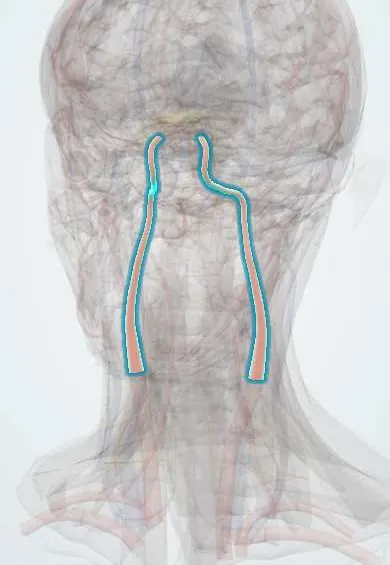
Moyamoya is a progressive narrowing and closure of the end of both internal carotid arteries and the start of the anterior and middle cerebral arteries, with a network of small, fragile collateral vessels growing at the base of the brain. When no cause is found it is moyamoya disease; when it accompanies another condition (such as sickle cell disease, Down syndrome, neurofibromatosis type 1 or prior radiotherapy) it is moyamoya syndrome.
Who gets it
Moyamoya disease is most common in East Asia (Japan and Korea), where a variant of the RNF213 gene is frequent, but it occurs worldwide, including in Latin America. It has two age peaks: children around 5 to 10 years and adults in their 30s and 40s, with more women affected. Moyamoya syndrome is an important cause of childhood stroke in sickle cell disease, present in Colombia mainly on the Caribbean and Pacific coasts, and in Down syndrome and neurofibromatosis type 1.
Causes
- Moyamoya disease: idiopathic, with a genetic susceptibility (RNF213 variants, familial in about one in ten)
- Moyamoya syndrome with sickle cell disease
- Down syndrome and neurofibromatosis type 1
- Cranial radiotherapy, especially for optic pathway and pituitary-area tumours in children
- Autoimmune thyroid disease (Graves disease) and other autoimmune conditions
- Other associations: some rare genetic syndromes and vasculopathies
Risk factors
- East Asian ancestry
- Family history of moyamoya
- Female sex
- Sickle cell disease, Down syndrome or neurofibromatosis type 1
- Previous cranial irradiation
Pathophysiology
The intima of the terminal internal carotid arteries thickens slowly (not atherosclerosis, not inflammation) → the lumen narrows on both sides, usually asymmetrically → blood flow to the anterior circulation falls → small perforating arteries at the base of the brain enlarge as collaterals (the puff of smoke) and the external carotid branches and posterior circulation also try to compensate → at rest flow is just enough, but cerebrovascular reserve is exhausted → anything that narrows brain vessels or lowers pressure (crying, hyperventilation lowers carbon dioxide; dehydration; fever; hypotension during anaesthesia) → ischaemia: TIAs, strokes in the watershed areas, seizures and headache. In adults, the fragile collaterals are under constant haemodynamic stress → they rupture or form small aneurysms → intraventricular or intracerebral haemorrhage. The disease advances in stages; as it progresses the collaterals from the internal carotid fade and the brain relies more and more on external carotid supply.
Classification
- Moyamoya disease (idiopathic, usually bilateral) versus moyamoya syndrome (associated with another condition, may be one-sided)
- Presentation: ischaemic (TIA, stroke; commonest in children), haemorrhagic (commonest in adults), seizures, headache or found by chance
- Angiographic stages (Suzuki 1 to 6): from narrowing of the carotid end, through maximal puff-of-smoke collaterals, to their disappearance as the external carotid takes over
- Unilateral or bilateral involvement; unilateral cases may progress to bilateral
Symptoms and signs
- Children: repeated TIAs with weakness of one side, numbness or speech trouble, often triggered by crying, coughing, blowing (a wind instrument, hot food) or exercise
- Ischaemic stroke with weakness, speech or visual loss
- Headache, often migraine-like
- Seizures
- Involuntary movements (chorea) in some children
- Slow decline in school performance and cognition from repeated silent ischaemia
- Adults: sudden severe headache, vomiting, falling consciousness or new deficit from brain haemorrhage
Diagnosis
- Clinical
- Think of it in any child with a TIA or stroke, especially when episodes are triggered by crying, blowing or exercise, in any child with sickle cell disease, Down syndrome or NF1 with neurological symptoms, and in young adults with intraventricular or deep haemorrhage without hypertension. Look for neurofibromas and café-au-lait spots, signs of sickle cell disease and features of Down syndrome.
- Tests
- Blood count and haemoglobin electrophoresis (sickle cell), thyroid function and antibodies, and tests to exclude other causes of childhood stroke (clotting, cardiac sources, vasculitis). Electroencephalography in children may show the characteristic slow waves that return after hyperventilation. Transcranial Doppler screening in children with sickle cell disease identifies those at high stroke risk.
- Imaging
- MRI with MR angiography is the first study: narrowing of the terminal carotids and proximal anterior and middle cerebral arteries, flow voids of collaterals in the basal ganglia, infarcts in watershed areas and the 'ivy sign' (bright sulci from slow collateral flow) on FLAIR. Catheter digital subtraction angiography is the reference standard: it shows the puff-of-smoke network, stages the disease and maps external carotid branches for surgical planning. Perfusion imaging (CT or MR perfusion, or SPECT with a vasodilator challenge) shows how much reserve is left.
Differential diagnosis
- Childhood arterial ischaemic stroke from focal cerebral arteriopathy or arterial dissection
- Primary angiitis of the central nervous system
- Intracranial atherosclerosis in adults
- Migraine with aura or hemiplegic migraine
- Epilepsy with post-ictal weakness (Todd paralysis)
- Cerebral arteriovenous malformation in a young adult with haemorrhage
- Cerebral venous thrombosis
Stroke or TIA in a child or young adult: moyamoya or a look-alike?
| Condition | Who | Arteries | Clue |
|---|---|---|---|
| Moyamoya disease | Children (ischaemia) and adults in their 30s and 40s (haemorrhage) | Both terminal internal carotids narrowed, puff-of-smoke collaterals | Attacks with crying or hyperventilation; ivy sign on MRI |
| Moyamoya syndrome in sickle cell disease | Children with sickle cell disease | Same pattern, often after years of high transcranial Doppler velocities | Anaemia, crises; abnormal transcranial Doppler screening |
| Atherosclerotic ischaemic stroke | Older adults with vascular risk factors | Plaques at the carotid bifurcation or in intracranial arteries, few collaterals | Hypertension, diabetes, smoking; plaque on imaging |
| Primary angiitis of the CNS | Adults, sometimes children | Beading of small and medium arteries in many territories | Headache, cognitive change, multiple infarcts; inflammatory CSF |
| Hemiplegic migraine | Children and young adults with family history | Normal | Aura spreading over minutes, headache, full recovery |
Goal of treatment
Prevent new strokes and bleeds by protecting brain perfusion day to day and, in symptomatic patients with poor reserve, adding a new blood supply through surgical revascularisation; treat the associated condition in moyamoya syndrome.
Treatment
- Medical
- Antiplatelet therapy (usually aspirin) for ischaemic moyamoya to reduce clot formation in narrowed arteries; anticoagulation is generally avoided. Treat seizures and headache, and avoid triggers: dehydration, hyperventilation and low blood pressure.
- Medical
- Moyamoya syndrome in sickle cell disease: regular blood transfusions to lower the proportion of sickle haemoglobin, alongside evaluation for revascularisation; treat thyroid disease when present.
- Surgical
- Revascularisation for patients with recurrent symptoms or poor perfusion reserve. Direct bypass connects the superficial temporal artery to a branch of the middle cerebral artery (flow at once; mainly adults). Indirect procedures lay vascular tissue on the brain surface so new vessels grow in over months: the superficial temporal artery (encephaloduroarteriosynangiosis, pial synangiosis), dura or temporalis muscle; these work well in children. Combined procedures are common.
- Surgical
- Haemorrhagic moyamoya in adults: direct or combined bypass reduces the risk of rebleeding by unloading the fragile collaterals; aneurysms on collaterals may need specific treatment.
- Follow-up
- Around any anaesthetic or surgery: keep blood pressure at or above the usual level, normal carbon dioxide (no hyperventilation), good hydration and normal temperature, and calm the child to prevent crying. Follow with perfusion imaging and neurological and cognitive assessment.
Complications
- Recurrent ischaemic strokes with motor, speech and visual deficits
- Cognitive decline and learning difficulties in children
- Intracerebral and intraventricular haemorrhage in adults
- Epilepsy
- Perioperative stroke or hyperperfusion syndrome after bypass
- Progression to the other side in unilateral cases
Common traps
- Strokes in children are too rare to need an arterial workup: every child with a stroke or TIA needs vessel imaging, and moyamoya is a classic cause
- Moyamoya is a vasculitis and needs immunosuppression: it is a non-inflammatory thickening of the arterial wall; steroids do not help
- Breathing fast to calm an anxious child with moyamoya is harmless: hyperventilation lowers carbon dioxide, constricts brain vessels and can trigger ischaemia
- Moyamoya always presents with stroke: adults often present with brain haemorrhage from rupture of fragile collaterals
- Revascularisation reopens the blocked carotids: the carotids stay closed; surgery brings a new supply from external carotid branches to the brain surface
Prognosis
The arteriopathy usually progresses, especially in children. Without treatment, children with ischaemic moyamoya often have repeated strokes and cognitive decline; revascularisation greatly reduces the risk of new strokes, and outcomes are best when surgery is done before major infarcts. In adults with haemorrhage, rebleeding is a major cause of death and disability, and bypass lowers this risk.
Prevention
- Transcranial Doppler screening of children with sickle cell disease and transfusion for those at high risk
- Awareness of moyamoya in Down syndrome, NF1 and after cranial radiotherapy
- In known patients, avoid dehydration, hyperventilation and low blood pressure, and plan anaesthesia carefully
- Screening of relatives in familial moyamoya where advised
Test yourself
Think of the answer, then tap the question to see it.
A 6-year-old has brief episodes of right arm weakness whenever she cries hard or blows on hot soup. What is the likely diagnosis and why the trigger?
Moyamoya disease. Hyperventilation lowers carbon dioxide, which constricts brain arteries; with exhausted reserve behind narrowed carotids, flow drops below what the brain needs.
Why are adults with moyamoya more likely to present with haemorrhage than children?
Over years the fragile collateral vessels carry high flow under stress, dilate and form small aneurysms, which rupture, often into the ventricles or deep brain.
What is the difference between direct and indirect revascularisation, and who is each for?
Direct bypass sutures the superficial temporal artery to a cortical branch for immediate flow, mainly in adults. Indirect procedures lay vascular tissue on the brain so vessels grow in over months; they work well in children.
A child with known moyamoya is to have an appendicectomy. What must the anaesthetic team avoid?
Hypotension, hyperventilation (low carbon dioxide), dehydration and fever, and distress with crying; each lowers brain perfusion and can cause a perioperative stroke.
Connections
Educational information, not medical advice. For any symptom, see a health professional.
Sources: Moyamoya Disease (StatPearls (NCBI Bookshelf), 2025); Moyamoya disease: MedlinePlus Genetics (MedlinePlus (U.S. National Library of Medicine), 2017).
Spotted a mistake?We are always improving for the community. Tell us what is wrong and our team will review it.Report a mistake
Representative model, for educational purposes only.