
Postsurgical peritoneal adhesions
Most abdominal operations leave internal scar bands. Most stay silent, but they are the main cause of bowel obstruction and can cause infertility and pain.
What it is
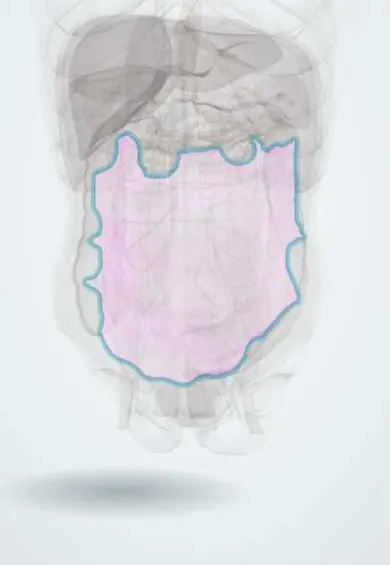
Adhesions are abnormal bands of fibrous tissue that join peritoneal surfaces that are normally separate: bowel to bowel, bowel to the abdominal wall, or the tubes and ovaries to the pelvis. They form after injury to the peritoneum, above all surgery, and also after infection, ischaemia, radiation or a foreign-body reaction. They cause adhesive small bowel obstruction, female infertility, chronic abdominal or pelvic pain, and difficult, riskier reoperations.
Who gets it
Adhesions are found at reoperation in about 95 percent of people who have had a laparotomy, and in far fewer after laparoscopy. They are the leading cause of small bowel obstruction where abdominal surgery is common. After an episode treated without surgery, about 12 percent are readmitted within a year and about 20 percent within 5 years; after an operation for obstruction, recurrence is about 8 percent at one year and 16 percent at 5 years. A hospital stay after surgery for adhesive obstruction is about three times as long as after successful non-operative treatment.
Causes
- Open abdominal and pelvic surgery (the main cause), especially lower abdominal, colorectal and gynaecological operations
- Laparoscopic surgery (fewer adhesions, but not none)
- Peritonitis and intra-abdominal infection, including pelvic inflammatory disease and a perforated appendix
- Endometriosis
- Abdominal radiotherapy
- Foreign material left in the peritoneum, which triggers a foreign-body reaction (including retained surgical items)
Risk factors
- Number of previous laparotomies and a midline incision
- Extensive tissue handling, drying of the bowel, burns and ischaemia of the peritoneum
- Infection or blood left in the peritoneal cavity
- Previous pelvic or colorectal surgery and radiotherapy
- Young age at surgery (more years in which to need another operation)
Pathophysiology
Surgery, infection or radiation injures the mesothelium → inflammation and clotting lay a fibrin film over the raw surfaces → if local fibrinolysis is active, the film dissolves and the surfaces heal separately; if it is suppressed (by ischaemia, infection, foreign material or extensive injury), the fibrin bridge persists → fibroblasts and new vessels grow into it and lay down collagen → a permanent band. Consequences follow from the anchor point: bowel tethered to the wall or another loop kinks, twists or is trapped under a band → small bowel obstruction, sometimes a closed loop that strangulates; adhesions around the tubes and ovaries block egg pick-up and tubal transport → infertility and higher risk of ectopic pregnancy; pulled, tethered viscera → chronic pain and dyspareunia in some patients; a fused abdomen at the next operation → difficult access and inadvertent injury, most often to the bowel (enterotomy).
Classification
- By cause: postoperative, post-inflammatory (infection, endometriosis), post-radiation
- By form: filmy and avascular, or dense and vascular; single band or matted (diffuse) adhesions
- By consequence: adhesive small bowel obstruction, infertility, chronic pain, hazard at reoperation (complicated adhesiolysis)
Symptoms and signs
- Most adhesions cause no symptoms
- Obstruction: colicky central abdominal pain, vomiting, distension and no passage of flatus, in someone with previous surgery; in older patients pain may be mild
- Strangulation: pain that becomes constant, fever, fast pulse and peritonism
- Infertility: difficulty conceiving after pelvic surgery or infection
- Chronic pain: localised, often positional or post-prandial abdominal or pelvic pain, and pain with intercourse
Diagnosis
- Clinical
- History of previous surgery, infection or radiation; recurrent episodes of obstruction support an adhesive cause. Examine every hernia orifice, because a strangulated hernia is the alternative that cannot wait. History and examination are poor at detecting strangulation, so imaging and repeated review decide.
- Tests
- In obstruction: blood count, electrolytes, kidney function and lactate, keeping in mind that a normal lactate does not exclude ischaemia. In infertility: tubal patency testing (hysterosalpingography) as part of the fertility workup; laparoscopy makes the diagnosis and can treat. In chronic pain, adhesions are a diagnosis of exclusion after other causes have been sought.
- Imaging
- CT of the abdomen and pelvis is the main test in suspected adhesive obstruction: it confirms obstruction, shows a transition point without another cause, and looks for strangulation (closed loop, poor wall enhancement, mesenteric oedema, free fluid). Adhesions themselves are usually invisible on imaging. Water-soluble oral contrast, given in the emergency department or after CT, is followed with an abdominal X-ray: contrast in the colon within about 24 hours predicts that the obstruction will settle, and its absence predicts failure of non-operative care. Ultrasound or MRI are used in pregnancy.
Differential diagnosis
- Obstructed or strangulated hernia (external or internal)
- Tumour, Crohn stricture or radiation enteritis
- Paralytic or postoperative ileus (no transition point)
- Gallstone ileus or volvulus
- Other causes of chronic pelvic pain or infertility: endometriosis, pelvic inflammatory disease, tubal disease
What an adhesion does depends on what it ties down
| Problem | Why adhesions cause it | How it shows | What is done in principle |
|---|---|---|---|
| Adhesive small bowel obstruction | A band kinks, twists or traps a loop of bowel | Colicky pain, vomiting, distension after previous surgery | Non-operative care with decompression and water-soluble contrast; surgery for strangulation, peritonitis or failure |
| Infertility | Bands around the tubes and ovaries block egg pick-up and transport | Difficulty conceiving after pelvic surgery or infection | Fertility workup, laparoscopy; assisted reproduction |
| Chronic abdominal or pelvic pain | Tethered organs pulled with movement | Localised, often positional pain, dyspareunia | Exclude other causes first; laparoscopic adhesiolysis only in selected patients |
| Hazard at the next operation | Fused surfaces hide the anatomy | Difficult access, inadvertent bowel injury | Careful entry away from old scars; recognise and repair any bowel injury |
Goal of treatment
Prevent adhesions with careful technique; in obstruction, let most episodes settle without surgery while operating promptly on the few with strangulation; and offer adhesiolysis for pain or infertility only when it is likely to help.
Treatment
- Conservative
- Adhesive small bowel obstruction without signs of strangulation, peritonitis or ischaemia: non-operative care is always tried first, with nil by mouth, nasogastric decompression, intravenous fluids and electrolyte correction, and frequent re-examination.
- Procedure
- Water-soluble contrast challenge: oral contrast followed by an abdominal X-ray; contrast reaching the colon predicts resolution, while its absence at about 24 hours predicts failure. Most authorities consider about 72 hours of non-operative care safe when the patient is not deteriorating.
- Surgical
- Operation without delay for peritonitis, strangulation, ischaemia or a closed loop on CT, and after failed non-operative care: division of the band or adhesiolysis, with resection of non-viable bowel. Laparoscopy suits selected simple cases (a single band, few previous laparotomies); in a distended abdomen with dense adhesions an open approach is often safer because of the risk of bowel injury.
- Surgical
- Chronic pain and infertility: diagnostic laparoscopy with adhesiolysis in carefully selected patients after other causes are excluded; tubal factor infertility may need assisted reproduction.
- Procedure
- Prevention at surgery: laparoscopic approach where suitable, gentle handling, keeping tissues moist, careful haemostasis, removing blood and foreign material, and adhesion barriers (hyaluronate carboxymethylcellulose film, icodextrin solution) in selected operations.
Complications
- Strangulation, bowel necrosis and perforation
- Recurrent obstruction
- Inadvertent enterotomy and fistula during adhesiolysis
- Infertility and ectopic pregnancy
- Chronic pain and repeated admissions and operations
Common traps
- Adhesive obstruction needs an operation to cut the band: most episodes settle with non-operative care; surgery is for strangulation, peritonitis or failure, and a new operation makes new adhesions
- The water-soluble contrast study is only a picture: it is a test that predicts the outcome (contrast in the colon means it will settle) and may speed resolution
- No surgical scar means it cannot be adhesions: infection, endometriosis and radiation also cause them, but in an abdomen without surgery a hernia or tumour must be looked for first
- Adhesions can be seen on a scan: the bands themselves are usually invisible; CT shows their effects, such as a transition point or a closed loop
- Laparoscopy causes no adhesions: it causes far fewer, not none
Prognosis
Most adhesive obstructions settle without surgery, but recurrence is common and slightly less frequent after operation, which is not a reason to operate first. Every new operation can create new adhesions. Laparoscopic adhesiolysis for selected patients with chronic pain gives relief in many, but evidence is mixed and the procedure is not routine.
Prevention
- Laparoscopic surgery where appropriate
- Gentle tissue handling, moist tissues, careful haemostasis and lavage of blood and contamination
- Avoiding unnecessary foreign material and closing the peritoneum carefully
- Adhesion barriers in selected operations
- Early treatment of pelvic infection
Test yourself
Think of the answer, then tap the question to see it.
Why does peritoneal injury lead to adhesions in some places and not others?
Injured surfaces are first stuck together by fibrin; where fibrinolysis clears it they heal apart, but where ischaemia, infection or foreign material suppress it the fibrin becomes permanent scar.
A woman with a past hysterectomy has an adhesive small bowel obstruction with no signs of strangulation. What is the plan?
Non-operative care (decompression, fluids, electrolytes, re-examination) with a water-soluble contrast challenge; operate if strangulation appears or contrast fails to reach the colon.
On X-ray about 24 hours after oral water-soluble contrast, none has reached the colon. What does it mean?
Non-operative treatment is likely to fail, so surgery should be planned.
Why are adhesions linked to both infertility and ectopic pregnancy?
Bands around the tubes and ovaries prevent the tube from picking up the egg and slow its transport, so conception fails or the embryo implants in the tube.
Connections
Educational information, not medical advice. For any symptom, see a health professional.
Sources: Bologna guidelines for diagnosis and management of adhesive small bowel obstruction (ASBO): 2017 update of the evidence-based guidelines from the world society of emergency surgery ASBO working group (World Journal of Emergency Surgery (PMC), 2018); Abdominal adhesions: A practical review of an often overlooked entity (Annals of Medicine and Surgery (PMC), 2017); A review of physiological and cellular mechanisms underlying fibrotic postoperative adhesion (International Journal of Biological Sciences (PMC), 2021); Prevention of peritoneal adhesions after gynecological surgery: a systematic review (Archives of Gynecology and Obstetrics (PMC), 2024).
Spotted a mistake?We are always improving for the community. Tell us what is wrong and our team will review it.Report a mistake
Representative model, for educational purposes only.