
Chylothorax
Milky lymph (chyle) leaking into the chest from the thoracic duct, often after surgery or with lymphoma. It squeezes the lung and drains fat and protein.
What it is
A pleural effusion made of chyle, the triglyceride-rich lymph from the gut, caused by a tear or blockage of the thoracic duct or its branches. Large, lasting leaks cause breathlessness, malnutrition and immune weakness.
Who gets it
Uncommon in adults, but it is the most common cause of a pleural effusion in newborns. About half of adult cases follow trauma, most of it surgical (oesophagectomy, cardiac surgery, lung resection with node dissection, neck dissection); among non-traumatic causes, cancer, above all lymphoma, comes first.
Causes
- Surgery in the chest or neck: oesophagectomy, congenital and adult cardiac surgery, lung resection with lymph node dissection, neck and spine surgery
- Central venous catheters and thrombosis of the superior vena cava or subclavian vein (raised venous pressure at the duct's outlet)
- Blunt or penetrating chest trauma, and rarely forceful coughing or vomiting
- Cancer: lymphoma, lung cancer, metastases to mediastinal nodes
- Lymphangioleiomyomatosis (also with tuberous sclerosis complex)
- Infections and inflammation: tuberculosis, sarcoidosis, filariasis
- Lymphatic malformations (generalised lymphatic anomaly, Gorham-Stout disease), yellow nail syndrome, and chylous ascites crossing the diaphragm (cirrhosis)
- Congenital chylothorax in newborns; no cause found in some (idiopathic)
Risk factors
- Oesophagectomy and other operations near the posterior mediastinum
- Lymphoma or mediastinal lymph node metastases
- Upper-limb or neck central lines with venous thrombosis
- Congenital heart surgery in children
- Lymphangioleiomyomatosis in women
Pathophysiology
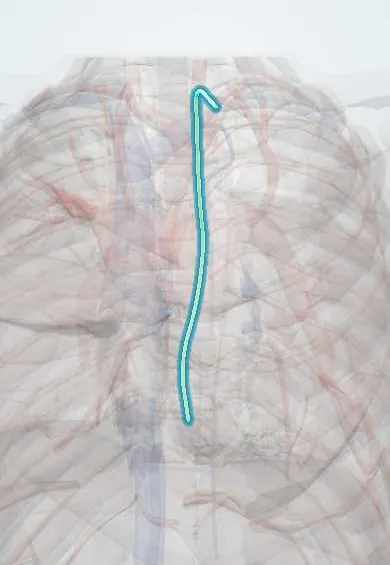
Dietary long-chain fats are packaged into chylomicrons in the intestinal lymphatics → chyle collects in the cisterna chyli (about L1-L2) and climbs through the aortic hiatus as the thoracic duct, on the right between the aorta and the azygos vein → the duct crosses to the left around T4-T6 and empties at the junction of the left subclavian and internal jugular veins, so an injury below the crossing usually gives a right-sided chylothorax and one above it a left-sided one → the duct carries up to about 2-2.5 litres a day, so a persistent leak drains triglycerides, protein, fat-soluble vitamins, electrolytes and T lymphocytes → malnutrition, dehydration and lymphopenia with infections. Chyle is bacteriostatic and barely irritates the pleura, so fever and pain are rare.
Classification
- Traumatic (surgical or non-surgical) versus non-traumatic (malignant, other medical causes, idiopathic)
- By output: low versus high daily drain output
- Congenital (neonatal) versus acquired
- Distinct from pseudochylothorax: a chronic cholesterol-rich effusion in a long-standing thickened pleura (rheumatoid arthritis, old tuberculosis), not from duct injury
Symptoms and signs
- Breathlessness, chest heaviness and cough as fluid accumulates
- Little pain or fever, because chyle is not inflammatory
- After surgery: high chest-drain output that turns milky once enteral feeding starts
- Milky, odourless fluid at thoracentesis (it may look clear or serous if the patient is fasting)
- With a lasting leak: weight loss, muscle wasting, oedema, and infections from lymphopenia
Diagnosis
- Clinical
- Suspected with milky pleural fluid, or a rising, milky drain output after chest or neck surgery, especially after feeding. Appearance alone misleads: not every chylothorax is milky, and empyema or pseudochylothorax can be.
- Tests
- Pleural fluid triglycerides above 110 mg/dL strongly support chylothorax, and below 50 mg/dL make it unlikely; values in between need lipoprotein electrophoresis, where chylomicrons confirm it. Pleural cholesterol is low (below 200 mg/dL), unlike pseudochylothorax, which has high cholesterol and cholesterol crystals. The fluid is usually lymphocyte-rich. Cytology, flow cytometry and tuberculosis tests look for the cause; serum albumin, lymphocyte count and electrolytes track losses.
- Imaging
- Chest radiograph and ultrasound show the effusion; CT of the chest and abdomen looks for lymphoma, nodes, masses, venous thrombosis and lung cysts of lymphangioleiomyomatosis. Lymphangiography (intranodal or by MR) and lymphoscintigraphy locate the leak and plan embolisation or surgery.
Differential diagnosis
- Pseudochylothorax (cholesterol effusion)
- Empyema (after centrifugation the supernatant clears in empyema but stays milky in chylothorax)
- Malignant pleural effusion
- Tuberculous pleurisy
- Misplaced central line infusing parenteral nutrition or lipid emulsion into the pleural space
- Haemothorax
Milky or chylous? Chylothorax and its look-alikes
| Condition | Cause | Pleural fluid lipids | Key clue |
|---|---|---|---|
| Chylothorax | Tear or blockage of the thoracic duct | Triglycerides above 110 mg/dL, chylomicrons present, cholesterol below 200 mg/dL | Recent chest or neck surgery, or lymphoma; output rises with feeding |
| Pseudochylothorax | Cholesterol builds up in a long-standing, thickened pleura | Cholesterol above 200 mg/dL, cholesterol crystals, no chylomicrons | Effusion present for years: rheumatoid arthritis, old tuberculosis |
| Empyema | Pus from pleural infection | Lipids not raised; the supernatant clears after centrifugation | Fever, pleuritic pain, low pH and glucose, organisms on Gram stain |
| Malignant pleural effusion | Tumour on the pleura | Usually not chylous (unless lymphoma blocks the duct) | Known cancer, often bloody fluid, positive cytology |
Goal of treatment
Drain the fluid so the lung re-expands, reduce chyle flow until the leak closes, replace lost nutrients and fluid, and treat the cause; intervene early when the output stays high.
Treatment
- Procedure
- Thoracentesis or a chest drain relieves breathlessness and lets the daily output be measured, which guides further treatment.
- Conservative
- Diet that lowers chyle flow: a very low long-chain-fat diet with medium-chain triglycerides (absorbed straight into the portal blood, bypassing the lymphatics), or nothing by mouth with parenteral nutrition for high-output leaks. Nutritional replacement of protein, fluid, electrolytes and fat-soluble vitamins.
- Medical
- Somatostatin or its analogue octreotide to reduce lymph flow (evidence is limited); treatment of the cause, such as chemotherapy or radiotherapy for lymphoma, sirolimus for lymphangioleiomyomatosis, anticoagulation for venous thrombosis, or tuberculosis treatment.
- Procedure
- Interventional radiology: lymphangiography followed by thoracic duct embolisation or disruption, now often the first intervention for persistent traumatic leaks; lymphangiography alone sometimes seals the leak.
- Surgical
- Thoracic duct ligation, usually thoracoscopic, low in the right chest between the aorta and azygos vein, when output stays high or the leak persists despite conservative care; early surgery is favoured after oesophagectomy.
- Procedure
- Refractory or malignant cases: talc pleurodesis, an indwelling pleural catheter or a pleuroperitoneal shunt.
- Follow-up
- Daily drain output, weight, albumin, lymphocyte count and electrolytes; infection watch while lymphopenic.
Complications
- Malnutrition, low albumin and fat-soluble vitamin deficiency
- Lymphopenia with bacterial, viral and opportunistic infections
- Dehydration and electrolyte disturbance (low sodium)
- Respiratory compromise from a re-accumulating effusion
- Pleural thickening and trapped lung
- Higher mortality after oesophagectomy when the leak persists
Common traps
- Chyle is always milky: in a fasting patient it can look clear or serous; measure pleural triglycerides (above 110 mg/dL) or look for chylomicrons
- Every milky effusion is chyle: empyema and pseudochylothorax can look milky too; centrifuge (empyema clears) and measure triglycerides and cholesterol
- The effusion appears on the side of the operation: the duct runs on the right below about T5, so low injuries (oesophagectomy) give right effusions and high ones give left effusions
- Chyle in the pleura behaves like pus: it is bacteriostatic and barely inflammatory; the real dangers are malnutrition and lymphopenia from losing it
- A non-traumatic chylothorax with no obvious cause is idiopathic: lymphoma is the leading non-traumatic cause; CT, cytology and flow cytometry come first
Prognosis
Many traumatic leaks close within one to two weeks with drainage and diet, and thoracic duct embolisation or ligation closes most of the rest. Non-traumatic chylothorax depends on the cause: it often settles with treatment of lymphoma, but untreated persistent leaks carry significant mortality from malnutrition and infection.
Test yourself
Think of the answer, then tap the question to see it.
A thoracic duct injury at T8 usually causes a chylothorax on which side, and why?
The right side: the duct runs to the right of the aorta in the lower chest and crosses to the left only around T4-T6.
Which pleural fluid finding confirms chylothorax when triglycerides are borderline?
Chylomicrons on lipoprotein electrophoresis.
How does pseudochylothorax differ from chylothorax?
It is a chronic cholesterol-rich effusion in thickened pleura (rheumatoid arthritis, old tuberculosis) with cholesterol crystals and no chylomicrons; the thoracic duct is intact.
Why do medium-chain triglycerides help in chylothorax?
They are absorbed directly into the portal blood instead of entering intestinal lymph as chylomicrons, so they feed the patient without increasing chyle flow.
Five days after an oesophagectomy, a man's right chest drain output rises and turns milky the day tube feeding starts; pleural triglycerides are 300 mg/dL. What happened, and why did feeding matter?
A thoracic duct leak (chylothorax), on the right because the duct runs there in the lower chest. Fed fat travels in gut lymph as chylomicrons and raises chyle flow; stop long-chain fat and plan early closure.
Why it happens
Connections
Educational information, not medical advice. For any symptom, see a health professional.
Sources: Chylothorax (StatPearls (NCBI Bookshelf), 2024); Thoracic Duct Leak (StatPearls (NCBI Bookshelf), 2023).
Spotted a mistake?We are always improving for the community. Tell us what is wrong and our team will review it.Report a mistake
Representative model, for educational purposes only.