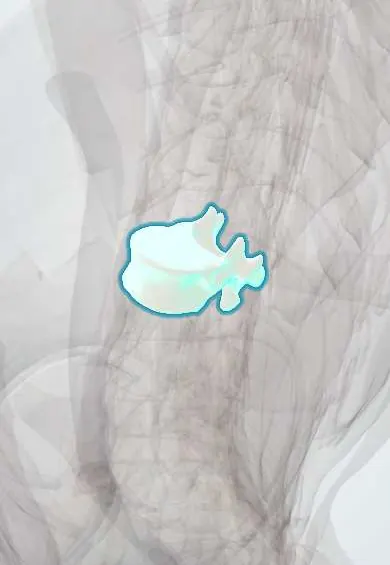
T12 vertebra !
T12 is the lowest thoracic vertebra, where the stiff mid-back meets the mobile lower back; it is a common place for fractures.
Official name: T12
Opens in the Durgical app, no sign-up needed.
What it is
The lowest mid-back vertebra, where the stiff thoracic spine meets the mobile lumbar spine: a common place for fractures.
What it does
Holds up the trunk and, with the ribs and breastbone, forms the rib cage, which protects the heart and lungs. The ribs make this part of the spine stiff.
Key facts
- Joints with
- T11 above and L1 below (discs, facet joints); head of rib 12 (single facet); no costotransverse joint
- Landmarks
- Transitional: single costal facet for rib 12; no transverse costal facets; lumbar-type inferior articular processes; mammillary processes; aortic hiatus at T12
Relations
- In front
- Abdominal aorta passing behind the median arcuate ligament with the thoracic duct and azygos vein; the crura of the diaphragm on each side; the celiac trunk leaves the aorta here
- Lateral
- Head of the twelfth rib; the pleura dips below this rib medially, and the upper pole of each kidney lies in front of it
- Behind
- Latissimus dorsi, serratus posterior (inferior) and thoracolumbar fascia; quadratus lumborum hangs from the twelfth rib
- Contents
- Lowest part of the spinal cord tapering to the conus medullaris, with the first roots of the cauda equina around it
How to find it
The twelfth rib is followed inward from the flank to the spine, but in a thick back it may not be felt; the T12 spine is then counted up from L4 on the line joining the iliac crests.
On imaging
Lateral views compare front and back body heights and the back wall line; CT shows retropulsed fragments and canal narrowing; MRI shows tears of the posterior ligaments and damage to the cord or conus. Rib anomalies make numbering by ribs unreliable; counting from C2 on whole-spine MRI is safer.
Common problems
- Compression fractures from osteoporosis, sometimes after a minor fall or even a cough.
- A rounded upper back (kyphosis) from posture, wedge fractures or Scheuermann disease in teens.
- Scoliosis: a sideways curve with rotation, often starting in adolescence.
How it is diagnosed
X-rays for fractures and curves (scoliosis is measured with the Cobb angle). MRI tells new fractures from old ones. A bone density scan (DEXA) checks for osteoporosis.
Treatment
- Osteoporosis fractures: pain control, a short time in a brace, and treatment of the osteoporosis.
- Painful fractures that do not settle: kyphoplasty or vertebroplasty (cement injected into the bone).
- Large or progressive curves: bracing in growing children, sometimes fusion surgery.
Clinical notes
- Burst fractures at T12–L1 can injure the conus medullaris and the cauda equina together, mixing bladder dysfunction with leg weakness
- A surgical approach to the kidney below the twelfth rib can open the pleura, because the pleural reflection crosses this rib medially
- Retropulsed fragments are judged by canal narrowing and neurology, not by the X-ray alone
Anatomical variants
- In one large trauma CT series about 3 in 100 people had only eleven pairs of ribs, so the last rib does not always mark T12
- A short or missing twelfth rib, or a small rib on L1 (lumbar rib), shifts counting by one level
Memory aid
Diaphragm openings, 'I 8 10 Eggs At 12': Inferior vena cava at T8, Esophagus at T10, Aorta at T12.
Related conditions
- Multiple myeloma
- Osteoporotic vertebral compression fracture
- Spinal tuberculosis (Pott disease)
- Tuberculosis
- Osteoporosis
Test yourself
Think of the answer, then tap the question to see it.
What separates a burst fracture of the T12 vertebra from a simple compression fracture?
A broken back wall of the body: the anterior and middle columns fail under axial load and bone is pushed back into the canal.
What passes through the aortic hiatus at the T12 vertebra?
The aorta, behind the median arcuate ligament, with the thoracic duct and often the azygos vein; it passes behind the diaphragm rather than through it.
Why can «the last rib» mislead when counting down to the T12 vertebra?
The twelfth rib may be too short to feel, and some people have only eleven pairs of ribs; counting from C2 on whole-spine MRI is safer.
Why can a burst fracture at T12–L1 mix bladder dysfunction with leg weakness?
It can injure the conus medullaris and the cauda equina together.
Educational information, not medical advice. For any symptom, see a health professional.
Its names
- Official Latin (TA2)
- vertebra thoracica XII TA2 1059
- Official Spanish (DeCS)
- Vértebra dorsal D12 DeCS D013904
- English (TA2)
- T12
Related
- T11–T12 disc
- T12–L1 disc
- Posterior intercostal arteries
- Anterior longitudinal ligament
- Rib-to-spine ligaments
- Endplates
- Mid-back facet joints
- Interspinales
Sources: Terminologia Anatomica (TA2); DeCS; Anatomy, Back, Thoracic Vertebrae.
Spotted a mistake?We are always improving for the community. Tell us what is wrong and our team will review it.Report a mistake
Representative model, for educational purposes only.