
Urethral and ureteric stricture
A scar that narrows the tube carrying urine. In the urethra it weakens the stream; in the ureter it can silently destroy a kidney.
What it is
A fixed narrowing of the urethra or the ureter caused by scar tissue. Urethral strictures mostly affect men, scar the spongy tissue around the anterior urethra and cause obstructed voiding. Ureteric strictures cause hydronephrosis above them and follow surgery, stones, radiation, infection such as tuberculosis, or cancer.
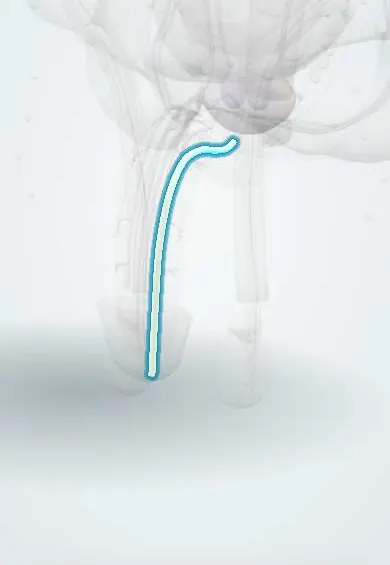
Who gets it
Urethral stricture affects men far more than women. In high-income countries most are iatrogenic (catheters, instruments, transurethral surgery, prostate cancer treatment) or of unknown cause, while infection after urethritis and external trauma are relatively more important in low- and middle-income countries. Ureteric strictures are less common; causes include surgery and endoscopy, radiation, retroperitoneal fibrosis, cancer and genitourinary tuberculosis, a classic cause of multiple ureteric strictures where tuberculosis is common.
Causes
- Urethra, idiopathic: a substantial share has no cause found even after a careful history
- Urethra, iatrogenic: catheters, cystoscopy, transurethral resection of the prostate, radical prostatectomy (bladder neck contracture), radiotherapy, hypospadias repair
- Urethra, trauma: straddle injury or a blow to the perineum (bulbar urethra) and pelvic fracture (membranous urethra)
- Urethra, inflammatory: lichen sclerosus (meatus, penile and bulbar urethra) and urethritis, including sexually transmitted infection
- Ureter, iatrogenic: endoscopic stone treatment and injury during pelvic or abdominal surgery; radiation
- Ureter: tuberculosis (strictures typically at the ureterovesical and ureteropelvic junctions, most often in the distal ureter), retroperitoneal fibrosis
- Ureter: urothelial cancer or a tumour pressing from outside (always exclude), strictures at surgical joins after urinary diversion or kidney transplant
Risk factors
- Long-term or traumatic catheterisation
- Previous urethral, prostate or pelvic surgery and pelvic radiotherapy
- Pelvic fracture or perineal trauma
- Sexually transmitted urethritis, lichen sclerosus
- Impacted ureteric stones and their treatment
- Tuberculosis exposure
Pathophysiology
Injury or inflammation damages the urothelium → urine leaks into the tissue beneath (corpus spongiosum in the urethra, ureteric wall in the ureter) → fibroblasts lay down dense collagen (spongiofibrosis) → the scar contracts and narrows the lumen → flow slows and pressure rises upstream → in the urethra the bladder muscle thickens and empties poorly, causing residual urine, infection and retention → in the ureter the kidney dilates (hydronephrosis) and loses function, often without pain → tuberculosis strictures can tighten further while the infection heals, because healing itself is fibrosis.
Classification
- Urethra, anterior (meatus, penile, bulbar; bulbar is the most common) versus posterior (membranous and prostatic: usually stenosis after surgery or a distraction defect after pelvic fracture)
- Urethra, by length (short, about 2 cm or less, versus long) and by number (single or multifocal, panurethral); length guides treatment
- Ureter, by level: ureteropelvic junction, proximal, mid and distal ureter, or panureteral
- Ureter, benign or malignant; intrinsic or extrinsic
- Female urethral stricture: rare, mostly after surgery or radiation
Symptoms and signs
- Urethral: weak or spraying stream, straining, a sense of incomplete emptying
- Urethral: post-void dribbling, frequency and urgency
- Urethral: recurrent urinary infections, prostatitis or epididymitis
- Urethral: acute urinary retention, or a catheter that will not pass
- Ureteric: often none; flank pain, especially when drinking a lot
- Ureteric: urinary infections, or a rising creatinine if both kidneys or a single kidney are affected
Diagnosis
- Clinical
- Ask about catheters, urethral and pelvic surgery, trauma, radiation, urethritis, tuberculosis and stones. Repeated infections of the prostate, epididymis or testis should raise suspicion of a stricture. Examine the urethra for scar, the meatus and foreskin for lichen sclerosus, and the abdomen for a full bladder.
- Tests
- Uroflowmetry: a maximum flow below about 15 mL/s is suspicious, and a flat, plateau-shaped curve suggests a stricture (volumes under 150 mL are hard to interpret); post-void residual by ultrasound. Urinalysis and culture; for tuberculosis (sterile pyuria, tuberculosis risk) three early-morning urine samples for mycobacterial culture plus a molecular test. Cystourethroscopy sees the narrowing directly but not the scar around it. Creatinine. Ureteroscopy with biopsy if cancer is possible.
- Imaging
- Retrograde urethrography with voiding cystourethrography shows the site and length of a urethral stricture; ultrasound urethrography can estimate spongiofibrosis. For the ureter: ultrasound for hydronephrosis, CT urography or MR urography for level, length and cause, and retrograde pyelography to outline the narrowing.
Differential diagnosis
- Benign prostatic hyperplasia (older men, enlarged prostate on rectal examination)
- Bladder neck obstruction or contracture
- Detrusor underactivity or neurogenic bladder
- Meatal stenosis, phimosis, urethral diverticulum
- For the ureter: impacted stone, ureteropelvic junction obstruction, urothelial cancer, extrinsic compression or retroperitoneal fibrosis
Weak stream or a blocked ureter: is it a stricture?
| Problem | Typical patient | Key clue | Best test |
|---|---|---|---|
| Urethral stricture | Man of any age with a past catheter, trauma or urethritis | Flat, plateau flow curve; catheter will not pass | Retrograde urethrogram, cystoscopy |
| Benign prostatic hyperplasia | Older man | Enlarged prostate on rectal examination; low flow | Examination, prostate ultrasound, uroflowmetry |
| Neurogenic bladder | Spinal or nerve disease, diabetes | Large residual without a narrowing; low detrusor pressure | Urodynamic testing |
| Ureteric stricture | After ureteroscopy, pelvic surgery, radiation or tuberculosis | Silent hydronephrosis above a narrow segment | CT urography, retrograde pyelogram |
| Ureteric stone | Acute colic | Dense stone on non-contrast CT | Non-contrast CT |
Goal of treatment
Restore free flow, protect the bladder and kidney, and choose the repair most likely to last rather than the one easiest to repeat.
Treatment
- Acute
- Urinary retention with an impassable urethra: a suprapubic catheter, avoiding forceful blind attempts that create false passages; it also lets the stricture mature before urethroplasty. Infected or obstructed kidney above a ureteric stricture: drain promptly with a nephrostomy or stent.
- Procedure
- Urethral dilation or direct-vision internal urethrotomy only for a first, short (under about 1.5 cm), single bulbar stricture: success reaches about 80% for strictures under 1 cm but falls to about 20% for longer ones and with each repeat. For the ureter, endoscopic treatment (preferably balloon dilation) is a first option for simple benign strictures under about 2 cm; repeated endoscopic attempts are avoided, and long-term stent changes are kept for palliative cases.
- Surgical
- Urethroplasty gives the best long-term results: excision of the scar and end-to-end anastomosis for short bulbar strictures (up to about 3 cm; success around 94%), or augmentation with an oral (buccal) mucosa graft for longer ones; genital skin is avoided in lichen sclerosus. Ureteric reconstruction by level: pyeloplasty or ureteroureterostomy for short proximal and mid strictures, reimplantation into the bladder with a psoas hitch or Boari flap for distal ones, buccal mucosa onlay for longer defects, and ileal ureter or autotransplantation only as last resorts.
- Medical
- Treat the cause: a 6-month antituberculous regimen for genitourinary tuberculosis, with the kidney drained promptly if it is obstructed and reconstruction delayed until the inflammation settles, since the disease heals by fibrosis; topical corticosteroids for lichen sclerosus; antibiotics for urethritis and urinary infection.
- Follow-up
- Uroflowmetry, residual volume and symptom scores after urethral treatment; ultrasound after ureteric repair to confirm that the kidney drains.
Complications
- Urinary retention and chronic residual urine
- Recurrent infection, prostatitis, epididymitis, bladder stones
- Bladder wall thickening and diverticula, urethral fistula or periurethral abscess
- Hydronephrosis and silent loss of a kidney; pyonephrosis
- Chronic kidney disease when both sides or a single kidney are blocked
- After repair: recurrence, erectile changes or post-void dribbling
Common traps
- Repeat the urethrotomy every time it recurs: each repeat makes the scar longer and less likely to respond; after a failure, urethroplasty is the durable option
- A weak stream in a man always means the prostate: a man with a past catheter, trauma or urethritis, or one with repeated prostate or epididymal infections, may have a stricture; the plateau flow curve and urethrogram tell them apart
- No pain means no ureteric problem: ureteric strictures often destroy a kidney silently, so hydronephrosis after surgery or stones needs follow-up
- A tuberculosis stricture just needs antituberculous drugs: the disease heals by scarring, many patients still need endoscopic or reconstructive surgery, and an obstructed kidney must be drained without waiting
- A stricture with no clear cause is benign: urothelial cancer can present as a ureteric stricture and must be excluded
Prognosis
Urethroplasty gives lasting results in most men, while repeated dilation or urethrotomy usually fails over time. Ureteric reconstruction is generally successful when kidney function is preserved; a kidney with little function left may not recover.
Prevention
- Careful, minimal catheterisation and smaller instruments during endoscopy
- Early treatment of urethritis and of lichen sclerosus
- Gentle ureteroscopy and short procedures for impacted stones; recognising ureteric injury during surgery
- Early diagnosis and treatment of tuberculosis
Test yourself
Think of the answer, then tap the question to see it.
A 35-year-old man who had a straddle injury years ago has a weak, spraying stream and a plateau-shaped flow curve. Likely diagnosis and the test that defines it?
Bulbar urethral stricture; a retrograde urethrogram (with cystoscopy) shows its site and length and guides the repair.
Why does repeated internal urethrotomy tend to fail?
Each cut heals with more scar, so the stricture becomes longer and denser; recurrence after one attempt favours urethroplasty.
Which infection classically causes multiple ureteric strictures and a small contracted bladder?
Genitourinary tuberculosis; ureteric strictures form as the lesions scar, so an obstructed kidney is drained promptly and reconstruction waits until the inflammation settles.
Which reconstruction bridges a stricture of the distal ureter that is too long for direct reimplantation?
Reimplantation with a psoas hitch, or a Boari flap made from the bladder wall, which bring the bladder up to the healthy ureter.
Why is urethral skin avoided as a graft in a stricture due to lichen sclerosus?
Grafts of genital skin tend to fail when lichen sclerosus is present, so oral (buccal) mucosa is used instead.
Connections
Educational information, not medical advice. For any symptom, see a health professional.
Sources: A Comprehensive Review Emphasizing Anatomy, Etiology, Diagnosis, and Treatment of Male Urethral Stricture Disease (Verla et al., BioMed Research International) (Europe PMC, 2019); Onlay Repair Technique for the Management of Ureteral Strictures: A Comprehensive Review (Xiong et al., BioMed Research International) (Europe PMC, 2020); Ureteral stricture: current treatment algorithm and key surgical principles in the robotic upper urinary tract reconstruction era (Bourillon et al., World Journal of Urology) (Europe PMC, 2026); Genitourinary Tuberculosis: A Comprehensive Review of a Neglected Manifestation in Low-Endemic Countries (Mantica et al., Antibiotics) (Europe PMC, 2021).
Spotted a mistake?We are always improving for the community. Tell us what is wrong and our team will review it.Report a mistake
Representative model, for educational purposes only.